What this calculator does
This tool uses the US dry bushel and the standard test weights used in United States and Canadian grain trading, so the figures match North American elevator and contract practice. It converts a measured grain volume - a bin, wagon, truck box or a bushel count - into a weight in pounds, kilograms, short tons and metric tonnes, using the grain type and its test weight.
How to use it
Pick the grain, enter the volume and choose its unit (volumetric bushels, cubic feet, cubic metres or litres), then confirm the test weight in pounds per bushel. The standard test weight is filled in automatically when you change the grain, but you should overwrite it with the figure from your grading ticket: a light corn crop may test 52 lb/bu instead of the 56 lb/bu standard, which is a 7% difference in payable weight.
The formula
With \(V\) = measured volume, \(V_{bu}\) = volume of one bushel, \(TW\) = test weight in lb/bu:
$$W_{lb} = \frac{V}{V_{bu}} \times TW, \qquad V_{bu} = 1.2444560\,\text{ft}^3$$One US dry bushel is 2150.42 cubic inches. Kilograms follow from \(W_{kg} = W_{lb} \times 0.45359237\), short tons from \(W_{lb}/2000\), and metric tonnes from \(W_{kg}/1000\).
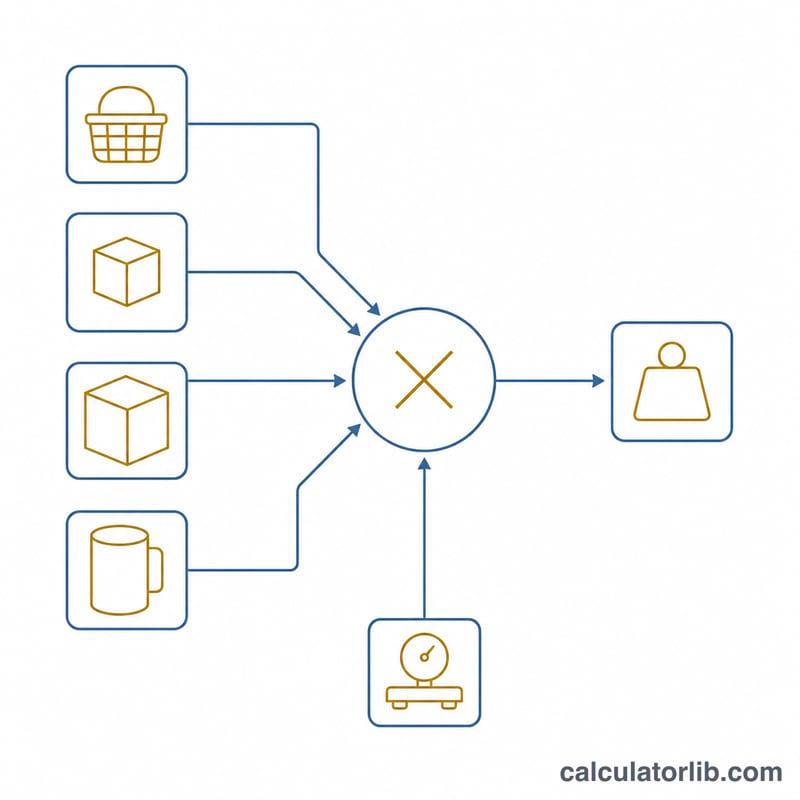
Based on the US dry bushel (1 bu = 1.2444560 cubic feet = 0.0352391 cubic metres) and US/Canadian standard test weights. Actual load weight varies with moisture, packing and foreign material.
Worked example
A round bin holds 2488.91 cubic feet of soybeans grading 60 lb/bu:
$$B = \frac{2488.91}{1.2444560} = 2000\ \text{bu}$$$$W_{lb} = 2000 \times 60 = 120000\ \text{lb} = 60\ \text{short tons} = 54.43\ \text{t}$$
Standard Test Weights by Grain (lb/bu)
In the United States a "bushel" of grain is traded as a fixed weight, not as a measured volume. The weights below are the standard (statutory / USDA marketing) bushel weights used in US grain trade; Canada's official grading system expresses the same idea in kilograms per hectolitre (kg/hL) under Canadian Grain Commission standards. Outside North America grain is normally traded directly in tonnes, so these figures are a US/Canadian convention rather than a universal one.
| Grain | Standard test weight (lb/bu) | Equivalent (kg/hL) | Weight of one trade bushel (kg) |
|---|---|---|---|
| Corn (maize), shelled | 56 | 72.1 | 25.40 |
| Wheat | 60 | 77.2 | 27.22 |
| Soybeans | 60 | 77.2 | 27.22 |
| Grain sorghum (milo) | 56 | 72.1 | 25.40 |
| Rye | 56 | 72.1 | 25.40 |
| Flaxseed | 56 | 72.1 | 25.40 |
| Barley | 48 | 61.8 | 21.77 |
| Buckwheat | 48 | 61.8 | 21.77 |
| Canola / rapeseed | 50 | 64.4 | 22.68 |
| Rice (rough / paddy) | 45 | 57.9 | 20.41 |
| Oats | 32 | 41.2 | 14.51 |
| Sunflower seed | 24–32 (oil vs. confection type) | 30.9–41.2 | 10.89–14.51 |
The kg/hL column is a direct unit conversion of the same density, since one US bushel is 0.3523907 hL:
$$\text{kg/hL} = \text{lb/bu} \times \frac{0.45359237}{0.3523907} = \text{lb/bu} \times 1.28732$$Two cautions. First, these are standard weights used to convert traded bushels into pounds and tonnes — they are not the density of the grain in your bin. Second, when grain is delivered, the elevator measures an actual test weight on a Winchester-type kettle and prints it on the scale ticket; that graded figure (plus any moisture shrink and dockage) governs settlement and overrides the table above. Light corn at 52 lb/bu is still sold as 56-lb bushels in the US market, but the physical pounds in the truck follow the measured value, so enter the ticket's test weight in the calculator whenever you have one.
Bushel and Grain Unit Conversions
The US dry bushel is defined exactly as 2150.42 cubic inches. Every volume factor below follows from that definition, and every mass factor from the international pound, 1 lb = 0.45359237 kg exactly.
| Quantity | Equals |
|---|---|
| 1 US dry bushel | 2150.42 in³ = 1.2444560 ft³ = 0.03523907 m³ = 35.23907 L |
| 1 cubic foot | 0.80356 US bu |
| 1 cubic metre | 28.3776 US bu = 1000 L |
| 1 litre | 0.0283776 US bu |
| 1 imperial (UK) bushel | 1.28435 ft³ = 36.36872 L ≈ 1.03205 US bu |
| 1 pound | 0.45359237 kg |
| 1 short ton (US) | 2000 lb = 907.185 kg = 0.907185 t |
| 1 metric tonne | 1000 kg = 2204.62 lb = 1.10231 short tons |
Combining a standard test weight with the pound-to-tonne factor gives the tonnes-per-bushel numbers used in export trade:
| Grain (standard lb/bu) | Tonnes per bushel | Bushels per tonne |
|---|---|---|
| Corn, sorghum, rye (56) | 0.0254012 | 39.368 |
| Wheat, soybeans (60) | 0.0272155 | 36.744 |
| Barley (48) | 0.0217724 | 45.930 |
| Oats (32) | 0.0145149 | 68.894 |
The full chain from a measured volume to metric weight is:
$$W_{\text{t}} = V_{\text{m}^3} \times 28.3776 \;\frac{\text{bu}}{\text{m}^3} \times T\;\frac{\text{lb}}{\text{bu}} \times 0.00045359237\;\frac{\text{t}}{\text{lb}}$$For example, a 40 m³ bin of wheat at 60 lb/bu: \(40 \times 28.3776 = 1135.10\) bu, then \(1135.10 \times 60 = 68{,}106\) lb, then \(68{,}106 \times 0.00045359237 = 30.89\) tonnes. Note the imperial bushel is a volume unit only — it is about 3.2 % larger than the US bushel, so never apply US lb/bu standards to an imperial-bushel figure without converting first.
How Test Weight and Volume Change the Result
Weight is simply volume in bushels multiplied by test weight, \(W_{\text{lb}} = B \times T\), so the two inputs act independently: a 7 % lighter test weight removes exactly 7 % of the tonnage from the same bin. The first block holds volume constant at 2000 bushels (equivalently 2488.91 ft³, or 70.48 m³) and varies the grain.
| Grain / test weight | Volume | Pounds | Short tons | Tonnes |
|---|---|---|---|---|
| Corn, 56 lb/bu (standard) | 2000 bu | 112,000 | 56.00 | 50.80 |
| Corn, 52 lb/bu (light test weight) | 2000 bu | 104,000 | 52.00 | 47.17 |
| Wheat, 60 lb/bu | 2000 bu | 120,000 | 60.00 | 54.43 |
| Soybeans, 60 lb/bu | 2000 bu | 120,000 | 60.00 | 54.43 |
| Barley, 48 lb/bu | 2000 bu | 96,000 | 48.00 | 43.54 |
| Oats, 32 lb/bu | 2000 bu | 64,000 | 32.00 | 29.03 |
The corn rows are the practical point: the same 2000-bushel bin loses \(112{,}000 - 104{,}000 = 8{,}000\) lb — 3.63 tonnes, or roughly one-seventh of a semi-trailer load — when the grain grades 52 lb/bu instead of 56. In US trade the grain is still sold as 2000 bushels, but the truck scale sees the lower figure, which is why measured test weight and volumetric bushels must not be mixed up.
The next rows start from a measured volume instead, so the tool first converts to bushels (\(\text{ft}^3 \times 0.80356\), \(\text{m}^3 \times 28.3776\)) and then applies the test weight.
| Container | Bushels | Grain / test weight | Pounds | Short tons | Tonnes |
|---|---|---|---|---|---|
| Gravity wagon, 1000 ft³ | 803.56 | Corn, 56 | 45,000 | 22.50 | 20.41 |
| Farm bin, 40 m³ | 1135.10 | Wheat, 60 | 68,106 | 34.05 | 30.89 |
| Farm bin, 40 m³ | 1135.10 | Oats, 32 | 36,323 | 18.16 | 16.48 |
Worked check on the wagon row: \(1000\ \text{ft}^3 \times 0.80356 = 803.56\) bu, and \(803.56 \times 56 = 45{,}000\) lb, i.e. \(45{,}000 \div 2000 = 22.50\) short tons or \(45{,}000 \times 0.00045359237 = 20.41\) tonnes. Two reminders when working from volume: level-full capacity is not the same as the heaped or partially filled volume you actually have, and a structure's rated capacity in bushels is a volume rating — the load it imposes still depends on the density of what is inside it. For anything load-bearing, check the bin or wagon manufacturer's rated weight capacity as well.
FAQ
Is a bushel a volume or a weight? Both. A volumetric bushel is 1.2444560 cubic feet; a trade bushel is a fixed weight (56 lb for corn, 60 lb for wheat and soybeans). This calculator converts the first into the second.
Why does my ticket weight differ? Moisture, packing, dockage and bin shape all shift the result. Grain settles over time, so a freshly filled bin holds fewer pounds per cubic foot than one that has sat for weeks.
Can I use an imperial bushel? No - the imperial bushel (1.28435 cubic feet) is larger. These figures are for the US dry bushel used in North American grain markets.