What this calculator does
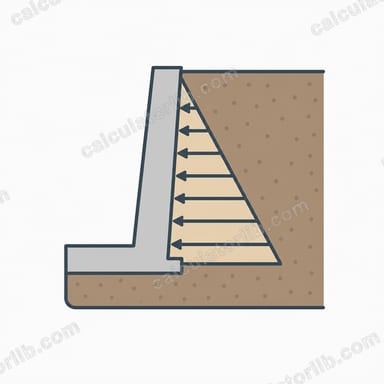
A retaining wall holds back a mass of soil, and that soil pushes sideways. This tool applies classical Rankine earth pressure theory to give you the horizontal pressure at the base of the wall, the total resultant thrust per metre of wall length, the height at which that thrust acts, and the overturning moment about the base (the heel). Those four numbers are the starting point for checking sliding, overturning and bearing capacity. The method is universal soil mechanics, not country-specific, but your local design code will dictate the load and resistance factors you apply afterwards.
How to use it
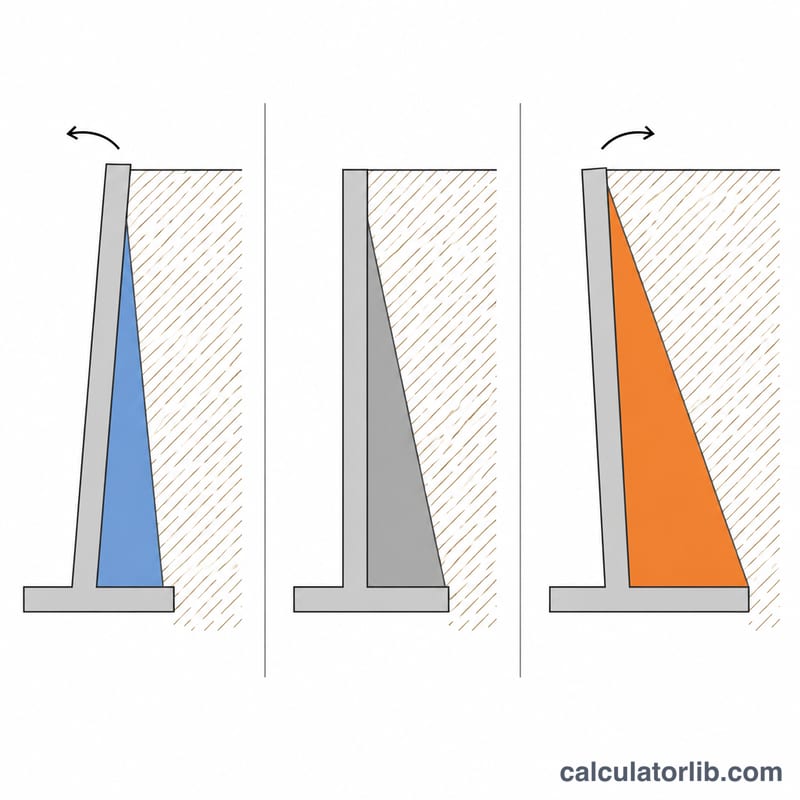
Pick the pressure condition first. Use active for a normal cantilever or gravity wall that can rotate a few millimetres away from the fill, at-rest for a rigid restrained wall such as a basement wall tied into a floor slab, and passive for soil resisting a wall or key that is pushed into it. Then enter the wall height \(H\) in metres, the soil unit weight \(\gamma\) in kN/m³ (typically 16–20 for granular fill), the friction angle \(\phi\) in degrees (28–38 for sand and gravel), and any uniform surcharge \(q\) in kPa from traffic, stockpiles or a nearby footing.
The formula explained
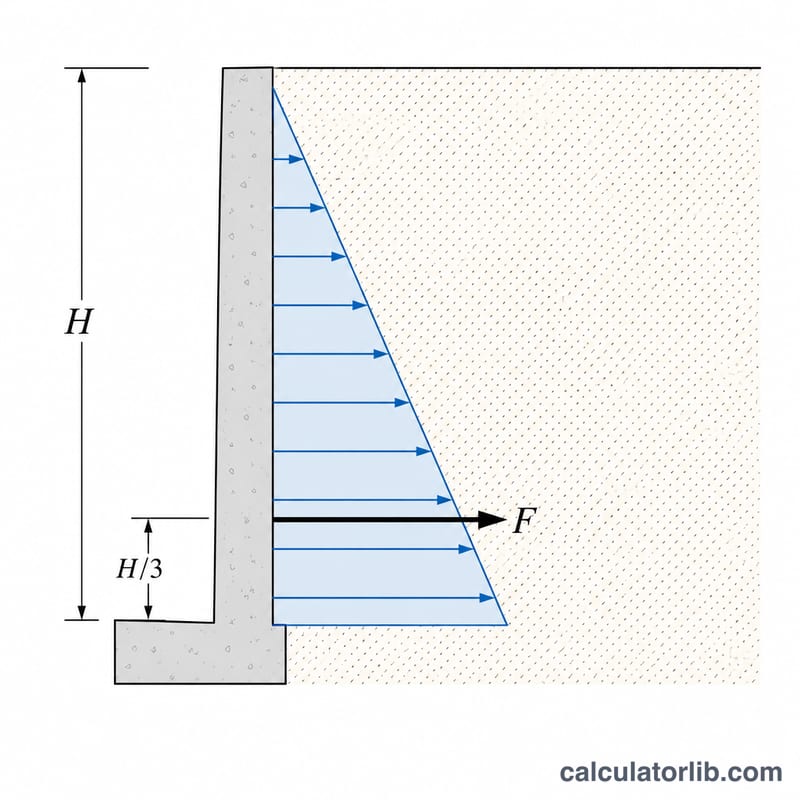
Pressure grows linearly with depth, so the soil component is triangular and the surcharge component is a uniform rectangle:
$$\sigma_h = K(\gamma H + q), \qquad P = \tfrac{1}{2}K\gamma H^2 + KqH$$with \(K = K_a\), \(K_0\) or \(K_p\) as selected. The triangle acts at \(H/3\) above the base and the rectangle at \(H/2\), so the combined lever arm is the force-weighted average of the two.
Worked example
Take \(H = 3\,\text{m}\), \(\gamma = 18\,\text{kN/m}^3\), \(\phi = 30^\circ\) and \(q = 10\,\text{kPa}\) in the active case:
$$K_a = \frac{1 - \sin 30^\circ}{1 + \sin 30^\circ} = \frac{0.5}{1.5} = 0.333$$$$\sigma_h = 0.333 \times (18 \times 3 + 10) = 21.33\,\text{kPa}$$$$P = \tfrac{1}{2}\times 0.333 \times 18 \times 3^2 + 0.333 \times 10 \times 3 = 27 + 10 = 37\,\text{kN/m}$$The resultant sits \(1.135\,\text{m}\) above the base, giving an overturning moment of \(42\,\text{kN}\cdot\text{m}\) per metre of wall.
Earth Pressure Coefficients and Typical Soil Properties
Lateral earth pressure is the product of a dimensionless coefficient \(K\) and the vertical stress in the backfill. The coefficient depends almost entirely on the drained (effective) friction angle \(\phi'\) of the fill, while the magnitude of the pressure depends on the unit weight \(\gamma\). The two tables below give indicative property ranges for common backfill materials and the exact Rankine coefficients this calculator uses.
Typical backfill properties (indicative ranges)
| Backfill material | Moist unit weight \(\gamma\) (kN/m³) | Submerged \(\gamma' = \gamma_{sat}-9.81\) (kN/m³) | Drained friction angle \(\phi'\) (°) |
|---|---|---|---|
| Clean sand and gravel (well graded, compacted) | 18 – 21 | 10 – 12 | 32 – 38 |
| Silty sand (SM) | 17 – 20 | 9 – 11 | 29 – 34 |
| Sandy silt / low-plasticity silt (ML) | 16 – 19 | 8 – 10 | 26 – 32 |
| Stiff clay (CL/CH), drained long-term | 18 – 21 | 9 – 11 | 20 – 28 |
| Compacted crushed rock / angular quarry run | 20 – 22 | 11 – 13 | 38 – 45 |
These are typical published ranges for preliminary sizing only. Actual values must come from site-specific laboratory or in-situ testing; compaction, grading, moisture and fines content all shift \(\phi'\) and \(\gamma\) significantly. Note that clays also have undrained strength and long-term swelling/creep behaviour that a simple \(\phi'\)-based Rankine analysis does not capture — cohesive backfill behind walls is generally discouraged.
Rankine coefficients as a function of \(\phi\)
$$K_a=\frac{1-\sin\phi}{1+\sin\phi},\qquad K_0=1-\sin\phi\ \text{(Jaky)},\qquad K_p=\frac{1+\sin\phi}{1-\sin\phi}=\frac{1}{K_a}$$
| \(\phi\) (°) | \(\sin\phi\) | Active \(K_a\) | At-rest \(K_0\) | Passive \(K_p\) |
|---|---|---|---|---|
| 26 | 0.438 | 0.390 | 0.562 | 2.56 |
| 28 | 0.469 | 0.361 | 0.531 | 2.77 |
| 30 | 0.500 | 0.333 | 0.500 | 3.00 |
| 32 | 0.530 | 0.307 | 0.470 | 3.25 |
| 34 | 0.559 | 0.283 | 0.441 | 3.54 |
| 36 | 0.588 | 0.260 | 0.412 | 3.85 |
| 38 | 0.616 | 0.238 | 0.384 | 4.20 |
| 40 | 0.643 | 0.217 | 0.357 | 4.60 |
Jaky's relation gives \(K_0 \approx 0.4\)–\(0.5\) for normally consolidated granular fill (\(\phi \approx 30\)–\(36^\circ\)), which is why braced, propped or rigid basement walls that cannot yield are routinely designed for \(K_0 \approx 0.5\). Over-consolidated or heavily compacted fill can push \(K_0\) well above 1.0 near the surface; Jaky's formula does not apply there.
All coefficients above assume the classical Rankine conditions: level backfill, a vertical and smooth (frictionless) wall back face, drained cohesionless soil with no water pressure, and homogeneous fill. Wall friction, a sloping backfill surface, a battered back face or layered soils require Coulomb, log-spiral or numerical methods, which generally reduce \(K_a\) slightly and change \(K_p\) substantially.
Key Terms and Symbols Explained
| Term / symbol | Unit | Meaning |
|---|---|---|
| Lateral earth pressure \(\sigma_h\) | kPa (kN/m²) | Horizontal stress the soil exerts on the wall face at a given depth. In the active case \(\sigma_h = K_a(\gamma z + q)\), so it grows linearly with depth \(z\) and is maximum at the base of the stem. |
| Active state | — | The wall yields away from the soil, the fill relaxes and mobilises its shear strength, and pressure falls to its minimum. Requires only small movement — roughly 0.1–0.5 % of wall height for granular fill. Typical for free-standing cantilever and gravity walls. |
| At-rest state | — | The wall does not move at all (basement walls, propped or heavily braced walls, walls founded on rock). Pressure sits between active and passive, with \(K_0 = 1-\sin\phi\). |
| Passive state | — | The wall pushes into the soil, which resists at its maximum. Requires large movement — of the order of 2–5 % or more of the embedded height — so full \(K_p\) is rarely available in service. |
| Earth pressure coefficient \(K\) | dimensionless | Ratio of horizontal to vertical effective stress, \(K = \sigma_h'/\sigma_v'\). Selected as \(K_a\), \(K_0\) or \(K_p\) according to how much the wall can move. |
| Unit weight \(\gamma\) | kN/m³ | Weight of soil per unit volume (bulk/moist unit weight). Below the water table use the submerged (buoyant) unit weight \(\gamma' = \gamma_{sat} - 9.81\) and add water pressure separately. |
| Effective friction angle \(\phi'\) | degrees (°) | Drained shear-strength parameter of the fill. Higher \(\phi'\) means lower active pressure and higher passive resistance. Always use the effective (drained) value with these formulas. |
| Surcharge \(q\) | kPa | Uniform vertical load on the backfill surface — traffic, stockpiles, an adjacent slab or building. It adds a constant horizontal pressure \(K q\) over the full wall height (not a triangle). |
| Resultant thrust \(P\) (also \(F\)) | kN per metre run of wall | The area of the pressure diagram — the total horizontal force pushing on a 1 m wide vertical slice of wall: \(P = \tfrac{1}{2}K\gamma H^{2} + K q H\). |
| Lever arm \(\bar y\) / point of application | m | Height above the base at which the resultant acts. The triangular soil component acts at \(H/3\); the rectangular surcharge component acts at \(H/2\). The combined \(\bar y\) is the force-weighted average. |
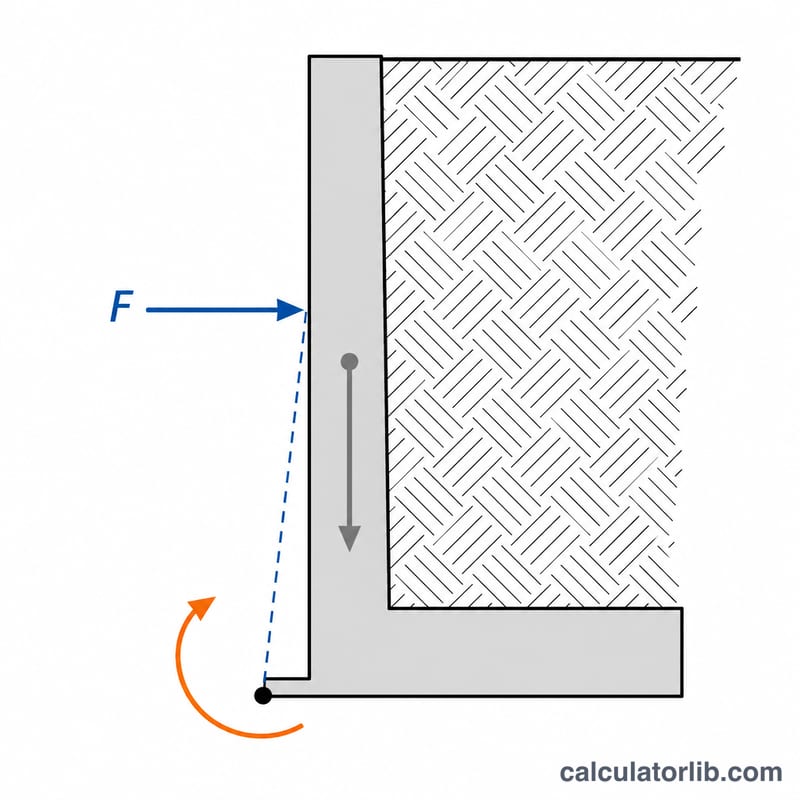
| Overturning moment \(M\) | kN·m per metre run | \(M = P\bar y\), taken about the toe. This is the demand that the wall's self-weight and backfill weight must resist. |
| Toe | — | The front edge of the base slab, on the exposed (low) side. Overturning and bearing pressures are conventionally checked about the toe. |
| Heel | — | The rear edge of the base slab, under the retained fill. Soil weight sitting on the heel is a major stabilising contribution for cantilever walls. |
Pressure versus thrust. These are different quantities and are easy to confuse. A pressure \(\sigma_h\) in kPa is a force per unit area at one specific depth — it is what sizes the stem's bending reinforcement locally. A thrust \(P\) in kN/m is a force per unit length along the wall, obtained by integrating that pressure over the full height of a 1 m wide strip. So a 4 m wall with a base pressure of 25 kPa does not "carry 25 kN"; it carries roughly 50 kN for every metre of its length. Every output of this calculator is expressed per metre run, so a 12 m long wall panel experiences 12 × the tabulated thrust and moment.
FAQ
Does this include water pressure? No. The model assumes a fully drained backfill. If water can build up behind the wall you must add hydrostatic pressure \(\gamma_w z\) and use the submerged unit weight for the soil below the water table — this often doubles the thrust, which is why blocked drains cause so many wall failures.
Why is the passive coefficient so large? \(K_p\) is the reciprocal of \(K_a\), so at \(\phi = 30^\circ\) it is 3.0 versus 0.33. Passive resistance also needs much larger wall movement to mobilise, so designers usually apply a generous factor of safety or ignore the top layer entirely.
Can I use it for cohesive clay? Only as a rough check. Clay adds a cohesion term \(-2c\sqrt{K_a}\) and shows long-term strength loss, so specialist analysis is required.