What this calculator does
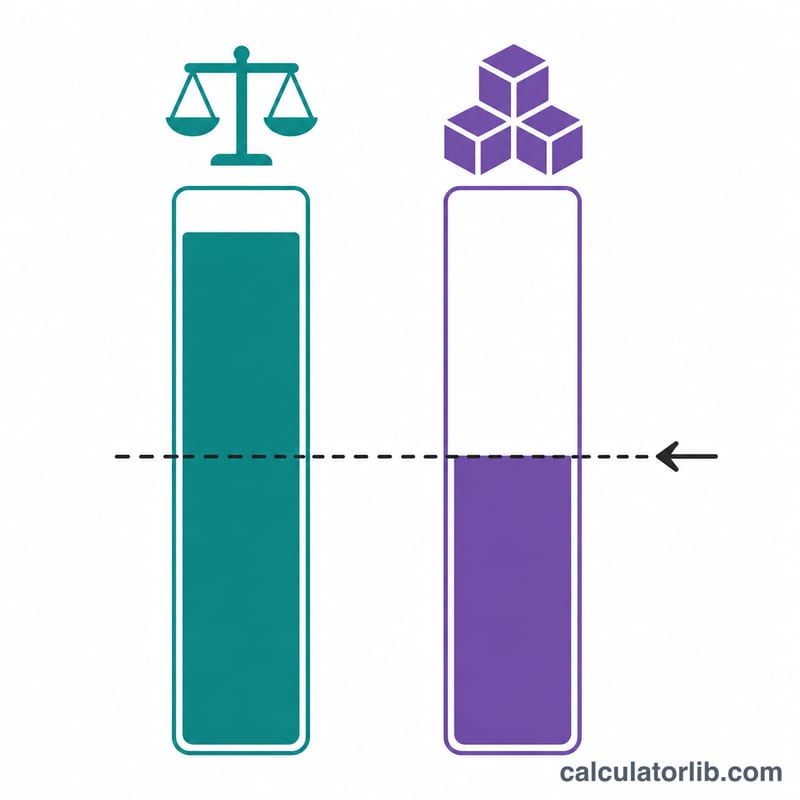
A truck is never limited by weight alone. Dense freight such as tiles or drinks hits the payload rating long before the deck is full, while light freight such as foam or packaging fills the space at half the legal weight. This tool evaluates both limits at once and reports the binding one, so you know whether to order a bigger deck or a heavier-rated chassis. All inputs are metric: kilograms, metres for the deck and centimetres for the carton.
How to use it
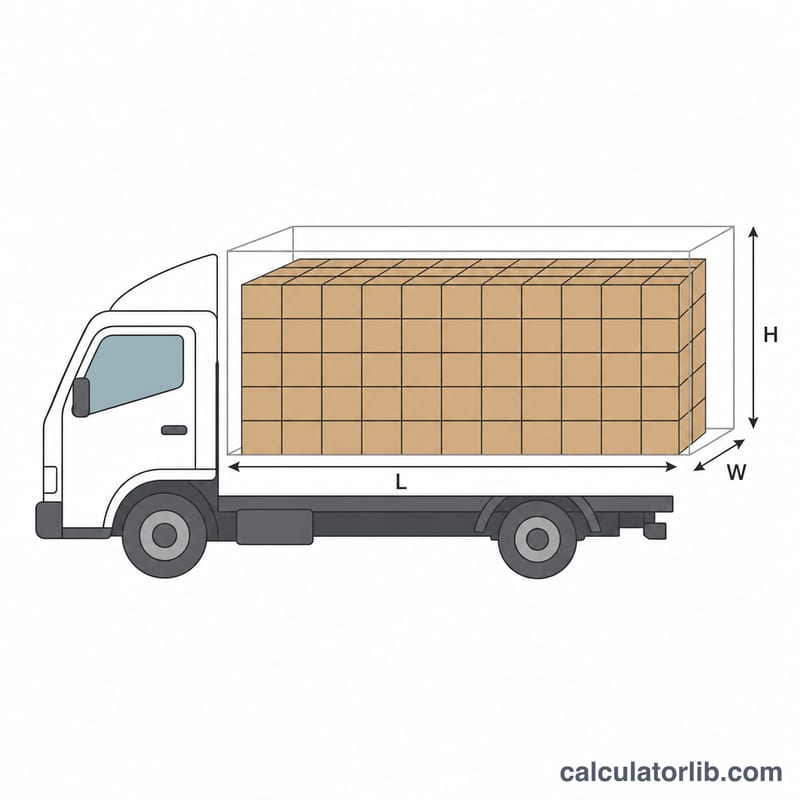
Enter the truck payload capacity (gross vehicle weight minus kerb weight), the internal deck length, width and usable stacking height, then the carton dimensions and weight. Finally set a packing efficiency, typically 80–90%, which allows for gaps, pallet footprints and non-stackable items. Leave it at 100% only for perfectly tessellating loads.
The formula
With \(W_{max}\) = payload in kg, \(w_{box}\) = weight per carton, \(V_{deck}\) = gross cargo volume, \(e\) = packing efficiency and \(v_{box}\) = carton volume:
$$N = \min\left(\left\lfloor \frac{W_{max}}{w_{box}} \right\rfloor, \left\lfloor \frac{V_{deck} \times e}{v_{box}} \right\rfloor\right)$$The floor function is used because a partial carton cannot be shipped.
Worked example
A truck rated at 10,000 kg has a deck of 6 m × 2.4 m × 2.4 m, and each carton is 120 × 100 × 100 cm weighing 300 kg, at 85% packing efficiency:
$$V_{deck} = 6 \times 2.4 \times 2.4 = 34.56\,\text{m}^3, \qquad v_{box} = \frac{120 \times 100 \times 100}{1{,}000{,}000} = 1.2\,\text{m}^3$$$$N = \min\left(\left\lfloor \frac{10000}{300} \right\rfloor, \left\lfloor \frac{34.56 \times 0.85}{1.2} \right\rfloor\right) = \min(33, 24) = 24$$So 24 cartons weighing 7,200 kg fit — a volume-limited load with 2,800 kg of unused payload.
Standard Truck, Trailer and Container Capacities
The figures below are typical published values for vehicles and ISO containers in common use. The rigid/articulated classes named by gross vehicle weight (7.5 t, 18 t, 26 t, 44 t) are UK and European conventions; North America classifies trucks differently (Class 6–8, with an 80,000 lb federal gross combination limit on the Interstate system), so the payload column will not transfer directly. Container dimensions are ISO-standard and are the same worldwide.
| Vehicle / unit | Typical payload | Internal L × W × H (m) | Gross cargo volume | Pallet positions (floor-loaded) |
|---|---|---|---|---|
| Transit-size panel van (LWB, medium roof) | 1.0–1.4 t | 3.4 × 1.7 × 1.9 | ≈ 11 m³ | 3–4 Euro (1200 × 800 mm) |
| 7.5 t rigid box / curtain | 2.8–3.5 t | 6.0 × 2.3 × 2.2 | ≈ 30 m³ | ≈ 10 Euro |
| 18 t rigid | 9–10 t | 7.2 × 2.45 × 2.5 | ≈ 44 m³ | ≈ 18 Euro / 14 standard (1200 × 1000 mm) |
| 26 t rigid (3-axle) | 15–16 t | 9.0 × 2.45 × 2.6 | ≈ 57 m³ | ≈ 20–22 Euro / 18 standard |
| 44 t articulated curtainsider (13.6 m trailer) | 26–29 t | 13.6 × 2.45 × 2.7 | ≈ 90 m³ | 33 Euro / 26 standard |
| 20 ft ISO container (general purpose) | ≈ 28 t | 5.90 × 2.35 × 2.39 | ≈ 33 m³ | 11 Euro / 9–10 standard |
| 40 ft ISO container (general purpose) | 26–28 t | 12.03 × 2.35 × 2.39 | ≈ 67 m³ | 25 Euro / 20–21 standard |
| 40 ft high-cube ISO container | ≈ 26 t | 12.03 × 2.35 × 2.69 | ≈ 76 m³ | 25 Euro / 20–21 standard |
How the pallet counts arise: a 2.45 m wide trailer takes three Euro pallets side by side across its 800 mm dimension (3 × 800 = 2400 mm), and 13.6 m of floor divides into 11 rows of 1200 mm, giving \(3 \times 11 = 33\) positions. The same trailer loaded with 1200 × 1000 mm standard pallets takes two across (2 × 1200 = 2400 mm) over 13 rows of 1000 mm, giving 26 positions.
Payload figures vary widely with chassis specification, body and tail-lift weight, fuel and AdBlue load, and the driver/crew allowance — two nominally identical 18 t rigids can differ by several hundred kilograms. A container's payload also depends on its own tare weight, which is stencilled on the door. Always treat the vehicle's manufacturer plate (or the container's CSC plate) as authoritative rather than any table, and remember that the road authority's axle-weight limits may bind before the plated gross weight does.
Weight-Limited vs Volume-Limited Load Scenarios
All six scenarios use one fixed vehicle: a 44 t articulated curtainsider with a 26,000 kg payload and a 13.6 × 2.45 × 2.7 m deck, loaded at 85% packing efficiency.
$$V_{deck} = 13.6 \times 2.45 \times 2.7 = 89.96\ \text{m}^3 \qquad V_u = 89.96 \times 0.85 = 76.47\ \text{m}^3$$
The calculator takes the lower of the two ceilings, so whichever count is smaller is the binding limit:
$$N = \min\left( \left\lfloor \frac{26{,}000}{w_{box}} \right\rfloor,\ \left\lfloor \frac{76.47}{V_{box}} \right\rfloor \right)$$
| Cargo | Carton (cm) | Carton volume | Carton weight | Weight-limited count | Volume-limited count | Final N | Shipped weight | Payload used | Usable volume used | Binding limit |
|---|---|---|---|---|---|---|---|---|---|---|
| Ceramic tiles | 40 × 40 × 20 | 0.032 m³ | 30 kg | 866 | 2,389 | 866 | 25,980 kg | 99.9% | 36.2% | Weight |
| Bottled drinks | 40 × 30 × 30 | 0.036 m³ | 15 kg | 1,733 | 2,124 | 1,733 | 25,995 kg | 100.0% | 81.6% | Weight |
| Books | 40 × 30 × 30 | 0.036 m³ | 20 kg | 1,300 | 2,124 | 1,300 | 26,000 kg | 100.0% | 61.2% | Weight |
| General dry goods (near-balanced) | 50 × 40 × 30 | 0.060 m³ | 20 kg | 1,300 | 1,274 | 1,274 | 25,480 kg | 98.0% | 100.0% | Volume (by 2%) |
| Packaged foam | 60 × 60 × 60 | 0.216 m³ | 4 kg | 6,500 | 354 | 354 | 1,416 kg | 5.4% | 100.0% | Volume |
| Empty plastic crates | 60 × 40 × 40 | 0.096 m³ | 2 kg | 13,000 | 796 | 796 | 1,592 kg | 6.1% | 99.9% | Volume |
Worked substitution for the tiles row:
$$V_{box} = \frac{40 \times 40 \times 20}{1{,}000{,}000} = 0.032\ \text{m}^3$$
$$N = \min\left( \left\lfloor \frac{26{,}000}{30} \right\rfloor,\ \left\lfloor \frac{76.47}{0.032} \right\rfloor \right) = \min(866,\ 2389) = 866\ \text{cartons}$$
The pattern is set by cargo density. Tiles run at about 940 kg/m³, so the trailer fills by weight with roughly two-thirds of the deck still empty — this is the classic "heavy and cheap to carry, expensive in wasted cube" profile. Foam and empty crates sit near 19 kg/m³ and 21 kg/m³ respectively and fill the cube with under 6% of the payload used; these loads are billed on volumetric weight for exactly this reason. The general dry goods row is the efficient case: 98.0% of payload and 100.0% of usable volume, with the two ceilings only 2% apart. A trailer's break-even density here is \(26{,}000 \div 76.47 \approx 340\ \text{kg/m}^3\) — cargo denser than that is weight-limited, lighter than that is volume-limited.
Practical Loading Recommendations
- Always round the carton count down. The calculator floors both ceilings because you cannot ship a part carton, and a "nearly fits" carton is the one that forces a second vehicle or a re-work at the loading bay. Plan on the whole number the tool returns.
- If the load is volume-limited, buy cube, not payload. A high-cube container or a taller/longer body is the direct fix — a 40 ft high-cube adds roughly 9 m³ over a standard 40 ft for the same footprint. Double-stacking is the cheaper fix where the carton's box compression strength allows it; check the stacking-strength marking on the carton and remember that strength falls substantially in humid conditions and over long storage times.
- Re-size cartons to tessellate with the deck. A 2.45 m wide deck takes 6 × 40 cm cartons across with 5 cm to spare, but only 4 × 60 cm with 5 cm wasted per row. Changing one carton dimension by a few centimetres so an exact whole number fits across the width often buys more capacity than any packing-efficiency improvement.
- If the load is weight-limited, never chase the last few cartons. Move to a heavier-rated chassis, or split the consignment across two vehicles. Exceeding the plated weight is an offence in essentially every jurisdiction and typically voids insurance; no commercial saving justifies it.
- Reserve payload for everything that is not product. A wooden EUR/EPAL pallet weighs about 25 kg and a plastic equivalent roughly 15–20 kg, so 26 pallets alone consume 500–650 kg. Add dunnage, load bars, edge boards, straps, blankets and any returnable packaging before deciding how many cartons fit.
- Keep 5–10% payload headroom. Timber pallets and paper-based packaging gain weight in damp conditions, actual carton weights drift above nominal, and weighbridges have their own tolerance. Loading to 100.0% of plate on paper means arriving overweight in practice.
- Check axle loads, not just the total. A vehicle can be legal on gross weight and still overloaded on the drive or rear axle. Distribute dense cargo along the full deck length rather than concentrating it over the headboard or the tail, keep the centre of gravity low and central, and verify with axle-weight figures rather than assumption.
- Build pallets to a whole number of cartons per layer. Mixed or partial layers waste height, destabilise the stack and defeat both stretch wrapping and any load-securing calculation. A clean layer pattern also makes the count auditable at the gate.
- Confirm the plate before dispatch. Read the manufacturer's plate or VIN gross rating on the actual vehicle presented, and the tare stencilled on the actual container — not the fleet spreadsheet. Trailer swaps and body or tail-lift fitments change usable payload.
This calculator gives a planning estimate, not a certificate of legal compliance. It assumes uniform cartons, a rectangular deck and a single packing efficiency figure; it does not model axle distribution, load-securing forces, hazardous-goods segregation, temperature-controlled airflow gaps, wheel arches, or the load-restraint standards that apply where you operate. Verify every load against the vehicle plate, a weighbridge and the road-transport rules of the country you are driving in before dispatch.
FAQ
Is payload the same as gross vehicle weight? No. Payload is the gross vehicle weight rating minus the kerb weight of the truck, and it must also cover the driver, fuel and any pallets or dunnage.
Why not use 100% packing efficiency? Real loads waste space on pallet overhang, aisles for forklift access, load bars and cartons that cannot be stacked. A 15% allowance is a common planning figure.
Does the result guarantee the load is legal? No. Even a compliant total weight can overload a single axle if the cargo sits too far forward or back, so check axle loads and local load-securing regulations.