
What is a V-Notch Weir Flow Calculator?
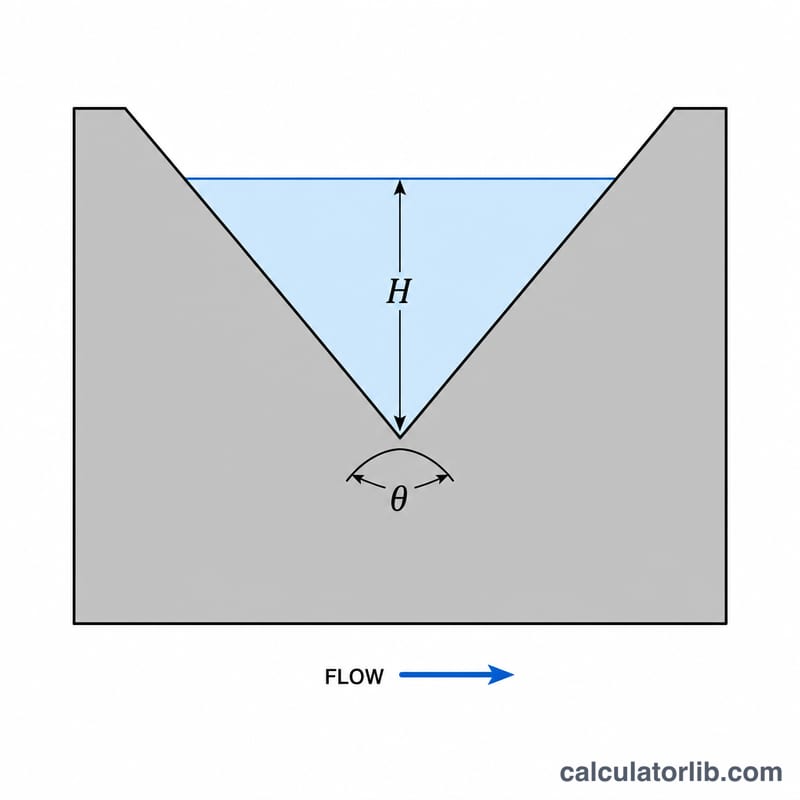
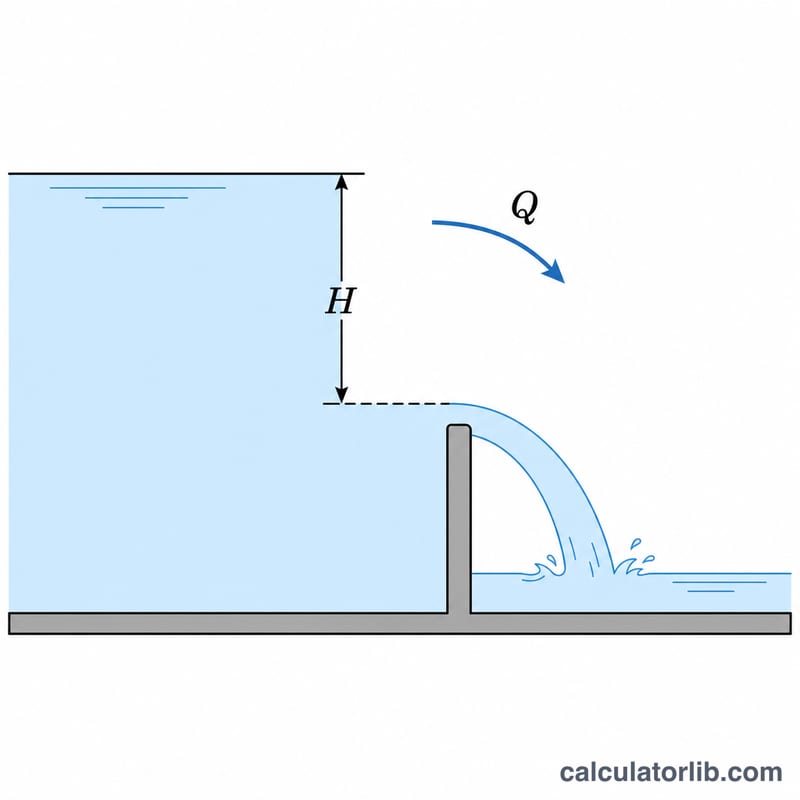
A V-notch (triangular) weir is a thin plate with a V-shaped opening placed across an open channel to measure flow. By reading the head of water above the notch vertex, you can determine the discharge. This calculator applies the standard triangular weir equation to convert head, notch angle, and a discharge coefficient into flow rate in m³/s, L/s, and m³/h. It is a universal hydraulics tool not tied to any jurisdiction.
How to Use It
Enter the head H (vertical height of water surface above the notch vertex) in metres, the included notch angle \(\theta\) in degrees (90° is the most common), the discharge coefficient Cd (typically 0.58–0.62 for a sharp-crested notch), and gravitational acceleration g (9.81 m/s²). The calculator returns the discharge in three units.
The Formula Explained
The governing equation is $$Q = \frac{8}{15} \, \text{C}_d \, \tan\!\left(\frac{\theta}{2}\right) \sqrt{2 \, \text{g}} \; \text{H}^{\,2.5}$$ The \(\tan(\theta/2)\) term captures the widening triangular cross-section, while the \(\text{H}^{2.5}\) exponent reflects that both flow depth and the increasing width contribute to discharge. The 8/15 constant comes from integrating velocity over the triangular area assuming an ideal velocity distribution.
Worked Example
For a 90° notch with H = 0.3 m, Cd = 0.6, and g = 9.81: \(\tan(45°) = 1\), \(\sqrt{2 \cdot 9.81} = 4.429\), \(0.3^{2.5} = 0.04930\). Then $$Q = 0.5333 \cdot 0.6 \cdot 1 \cdot 4.429 \cdot 0.04930 \approx 0.06987 \; \text{m}^3/\text{s}$$ or about 69.9 L/s.
FAQ
Why a V-notch instead of a rectangular weir? V-notches are more accurate at low flows because the narrowing shape keeps head readings sensitive even when discharge is small.
What Cd value should I use? For a fully contracted sharp-crested 90° notch, Cd ≈ 0.58–0.60 is typical; refer to calibration data for your specific weir.
Does head include the channel approach velocity? The basic formula assumes negligible approach velocity; for high velocities an energy head correction may be needed.