What is the Hot Car Temperature Calculator?
This tool estimates how hot the interior of a parked, closed car becomes over time when left in the sun. The inside of a vehicle heats up far faster than most people expect — even on a mild day, the cabin can become deadly within minutes. The calculator uses a logarithmic model based on published vehicle-heating studies to show how the interior temperature climbs above the outside air temperature.
How to use it
Enter the current outside temperature, choose Fahrenheit or Celsius, and enter how many minutes the car has been parked. The calculator returns the estimated interior temperature and the temperature rise above ambient. Use it to understand just how quickly a vehicle becomes dangerous.
The formula explained
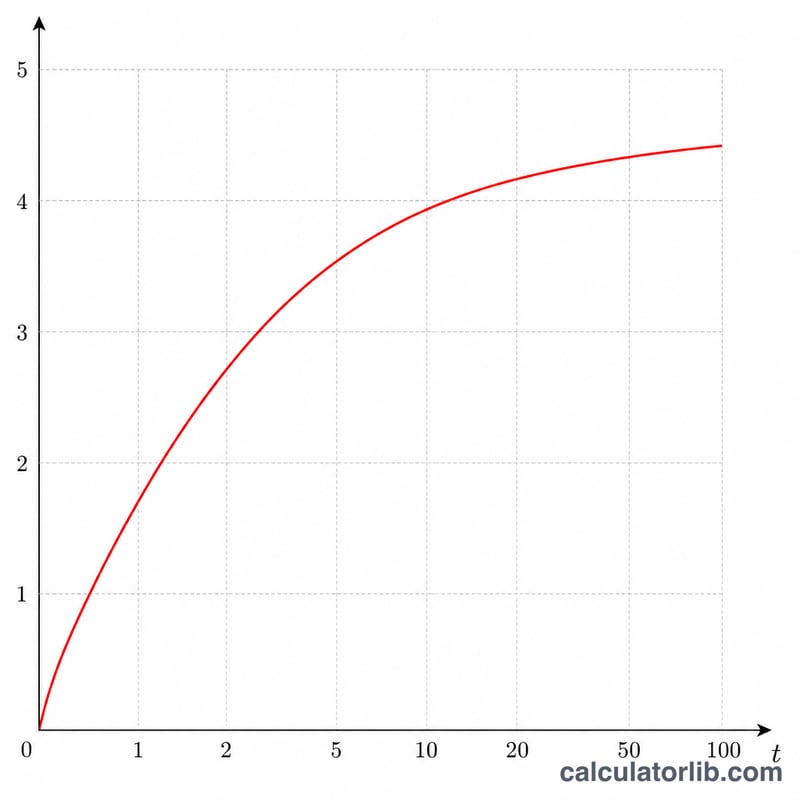
The heat rise follows a logarithmic curve because the car warms quickly at first, then more slowly as it approaches a peak. We model the rise (in °F) as $$\Delta T = 12.4 \times \ln\!\left(t + 1\right)$$ where \(t\) is minutes. This gives about +29.7°F after 10 minutes, +42.6°F after 30 minutes and +51.0°F after 60 minutes. That errs on the hot side: in a study of a dark sedan on sunny days (McLaren et al., Pediatrics, 2005), the cabin rose by about 40°F within an hour, with 80% of the rise in the first 30 minutes, whatever the outside temperature (72–96°F). The inside temperature is then simply the outside temperature plus this rise (rise is converted to °C when Celsius is selected).
Worked example
Suppose it is 85°F outside and a car has been parked for 30 minutes. $$\Delta T = 12.4 \times \ln(30 + 1) = 12.4 \times 3.434 \approx 42.6\,\text{°F}$$ Adding to 85°F gives about 128°F inside — well into the lethal range. The longer a car sits, the hotter and more dangerous it becomes.
Estimated Interior Temperature by Outside Temperature and Time
This table uses the calculator's model: the interior temperature equals the outside temperature plus a rise of \(\Delta T = 12.4 \times \ln(t+1)\) °F, where \(t\) is the time in minutes. The rise is about 29.7°F at 10 minutes (\(\ln 11 = 2.398\)), 42.6°F at 30 minutes (\(\ln 31 = 3.434\)) and 51.0°F at 60 minutes (\(\ln 61 = 4.111\)). Every cell below is the outside temperature plus these unrounded rises, so the values may differ slightly from any rounded figures quoted in the formula section. Celsius equivalents are in parentheses.
| Outside temperature | After 10 min | After 30 min | After 60 min |
|---|---|---|---|
| 70°F (21.1°C) | 99.7°F (37.6°C) | 112.6°F (44.8°C) | 121.0°F (49.4°C) |
| 80°F (26.7°C) | 109.7°F (43.2°C) | 122.6°F (50.3°C) | 131.0°F (55.0°C) |
| 90°F (32.2°C) | 119.7°F (48.7°C) | Estimated 132.6°F (55.9°C) | 141.0°F (60.6°C) |
| 100°F (37.8°C) | 129.7°F (54.3°C) | 142.6°F (61.4°C) | 151.0°F (66.1°C) |
In Celsius terms the rise is about 16.5°C at 10 minutes, 23.7°C at 30 minutes and 28.3°C at 60 minutes. These are model estimates, not measurements. Real values vary with sunlight, car colour, window tint, interior materials and ventilation.
Interpreting Your Result
The number shown is an estimate of the cabin air temperature in a closed, parked car. Surfaces exposed to direct sun, such as the dashboard, steering wheel and seats, can be considerably hotter than the air. The model is a simplified fit and does not account for sun angle, cloud cover, shade or vehicle design.
Published vehicle-heating studies, including research from Arizona State University and Stanford, generally find that most of the temperature rise happens in the first 30 minutes, with the rate slowing afterwards. This is why the formula uses a logarithm: the rise grows quickly at first and then flattens.
For context, a core body temperature of about 104°F (40°C) is commonly cited as the threshold for heatstroke, and about 107°F (41.7°C) is regarded as a critical level at which severe organ damage can occur. Interior air temperatures well above these values, as in the table above, are reached in many conditions.
This result is not a safety guarantee. A low estimate does not mean a car interior is safe, and the tool cannot predict what will happen in a specific vehicle on a specific day.
Step-by-Step Calculation by Hand
- If the outside temperature is in °C, convert it to °F: \(F = C \times 1.8 + 32\).
- Add 1 to the number of minutes: \(t + 1\).
- Take the natural logarithm: \(\ln(t+1)\).
- Multiply by 12.4 to get the rise in °F: \(\Delta T = 12.4 \times \ln(t+1)\).
- Add the rise to the outside temperature in °F: \(T_{\text{inside}} = T_{\text{outside}} + \Delta T\).
- For a Celsius result, divide the rise by 1.8 and add it to the outside temperature in °C. Alternatively, convert the final °F result with \(C = (F - 32) \times 5/9\).
Quick check: for \(t = 10\) minutes, \(t + 1 = 11\) and \(\ln(11) = 2.398\). Then \(\Delta T = 12.4 \times 2.398 \approx 29.7\)°F. At 80°F outside, the interior estimate is \(80 + 29.7 = 109.7\)°F.
FAQ
Is this exact? No. Actual interior temperature depends on sun angle, color, windows, and ventilation. Treat results as an awareness estimate, not a safety guarantee.
At what temperature is it dangerous? Children's bodies overheat 3–5× faster than adults. Heatstroke risk begins around a core temperature of 104°F (40°C), which a hot cabin can cause very quickly.
Does cracking a window help? Studies show leaving windows slightly open has minimal effect on the peak temperature. Never leave a child or pet in a parked car, even briefly.