
What is the Fresnel Sine Integral?
The Fresnel sine integral \(S(x)\) and its companion cosine integral \(C(x)\) are special functions that appear throughout optics (Fresnel diffraction), antenna theory, and the geometry of the Cornu (Euler) spiral. This calculator uses the pi/2-normalized convention, defining \(S(x)\) as the integral from 0 to x of sin(pi t squared / 2) dt and \(C(x)\) as the same integral with cosine. In this convention both functions approach \(\frac{1}{2}\) as x grows toward positive infinity.
$$S(\text{x}) = \int_{0}^{\text{x}} \sin\!\left(\frac{\pi}{2}\,t^{2}\right)\,dt$$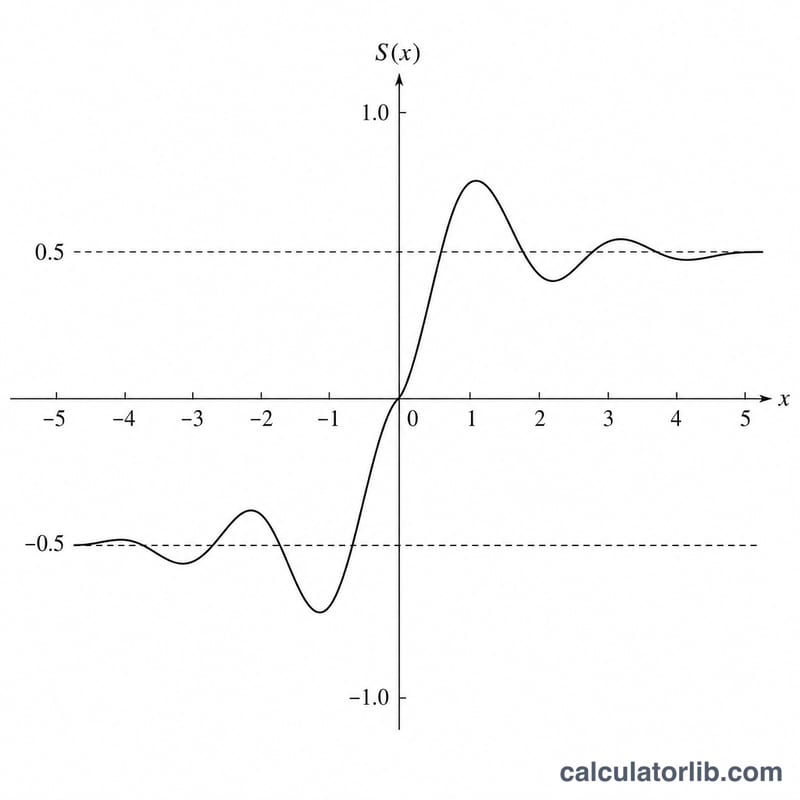
How to Use It
Enter any real value of x (positive or negative) and choose how many decimal places to display. Because the integrands are even in t, \(S(x)\) and \(C(x)\) are odd functions: \(S(-x) = -S(x)\) and \(C(-x) = -C(x)\). The calculator evaluates the magnitude and applies the sign automatically. At \(x = 0\) both integrals are exactly 0.
The Formula Explained
There is no elementary closed form, so we evaluate numerically. For moderate arguments the rapidly converging power series is used: \(S(x) = \sum (-1)^n (\pi/2)^{2n+1} x^{4n+3} / [(2n+1)! (4n+3)]\), and a similar series for \(C(x)\). For large \(|x|\) the integrand oscillates quickly, so we switch to composite Simpson's rule with the number of subintervals scaled with x squared to preserve accuracy.
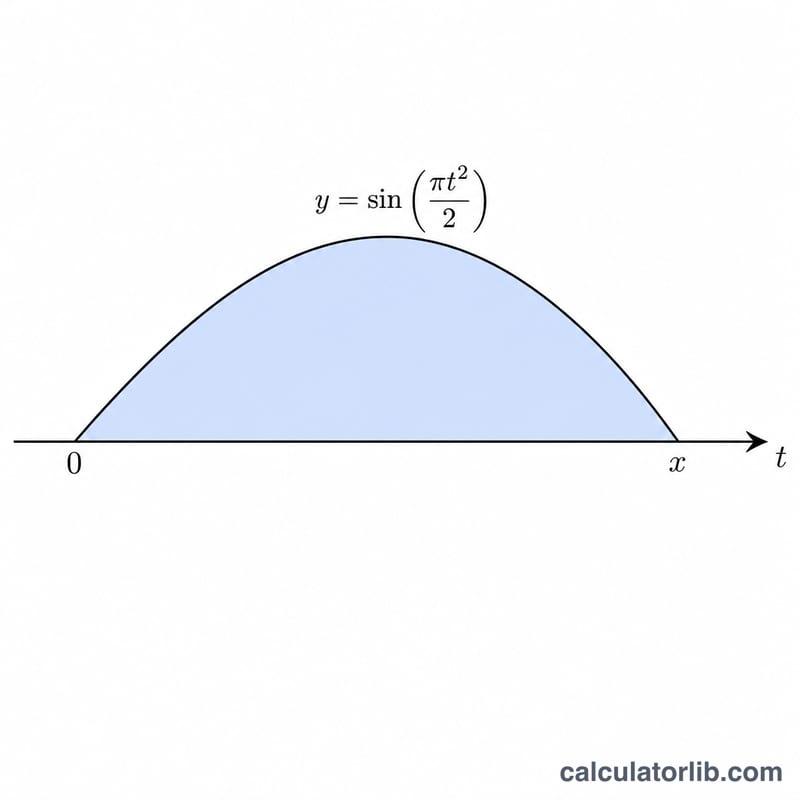
Worked Example (x = 1)
Summing the series:
$$0.52359878 - 0.09228062 + 0.00724487 - 0.00031216 + 0.00000845 + \ldots \approx 0.4382591474$$gives \(S(1) \approx 0.4382591474\), matching the published reference value \(0.4382591473903\). The companion value is \(C(1) \approx 0.7798934004\).
FAQ
Which normalization is used? The pi/2-normalized form with the pi/2 factor inside the sine and cosine, so the limits are \(\frac{1}{2}\) rather than involving \(\sqrt{\pi/8}\).
What happens for large x? \(S(x)\) and \(C(x)\) oscillate around \(\frac{1}{2}\) with shrinking amplitude and converge to \(\frac{1}{2}\) as x goes to infinity (and to \(-\frac{1}{2}\) as x goes to negative infinity).
Is C(x) computed too? Yes, the cosine companion \(C(x)\) is shown as a secondary output alongside the primary \(S(x)\).