
What is the hyperbolic sine integral Shi(x)?
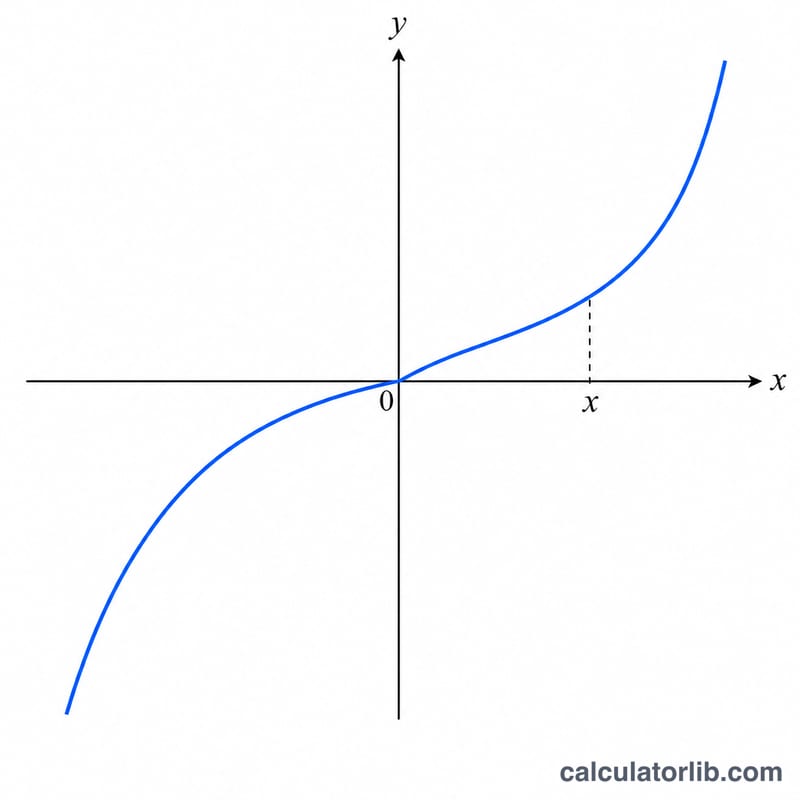
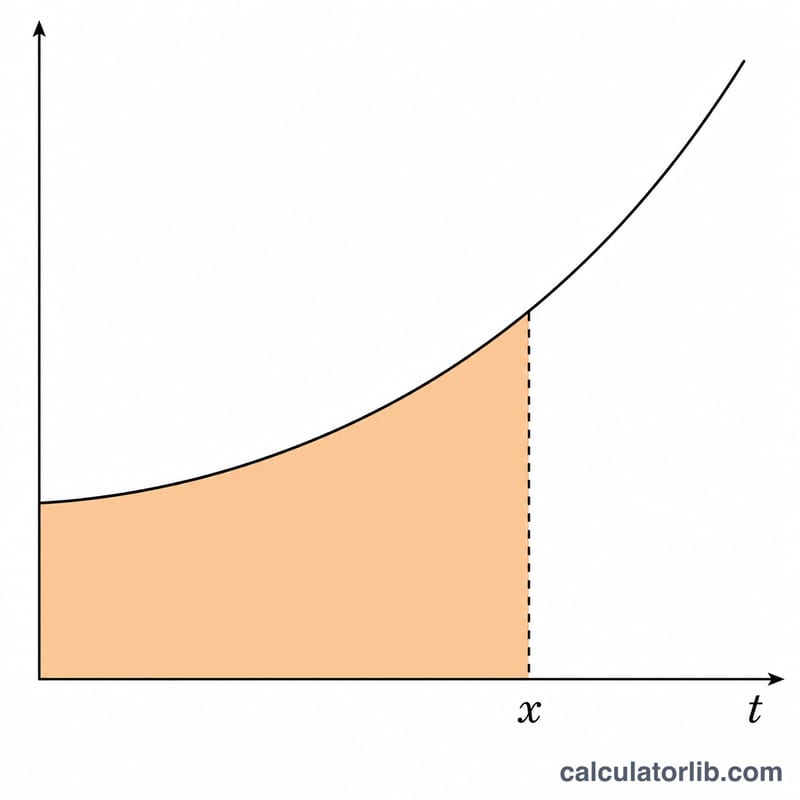
The hyperbolic sine integral, written \(\operatorname{Shi}(x)\), is a special function defined as the definite integral of \(\sinh(t)/t\) from 0 to x. Although the integrand looks like it would blow up at t = 0, the singularity is removable: as t approaches 0, \(\sinh(t)/t\) approaches 1. Because of this, \(\operatorname{Shi}(x)\) is analytic everywhere on the real line, with \(\operatorname{Shi}(0) = 0\), and it is an odd function, meaning \(\operatorname{Shi}(-x) = -\operatorname{Shi}(x)\).
How to use this calculator
Enter any real number x in the input field and the calculator returns \(\operatorname{Shi}(x)\). When x is greater than zero it also reports the related hyperbolic cosine integral \(\operatorname{Chi}(x)\). For \(x \le 0\), \(\operatorname{Chi}(x)\) is reported as undefined because it involves \(\ln(x)\) and develops a complex branch. Results are shown to roughly twelve significant digits using double-precision arithmetic.
The formula explained
This tool sums the Maclaurin series $$\operatorname{Shi}(x) = x + \frac{x^{3}}{3\cdot 3!} + \frac{x^{5}}{5\cdot 5!} + \cdots$$ which converges for every real x. Each term is built incrementally from the previous one to avoid factorial overflow, and the sum stops when a new term is negligibly small relative to the running total. \(\operatorname{Chi}(x)\) is computed as $$\operatorname{Chi}(x) = \gamma + \ln(x) + \frac{x^{2}}{2\cdot 2!} + \frac{x^{4}}{4\cdot 4!} + \cdots$$ where \(\gamma\) is the Euler-Mascheroni constant, approximately 0.5772156649.
Worked example
For x = 1: the series gives $$1 + \frac{1}{18} + \frac{1}{600} + \frac{1}{35280} + \cdots \approx 1.0572508754.$$ The known reference value is \(\operatorname{Shi}(1) = 1.0572508753757285\), and \(\operatorname{Chi}(1) = 0.8378669409765007\), matching the calculator output.
FAQ
Is Shi(x) the same as the sine integral Si(x)? No. \(\operatorname{Si}(x)\) integrates \(\sin(t)/t\), while \(\operatorname{Shi}(x)\) integrates the hyperbolic \(\sinh(t)/t\). They are related by \(\operatorname{Shi}(x) = -i\cdot\operatorname{Si}(ix)\).
Why is Chi undefined for x ≤ 0? \(\operatorname{Chi}(x)\) contains \(\ln(x)\); for negative x this becomes complex, and at x = 0 it diverges to negative infinity.
How large can x be? Since \(\sinh\) grows roughly like \(e^{|x|}/2\), double precision overflows near \(|x| \approx 700\). For moderate values the series is extremely accurate.