
What Is the Sinh (Hyperbolic Sine) Calculator?
This calculator computes the hyperbolic sine of any real number x. The hyperbolic sine, written sinh(x), is one of the fundamental hyperbolic functions and appears throughout mathematics, physics, and engineering — for example in the shape of a hanging cable (catenary), in special relativity, and in the solutions of differential equations.
How to Use It
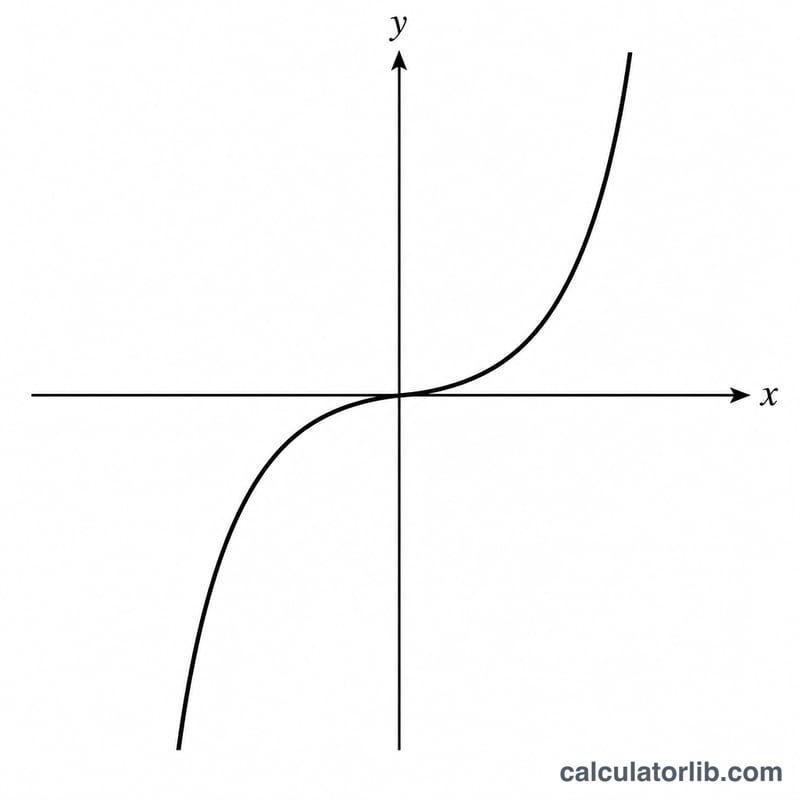
Enter any real number into the field labeled "Value of x" and submit. The calculator returns sinh(x) with full precision. You can use positive numbers, negative numbers, or zero. Because sinh is an odd function, \(\sinh(-x) = -\sinh(x)\), so the sign of your input flips the sign of the result.
The Formula Explained
The hyperbolic sine is defined directly in terms of the exponential function:
$$\sinh(x) = \frac{e^{x} - e^{-x}}{2}$$
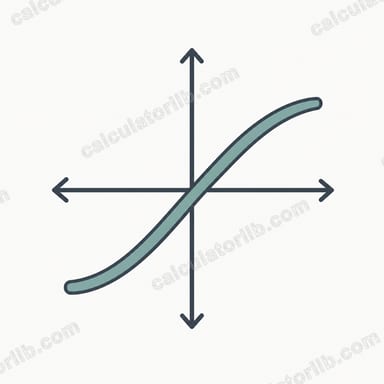
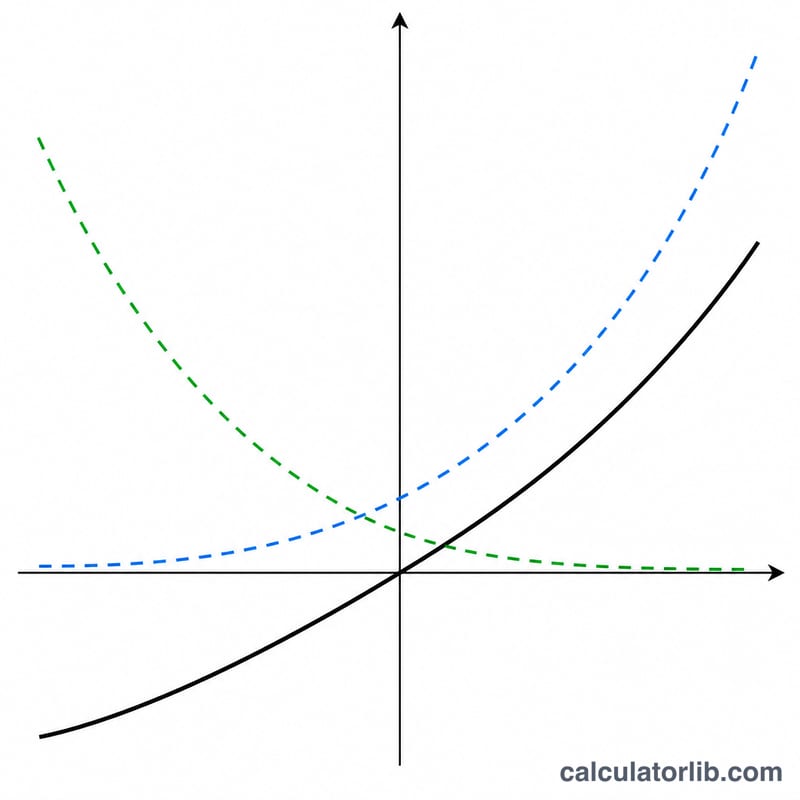
Here \(e \approx 2.718281828\) is Euler's number. The function grows roughly like \(\tfrac{1}{2}e^{x}\) for large positive x and like \(-\tfrac{1}{2}e^{-x}\) for large negative x. At \(x = 0\) it equals 0, and its derivative is \(\cosh(x)\).
Worked Example
Suppose \(x = 1\). Then \(e^{1} \approx 2.718281828\) and \(e^{-1} \approx 0.367879441\). Subtracting gives \(2.350402387\), and dividing by 2 gives $$\sinh(1) \approx 1.175201194$$ The calculator performs this exact computation for any value you enter.
FAQ
Is sinh the same as sin? No. sin is the ordinary (circular) trigonometric sine; sinh is the hyperbolic sine, defined with exponentials rather than angles.
What is sinh(0)? It is exactly 0, since \((e^{0} - e^{0})/2 = (1 - 1)/2 = 0\).
Can x be negative? Yes. sinh is defined for all real numbers and is odd, so \(\sinh(-2) = -\sinh(2)\).