
What Is the Slant Height of a Cone?
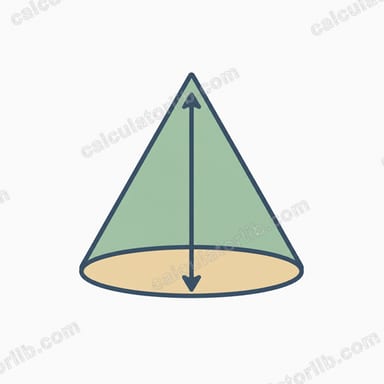
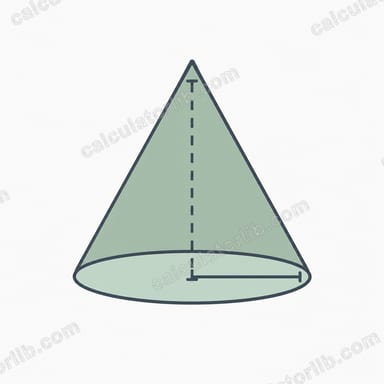
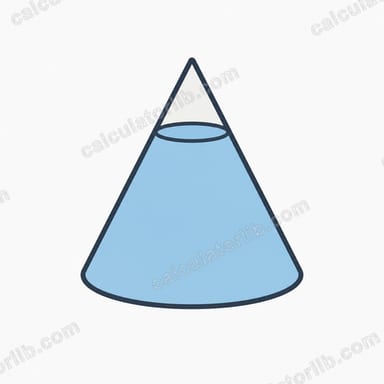
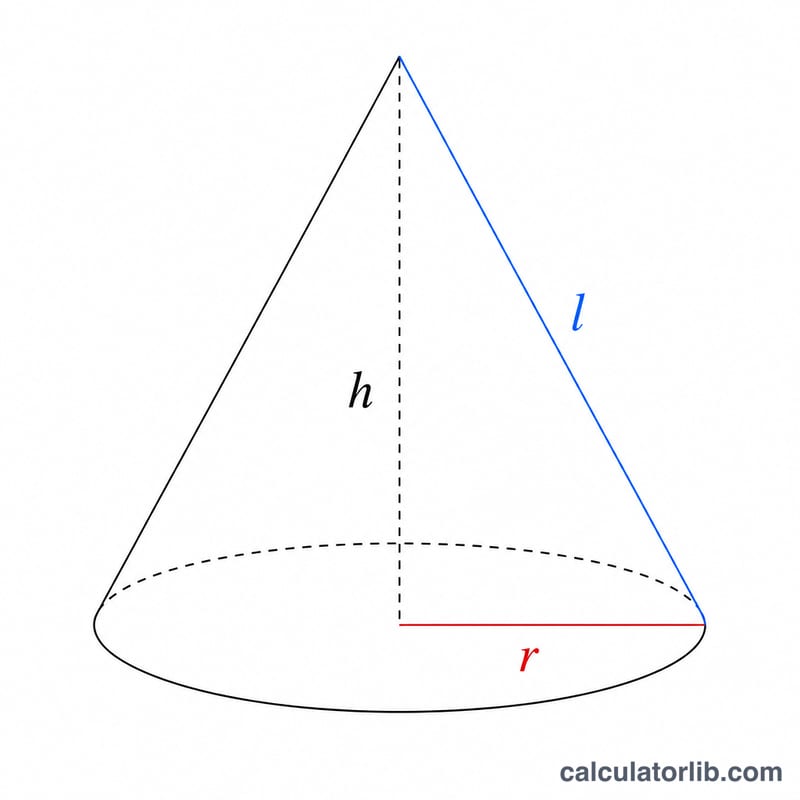
The slant height of a right circular cone is the straight-line distance from the apex (tip) to any point on the edge of the circular base. Unlike the vertical height, which runs straight down the center axis, the slant height runs along the outer surface. It is a key measurement when calculating the lateral (curved) surface area of a cone.
How to Use This Calculator
Enter the base radius (\(r\)) and the vertical height (\(h\)) of your cone in the same units. The calculator returns the slant height (\(l\)) instantly. Both values must be positive numbers. If you only know the diameter, divide it by two to get the radius first.
The Formula Explained
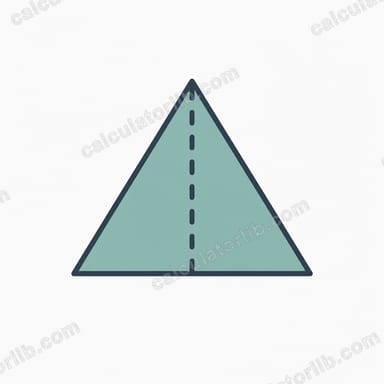
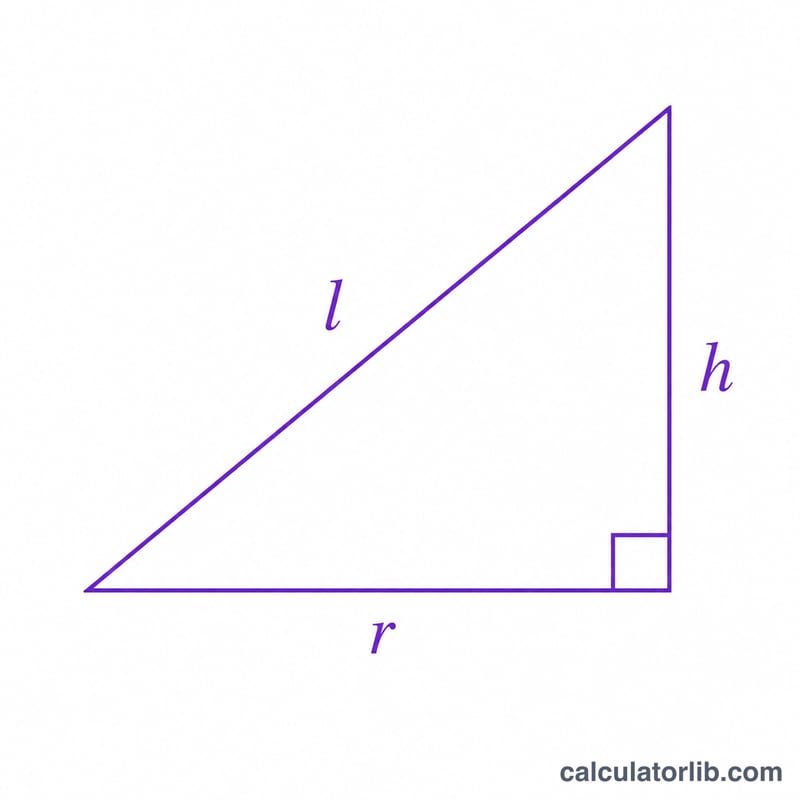
The radius, height, and slant height of a cone form a right triangle, with the slant height as the hypotenuse. By the Pythagorean theorem:
$$l = \sqrt{r^{2} + h^{2}}$$
Here \(r\) is the base radius, \(h\) is the perpendicular height from the base to the apex, and \(l\) is the slant height. Because it is derived purely from geometry, the formula works in any consistent unit of length.
Worked Example
Suppose a cone has a radius of 3 cm and a height of 4 cm. Then $$l = \sqrt{3^{2} + 4^{2}} = \sqrt{9 + 16} = \sqrt{25} = 5 \text{ cm}.$$ This is the familiar 3-4-5 right triangle, so the slant height is exactly 5 cm.
FAQ
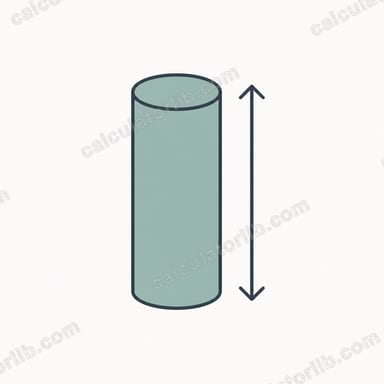
Is slant height the same as height? No. The vertical height is measured straight down the central axis, while the slant height runs along the surface from the tip to the base edge. The slant height is always longer than the vertical height.
What units should I use? Any unit works, as long as the radius and height use the same one. The result is in that same unit.
Can I find the radius if I know \(l\) and \(h\)? Yes — rearrange the formula: \(r = \sqrt{l^{2} - h^{2}}\).