
What is the Law of Sines?
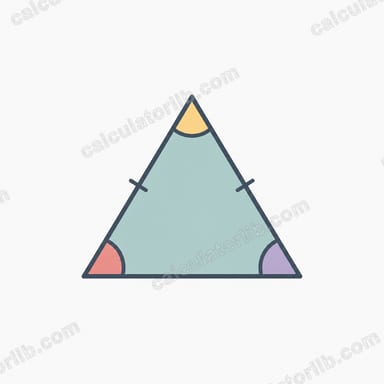
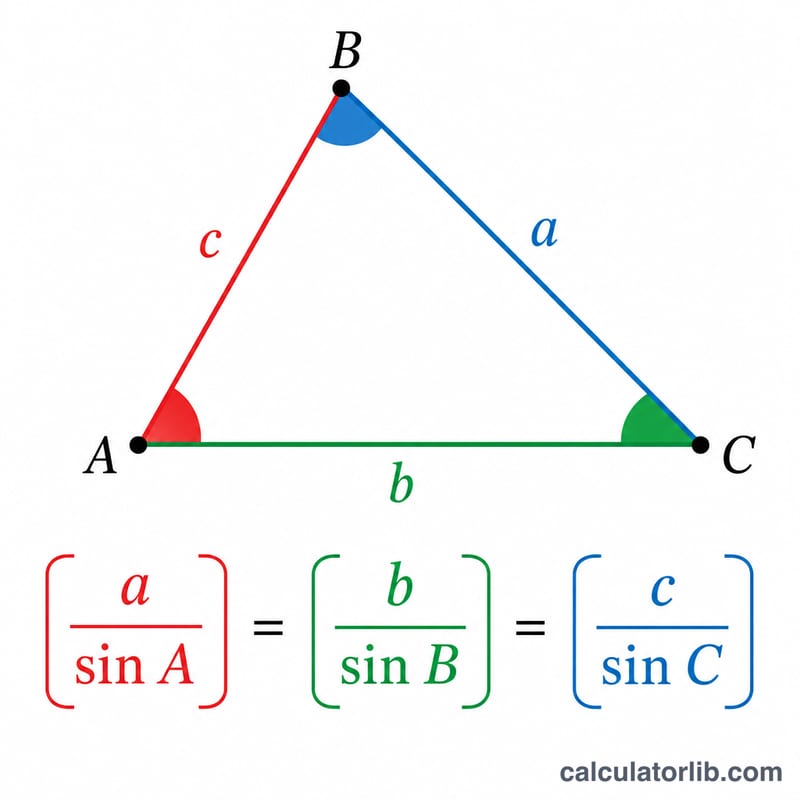
The Law of Sines relates the sides of any triangle to the sines of their opposite angles: the ratio of a side length to the sine of the angle across from it is the same for all three sides. It is one of the core tools of trigonometry for solving triangles that are not right-angled, and it works for acute, right and obtuse triangles alike.
How to use this calculator
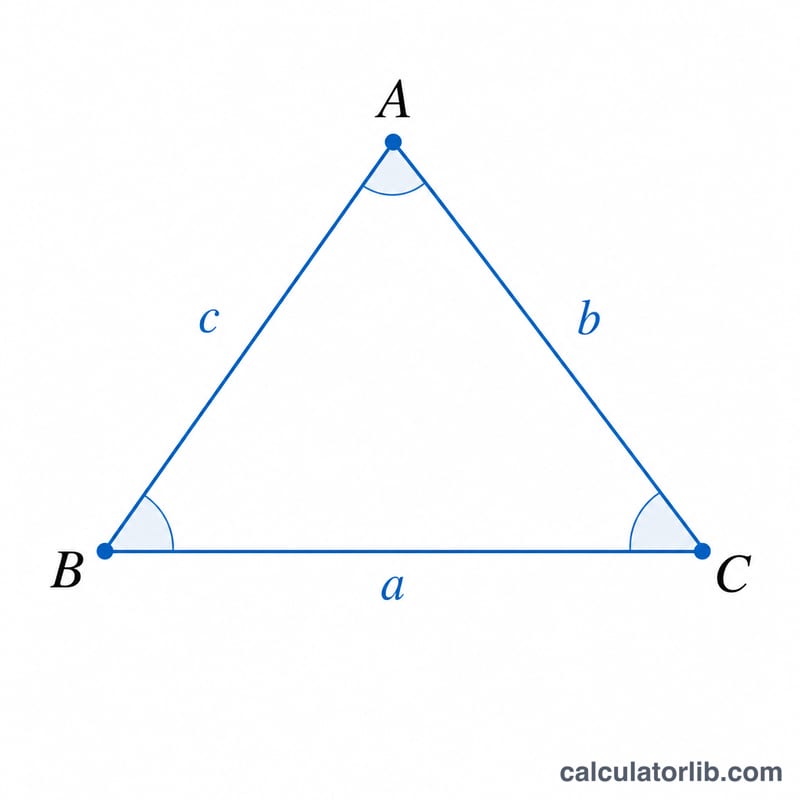
This solver uses the AAS/ASA case. Enter one known side (a) together with its opposite angle (A) and a second angle (B). The calculator first finds the third angle as \(C = 180^{\circ} - A - B\), then applies the Law of Sines to compute the remaining sides b and c. It also reports the perimeter and the area of the triangle.
The formula explained
Starting from $$\frac{a}{\sin A} = \frac{b}{\sin B} = \frac{c}{\sin C},$$ divide the known side by the sine of its opposite angle to get the common ratio \(k = a / \sin A\). Each unknown side is then that ratio times the sine of its own opposite angle: \(b = k \cdot \sin B\) and \(c = k \cdot \sin C\). The area is computed with \(\tfrac{1}{2} \cdot a \cdot b \cdot \sin C\).
Worked example
Suppose \(a = 10\), \(A = 40^{\circ}\) and \(B = 60^{\circ}\). Then $$C = 180 - 40 - 60 = 80^{\circ}.$$ The ratio $$k = \frac{10}{\sin 40^{\circ}} \approx \frac{10}{0.642788} \approx 15.5572.$$ So $$b = 15.5572 \times \sin 60^{\circ} \approx 13.4730$$ and $$c = 15.5572 \times \sin 80^{\circ} \approx 15.3209.$$ The perimeter is about 38.79 and the area about 66.34 square units.
FAQ
What triangle cases does this handle? It handles the AAS and ASA cases — when you know two angles and one side. For SSA (two sides and a non-included angle) the ambiguous case may apply.
Why must the angles be less than 180° together? Because the three interior angles of a triangle always sum to exactly 180°, so \(A + B\) must be under 180° for a valid triangle.
Are inputs in degrees or radians? Enter angles in degrees; the calculator converts internally to radians for the trigonometric functions.