
What is the Law of Sines?
The Law of Sines states that in any triangle the ratio of a side's length to the sine of its opposite angle is the same for all three sides. This calculator uses that relationship to find one unknown side when you already know another side and two relevant angles. It works for any triangle — acute, right, or obtuse — and is a core tool in trigonometry, surveying, navigation, and engineering.
How to use this calculator
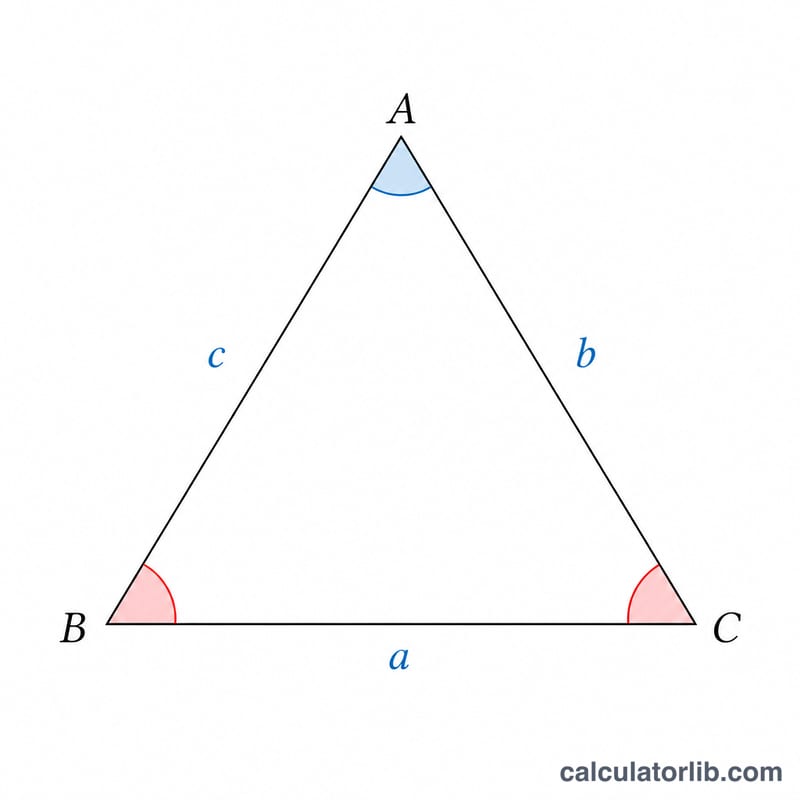
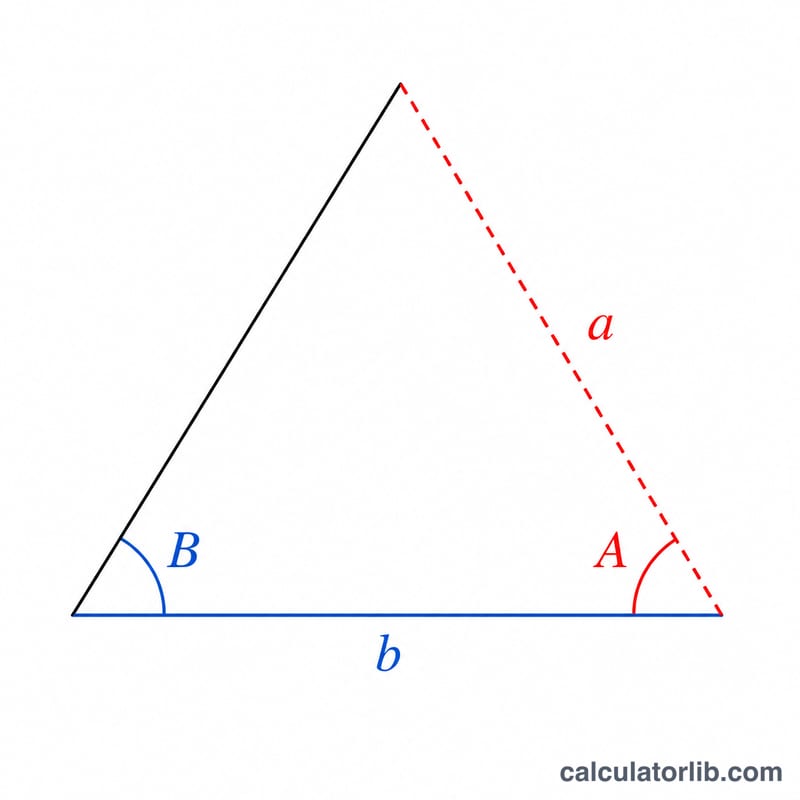
Enter the length of a known side b, the angle B that sits opposite that known side, and the angle A that sits opposite the side you want to find. The calculator returns side a. Make sure each angle you enter is truly opposite the matching side, and that all angles are in degrees.
The formula explained
Starting from the proportion \( a / \sin(A) = b / \sin(B) \), we multiply both sides by sin(A) to isolate the unknown side: $$a = b \cdot \frac{\sin\!\left(A\right)}{\sin\!\left(B\right)}$$ Internally the calculator converts each angle from degrees to radians before taking the sine.
Worked example
Suppose b = 10, angle B = 30°, and angle A = 45°. Then \( \sin(45°) \approx 0.70711 \) and \( \sin(30°) = 0.5 \). So $$a = 10 \times \frac{0.70711}{0.5} = \frac{7.0711}{0.5} = \mathbf{14.142}$$ The missing side is about 14.14 units.
FAQ
Do the three angles need to add to 180°? You only enter two angles here. As long as A and B are valid interior angles (and \( A + B < 180° \)), the result is geometrically consistent.
Can I use radians? No — enter angles in degrees; the tool converts internally.
Why might I get an error or zero? If angle B is 0° (or 180°), sin(B) is zero and division is undefined, so no finite side exists.