
What is the SSA Triangle Case?
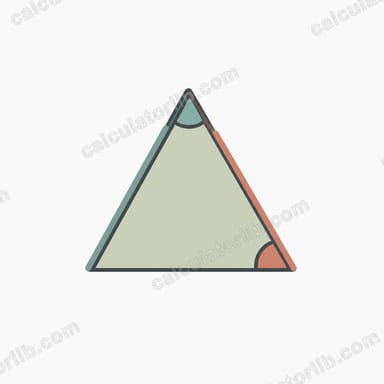
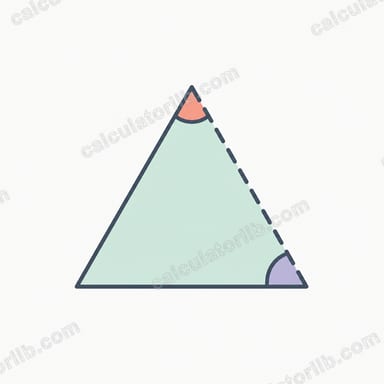
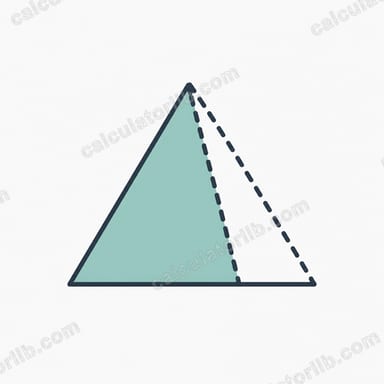
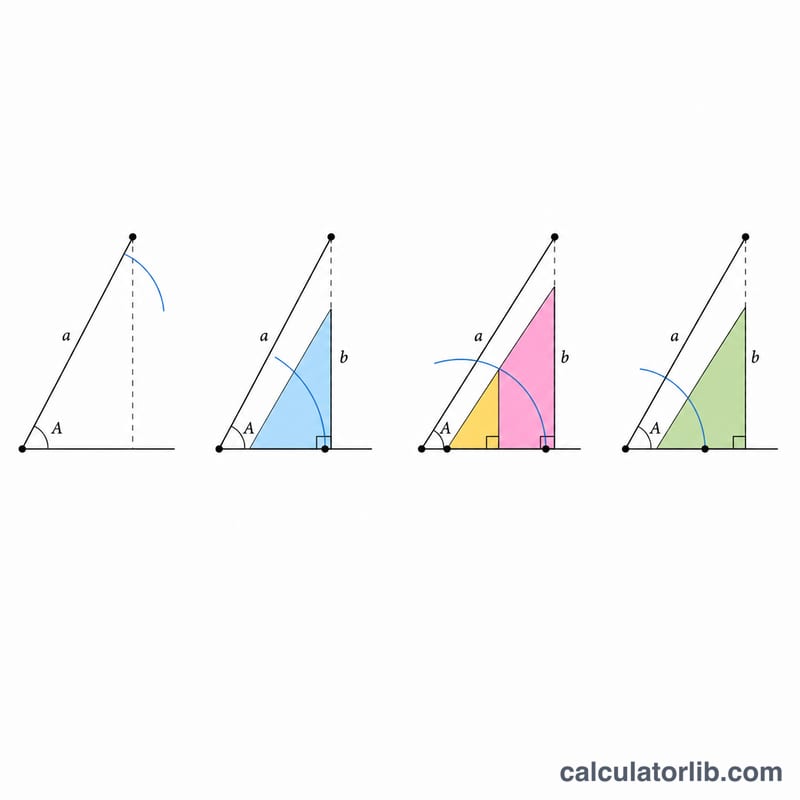
The SSA (side-side-angle) case arises when you know two sides of a triangle and an angle that is not between them. This calculator uses the Law of Sines to solve for the unknown angle B, the third angle C, and the third side c. SSA is famous as the "ambiguous case" because the given data can correspond to zero, one, or two distinct triangles.
How to use it
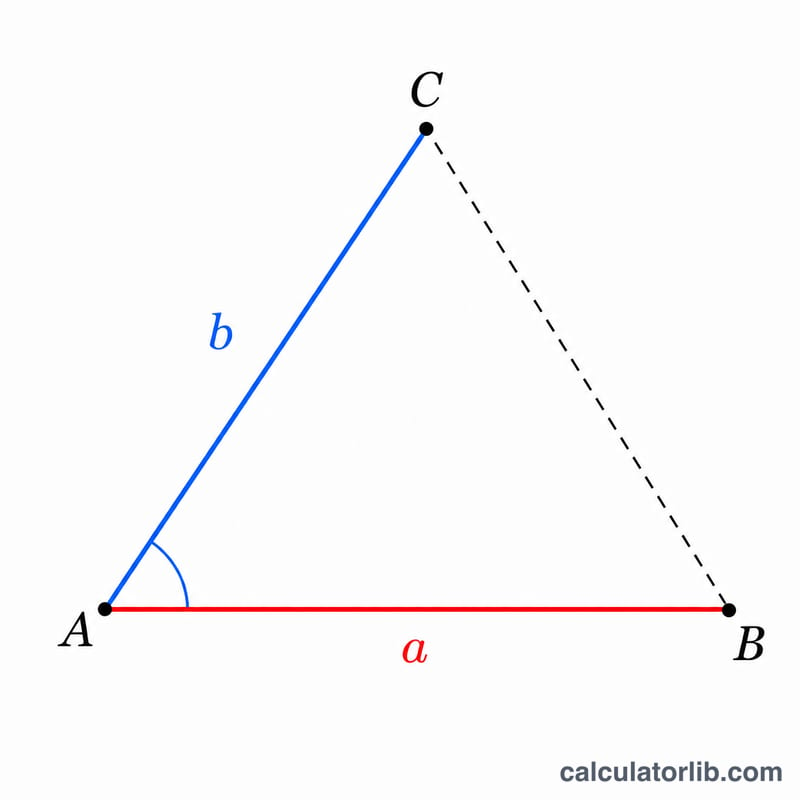
Enter side a (the side opposite the known angle A), the angle A in degrees, and side b. The calculator computes sin(B), the acute value of B, then C and c. It also reports how many valid triangles the inputs produce.
The formula explained
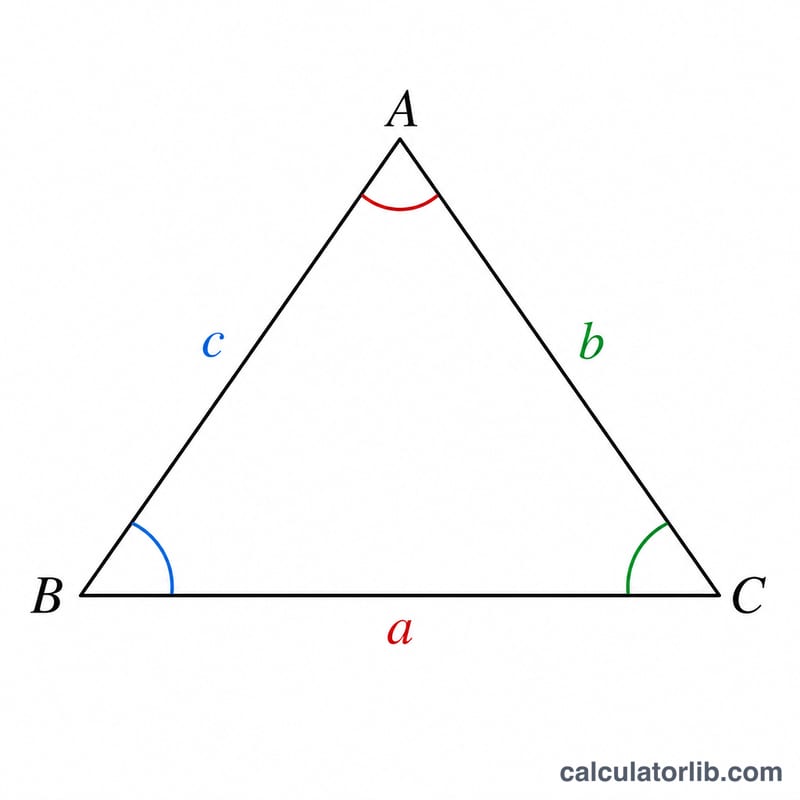
By the Law of Sines, \(\frac{\sin B}{b} = \frac{\sin A}{a}\), so $$\sin B = \frac{\text{Side }b \cdot \sin\!\left(\text{Angle }A\right)}{\text{Side }a}$$ If this value exceeds 1 there is no triangle. Otherwise \(B = \arcsin(\dots)\), \(C = 180^{\circ} - A - B\), and $$c = \frac{\text{Side }a \cdot \sin C}{\sin\!\left(\text{Angle }A\right)}$$ A second triangle (using \(B' = 180^{\circ} - B\)) exists whenever \(a < b\) and \(A + B' < 180^{\circ}\).
Worked example
With \(a = 7\), \(A = 40^{\circ}\), \(b = 5\): $$\sin B = \frac{5 \cdot \sin(40^{\circ})}{7} = \frac{5 \cdot 0.6428}{7} \approx 0.4591$$ so \(B \approx 27.33^{\circ}\), \(C \approx 112.67^{\circ}\), and $$c = \frac{7 \cdot \sin(112.67^{\circ})}{\sin(40^{\circ})} \approx 10.04$$ Because \(a > b\) here, only the acute B gives a valid triangle — wait, since \(a > b\) only one triangle results.
FAQ
Why "ambiguous"? Two different triangles can share the same a, A, and b when the side opposite the known angle is shorter than the other given side.
When are there two triangles? When \(a < b\) yet \(b \cdot \sin(A) < a\), both an acute and an obtuse B satisfy the equation.
What if \(\sin(B) > 1\)? No triangle exists — the given side a is too short to reach side b.