
What This Calculator Does
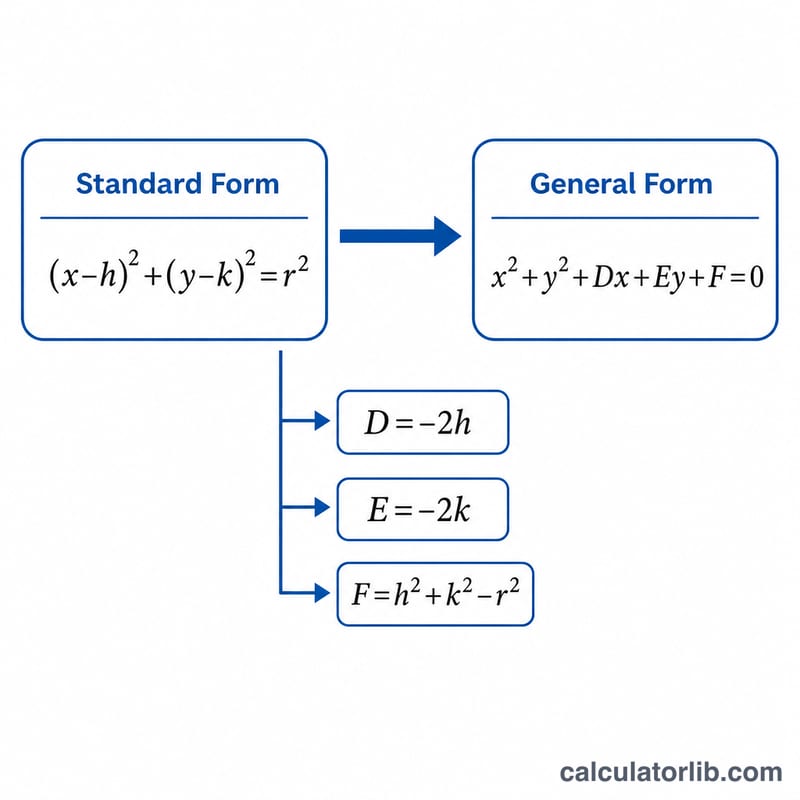
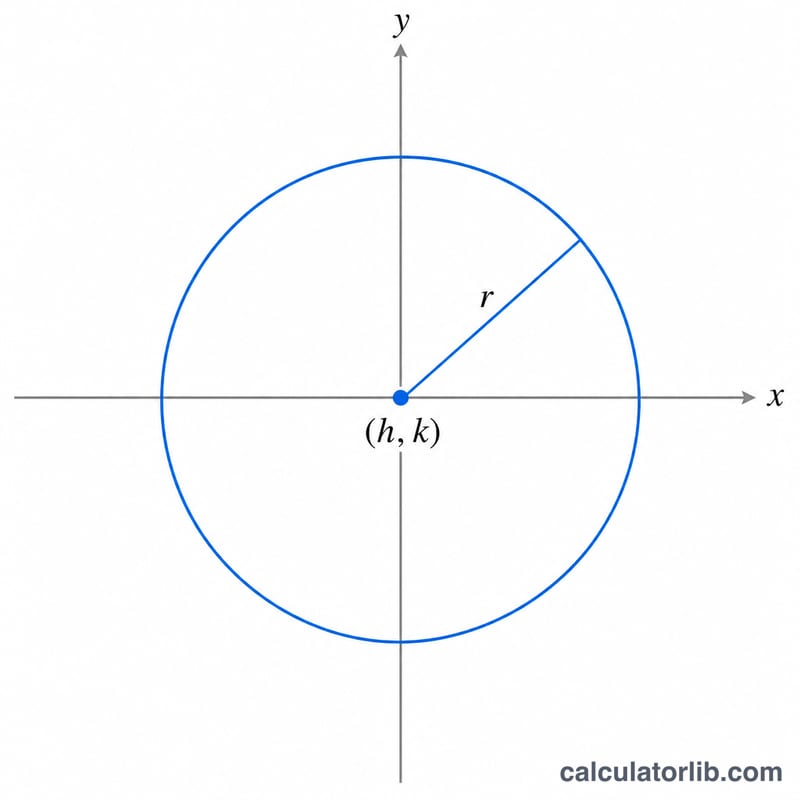
A circle can be written two ways. The standard form (or center-radius form) is \((x - h)^2 + (y - k)^2 = r^2\), which shows the center \((h, k)\) and radius \(r\) directly. The general form is \(x^2 + y^2 + Dx + Ey + F = 0\), where the structure is hidden inside three coefficients. This tool converts standard form to general form by computing \(D\), \(E\), and \(F\) from the center and radius you provide.
How to Use It
Enter the center coordinates \(h\) and \(k\), then the radius \(r\). The calculator outputs the full general-form equation along with each coefficient. Values may be positive, negative, or zero, and decimals are supported.
The Formula Explained
Expanding the standard form gives the relations used here:
$$D = -2h, \quad E = -2k, \quad F = h^2 + k^2 - r^2.$$
Substituting these back into \(x^2 + y^2 + Dx + Ey + F = 0\) reproduces \((x - h)^2 + (y - k)^2 = r^2\) exactly, so the conversion is exact and reversible.
Worked Example
Suppose the center is \((2, 3)\) and the radius is \(5\). Then \(D = -2(2) = -4\), \(E = -2(3) = -6\), and $$F = 2^2 + 3^2 - 5^2 = 4 + 9 - 25 = -12.$$ The general form is $$x^2 + y^2 - 4x - 6y - 12 = 0.$$
FAQ
Can the radius be zero? A radius of 0 describes a single point (a degenerate circle); the formula still works, giving \(F = h^2 + k^2\).
Why is F sometimes negative? \(F = h^2 + k^2 - r^2\). When the radius is large relative to the center distance from the origin, \(F\) becomes negative — that is normal.
How do I go back to standard form? Use \(h = -D/2\), \(k = -E/2\), and \(r = \sqrt{h^2 + k^2 - F}\).