
What this calculator does
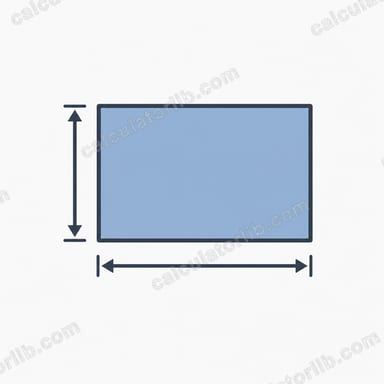
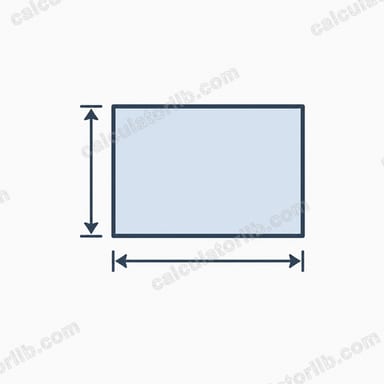
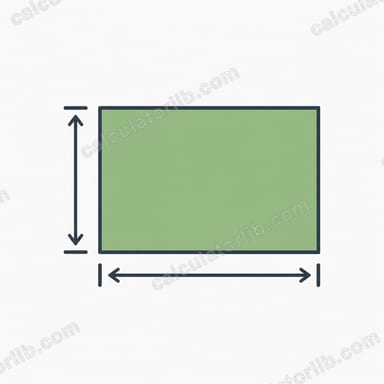
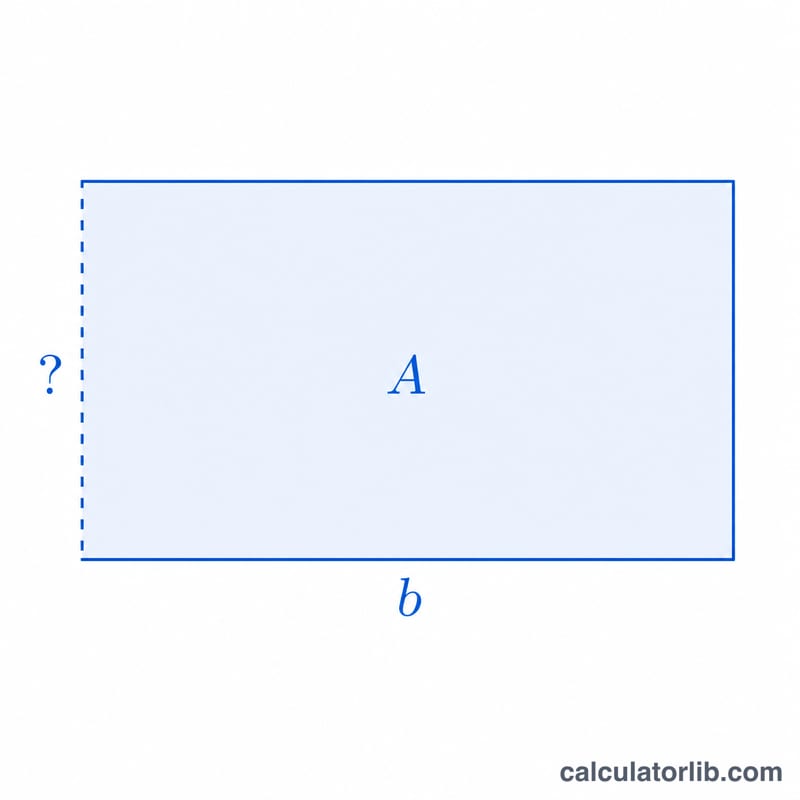
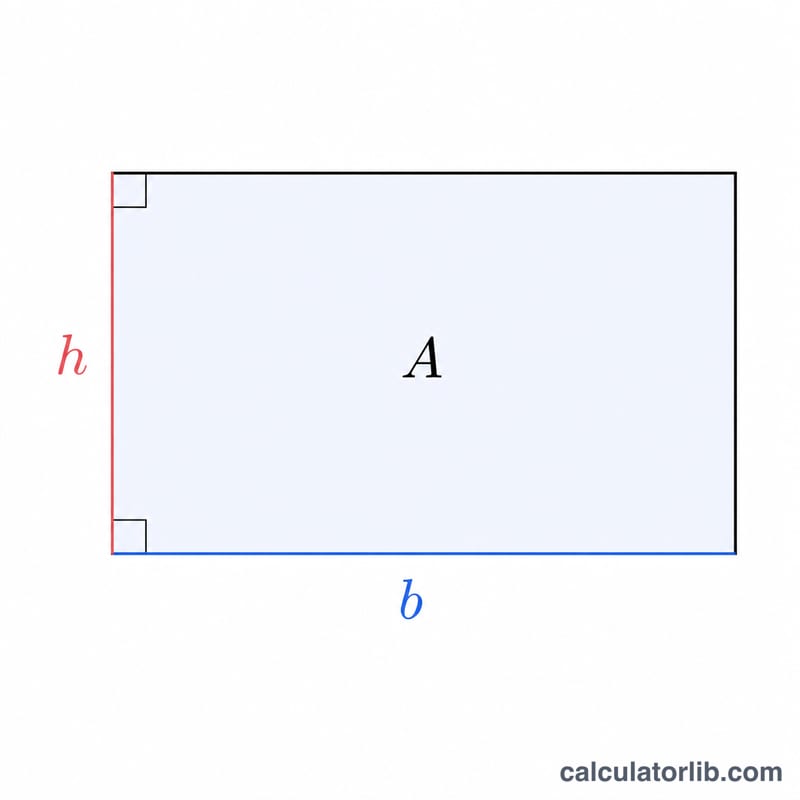
The area of a rectangle is the product of its two sides: \(A = \text{length} \times \text{width}\). If you already know the area and just one of the sides, you can recover the other side by simple division. This tool does that for you and also returns the full perimeter, so you instantly know all four edges.
How to use it
Enter the rectangle's area in the first box and the side length you already know in the second box. The calculator returns the missing side using \(\text{missing side} = \text{area} \div \text{known side}\), then computes the perimeter as twice the sum of the two sides. Use consistent units throughout — if the area is in square metres and the known side is in metres, the missing side comes out in metres.
The formula explained
Because a rectangle's area is \(A = a \times b\), dividing both sides by the known side \(a\) isolates the unknown side: $$b = \frac{A}{a}$$ Once both sides are available, the perimeter is \(P = 2(a + b)\). The known side must be greater than zero, since dividing by zero is undefined.
Worked example
Suppose a rectangular garden has an area of 48 m² and one side measures 6 m. The missing side is $$48 \div 6 = \mathbf{8 \text{ m}}$$ The perimeter is $$2 \times (6 + 8) = \mathbf{28 \text{ m}}$$ That tells you exactly how much fencing you would need.
FAQ
What units should I use? Any units work as long as they are consistent. If area is in cm² and the side is in cm, the result is in cm.
What if I only know the area? You can't find a unique side from area alone — a rectangle of area 48 could be \(6 \times 8\), \(4 \times 12\), \(2 \times 24\) and so on. You need one side to pin down the other.
Does this work for squares? Yes. For a square, every side equals the square root of the area, so entering a known side equal to \(\sqrt{A}\) returns the same value.