
What is the Arctangent Calculator?
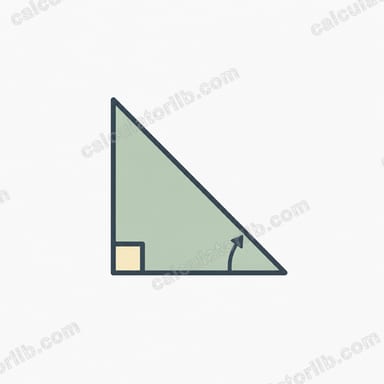
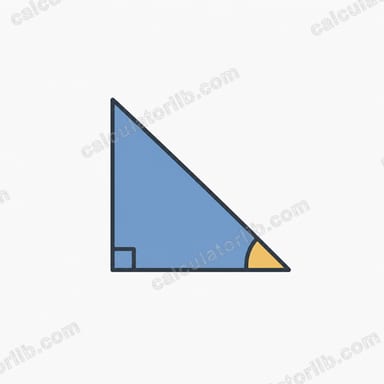
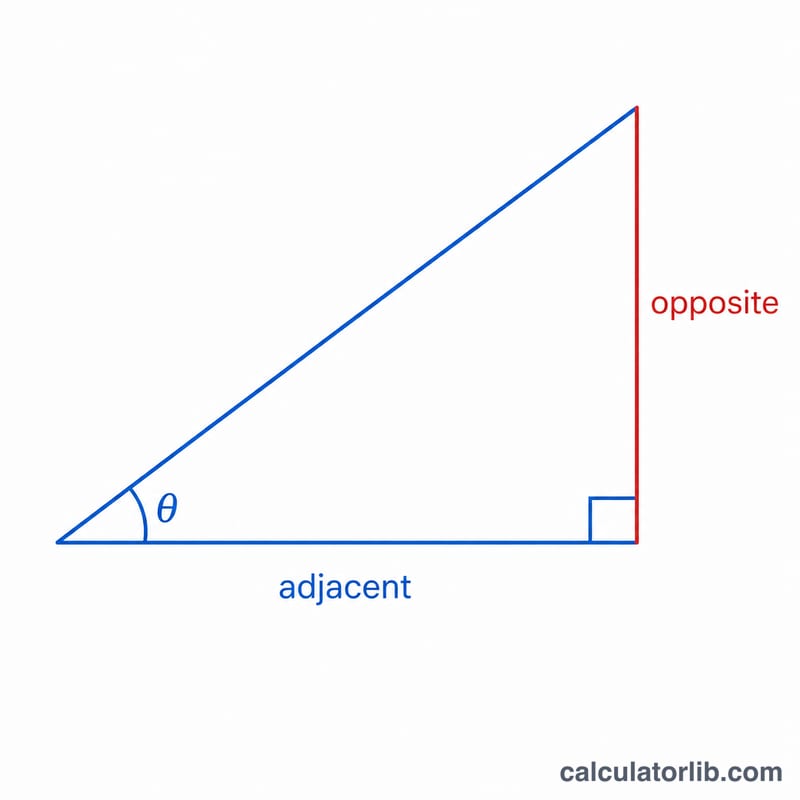
The arctangent (arctan or tan⁻¹) calculator finds the angle of a right triangle when you know the lengths of the side opposite the angle and the side adjacent to it. Because the tangent of an angle equals opposite divided by adjacent, the inverse operation — arctangent — recovers the angle itself. This is a universal mathematical tool, useful in trigonometry, geometry, surveying, engineering, navigation, and computer graphics.
How to use it
Enter the length of the opposite side (the side across from the angle you want) and the adjacent side (the side next to the angle, not the hypotenuse). The calculator returns the angle θ in both degrees and radians. The lengths can be in any consistent unit since only their ratio matters.
The formula explained
The core relationship is $$\theta = \arctan\!\left(\frac{\text{Opposite}}{\text{Adjacent}}\right)$$ The calculator uses the two-argument arctangent (atan2) internally so it handles the case where adjacent is zero — giving a clean 90° — and returns angles in the correct quadrant. The radian value is then converted to degrees with $$\theta° = \theta_{rad} \times \frac{180}{\pi}$$
Worked example
Suppose a ramp rises 3 metres over a horizontal run of 4 metres. Here opposite = 3 and adjacent = 4, so $$\theta = \arctan\!\left(\frac{3}{4}\right) = \arctan(0.75) \approx 0.6435 \text{ radians} \approx 36.87°$$ The ramp therefore makes an angle of about 36.87 degrees with the ground.
Key Terms Explained
- Arctangent (tan⁻¹)
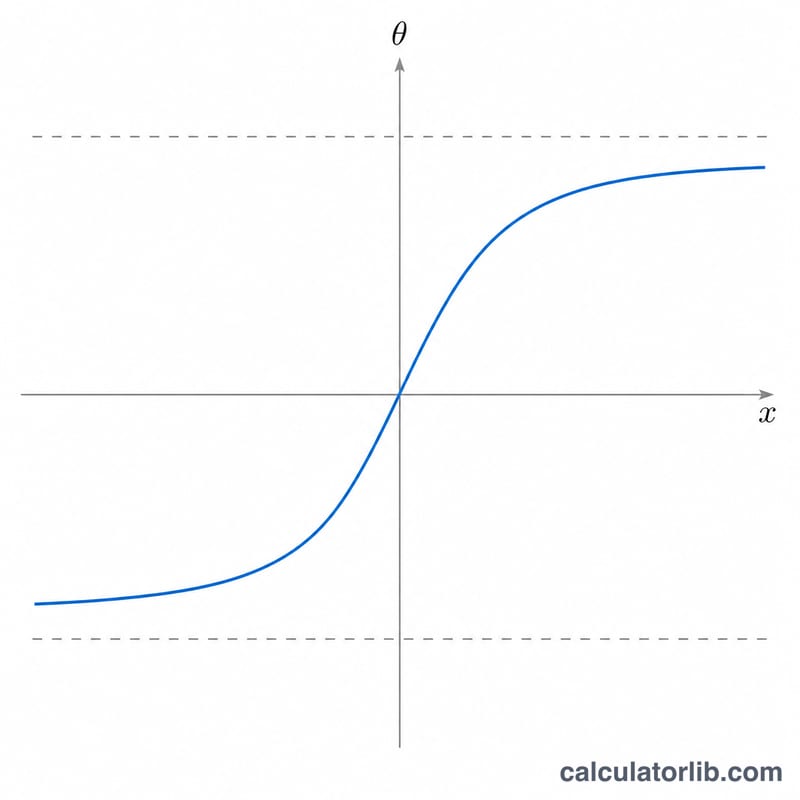
- The inverse of the tangent function. It takes a ratio and returns the angle whose tangent equals that ratio. Written \(\arctan(x)\) or \(\tan^{-1}(x)\); its principal output ranges from \(-90^\circ\) to \(+90^\circ\).
- Opposite side
- In a right triangle, the leg directly across from the angle of interest. It forms the numerator of the tangent ratio.
- Adjacent side
- The leg next to the angle of interest (other than the hypotenuse). It forms the denominator of the tangent ratio.
- Hypotenuse
- The longest side of a right triangle, opposite the 90° angle. It is not used by arctangent, but it appears in arcsine (opposite/hypotenuse) and arccosine (adjacent/hypotenuse).
- Tangent ratio
- For an angle \(\theta\), \(\tan\theta = \frac{\text{opposite}}{\text{adjacent}}\). Arctangent reverses this operation to find \(\theta\).
- Radian vs degree
- Two units for measuring angles. A full circle is \(360^\circ\) or \(2\pi\) radians, so \(1\text{ rad} = \frac{180}{\pi} \approx 57.2958^\circ\). Convert radians to degrees by multiplying by \(\frac{180}{\pi}\).
- atan2 (two-argument arctangent)
- A variant, \(\operatorname{atan2}(\text{opposite}, \text{adjacent})\), that takes the opposite and adjacent values separately rather than as a single ratio. By examining the signs of both arguments it returns angles across the full \(-180^\circ\) to \(+180^\circ\) range, correctly placing the angle in all four quadrants — something single-argument arctangent cannot do.
FAQ
What is the difference between tan and arctan? Tangent takes an angle and gives a ratio; arctangent takes the ratio and gives back the angle.
Why give both degrees and radians? Degrees are common in everyday and engineering work, while radians are standard in higher mathematics and programming.
What if adjacent is 0? The angle is exactly 90° (\(\pi/2\) radians), since the opposite side is then vertical relative to a zero-length base.