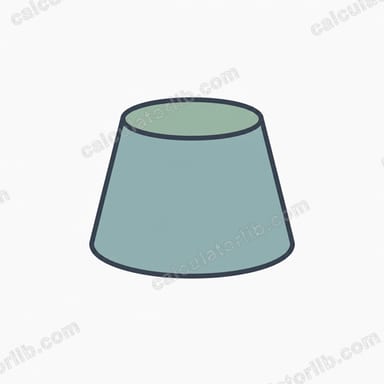

What is a square frustum?
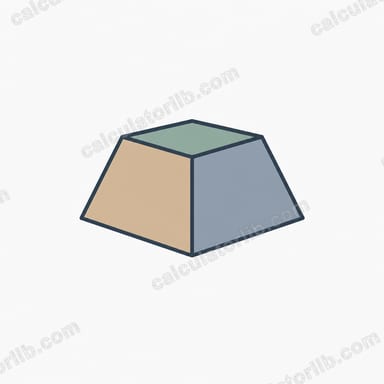
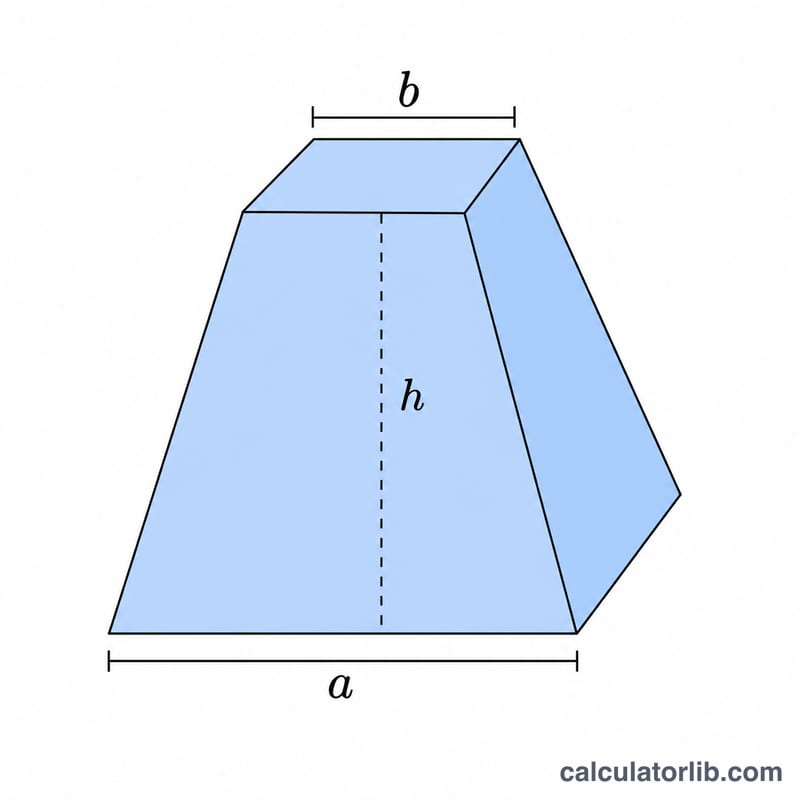
A square frustum, or truncated square pyramid, is what remains when you slice the top off a regular square pyramid with a cut parallel to its base. It has a square bottom face of side a, a smaller square top face of side b directly above and parallel to it, a perpendicular height h between the two faces, and four congruent isosceles-trapezoid side faces. This calculator works in any single consistent length unit, so volume comes out in that unit cubed and areas in that unit squared. The math is pure geometry and applies identically everywhere.
How to use it
Enter the bottom edge length a, the top edge length b (use 0 for a complete pyramid, or set b = a for a box), and the height h. All three must use the same unit. The tool returns the volume, the lateral (side) surface area of the four trapezoids, the total surface area including both square faces, and the slant height of a side face.
The formulas explained
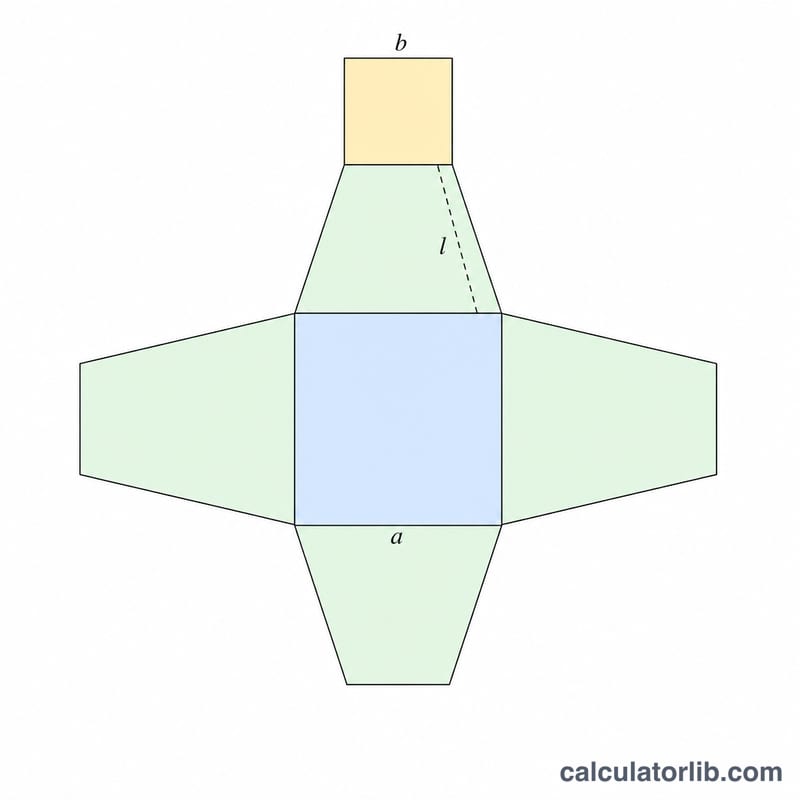
The volume uses the general prismatoid/frustum rule \(V = \frac{h}{3}\left(A_1 + A_2 + \sqrt{A_1 A_2}\right)\). For square faces \(A_1 = a^2\) and \(A_2 = b^2\), so $$V = \frac{h}{3}\left(a^2 + ab + b^2\right).$$ Each side face is a trapezoid of parallel sides \(a\) and \(b\) and a slant height $$\ell = \sqrt{h^2 + \left(\frac{a-b}{2}\right)^2}.$$ One trapezoid has area \(\frac{a+b}{2}\cdot \ell\), and four of them give the lateral area $$S_{\text{side}} = 2(a+b)\ell.$$ Adding both square faces gives the total surface area $$S = S_{\text{side}} + a^2 + b^2.$$
Worked example
Take \(a = 2\), \(b = 1\), \(h = 1\). $$\text{Volume} = \frac{1}{3}(4 + 2 + 1) = \frac{7}{3} \approx 2.33333.$$ $$\ell = \sqrt{1 + 0.25} = \sqrt{1.25} \approx 1.118034.$$ $$\text{Lateral area} = 2(3)(1.118034) \approx 6.708204.$$ $$\text{Total surface area} = 6.708204 + 4 + 1 \approx 11.708204.$$
FAQ
What if the top edge is 0? The frustum becomes a complete square pyramid: \(V = \frac{h\cdot a^2}{3}\) and \(S_{\text{side}} = 2a\cdot\sqrt{h^2 + \left(\frac{a}{2}\right)^2}\).
What if a equals b? The shape is a rectangular box (square prism): \(\ell = h\), \(V = a^2 h\), and \(S = 4ah + 2a^2\).
Do I need to pick units? No. Use any single length unit consistently; the output is simply in that unit cubed (volume) and squared (areas).