
What are the Fresnel integrals?
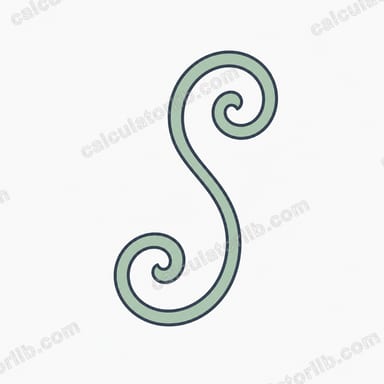
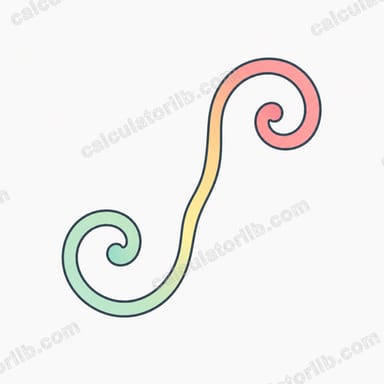
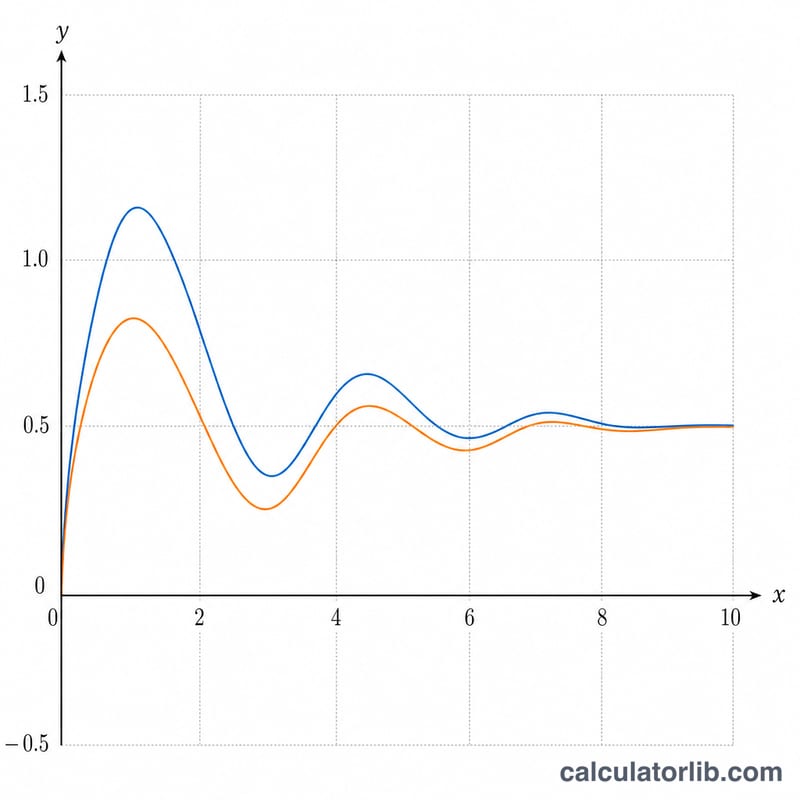
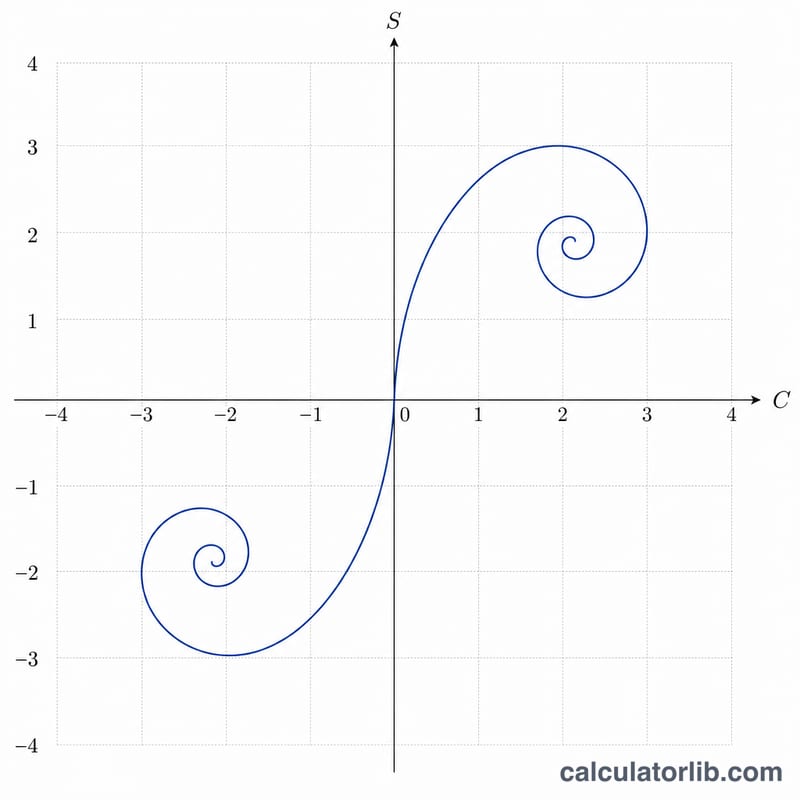
The Fresnel integrals \(S(x)\) and \(C(x)\) are special functions that appear throughout optics (near-field diffraction at edges and apertures), electromagnetics, and the design of highway and railway transition curves. Plotting \(C(x)\) on the horizontal axis against \(S(x)\) on the vertical axis traces the elegant Cornu (Euler) spiral. This calculator evaluates both integrals for any real argument \(x\).
The formula and conventions
This tool defaults to the normalized (pi/2) convention, the most widely used form:
$$S(x) = \int_{0}^{x} \sin\!\left(\frac{\pi}{2}\,t^{2}\right)dt, \qquad C(x) = \int_{0}^{x} \cos\!\left(\frac{\pi}{2}\,t^{2}\right)dt$$
An unnormalized option replaces the integrand argument \(\frac{\pi}{2}t^{2}\) with simply \(t^{2}\):
$$S(x) = \int_{0}^{x} \sin\!\left(t^{2}\right)dt, \qquad C(x) = \int_{0}^{x} \cos\!\left(t^{2}\right)dt$$
Both functions are odd: \(S(-x) = -S(x)\) and \(C(-x) = -C(x)\). As \(x\) tends to \(+\infty\), both \(S\) and \(C\) approach \(1/2\).
How to use it
Enter your value of \(x\), pick the convention, and read off \(S(x)\) and \(C(x)\) to several significant digits. For \(x = 0\) both integrals are exactly \(0\). Negative arguments use the oddness property automatically.
How it is computed
No elementary closed form exists, so the calculator uses composite Simpson's rule on the interval \([0, |x|]\) with a fine grid (at least 1000 subintervals, scaling with \(|x|\) to track the increasingly rapid oscillation). The sign of \(x\) is applied afterward because the integrands are odd. This reproduces published reference values to roughly six decimal places for moderate \(|x|\).
Worked example
For \(x = 1\) in the normalized convention: \(C(1) = \int_{0}^{1} \cos\!\left(\frac{\pi}{2}t^{2}\right)dt\) is about \(0.7798934\), and \(S(1)\) is about \(0.4382591\). At \(x = 2\), \(C(2)\) is about \(0.488253\) and \(S(2)\) is about \(0.343416\).
FAQ
Which convention should I use? Most physics and engineering texts (and diffraction tables) use the normalized \(\pi/2\) form, which is the default here.
What is the Cornu spiral? It is the parametric curve \((C(x), S(x))\); it spirals toward the points \((1/2, 1/2)\) and \((-1/2, -1/2)\) as \(x\) grows large.
How accurate is the result? Simpson's rule with the chosen grid typically matches reference tables to about six decimal digits for \(|x|\) up to roughly \(6\).