
What this calculator does
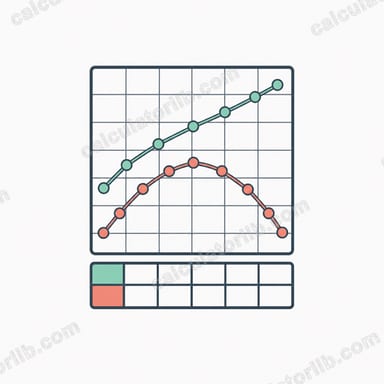
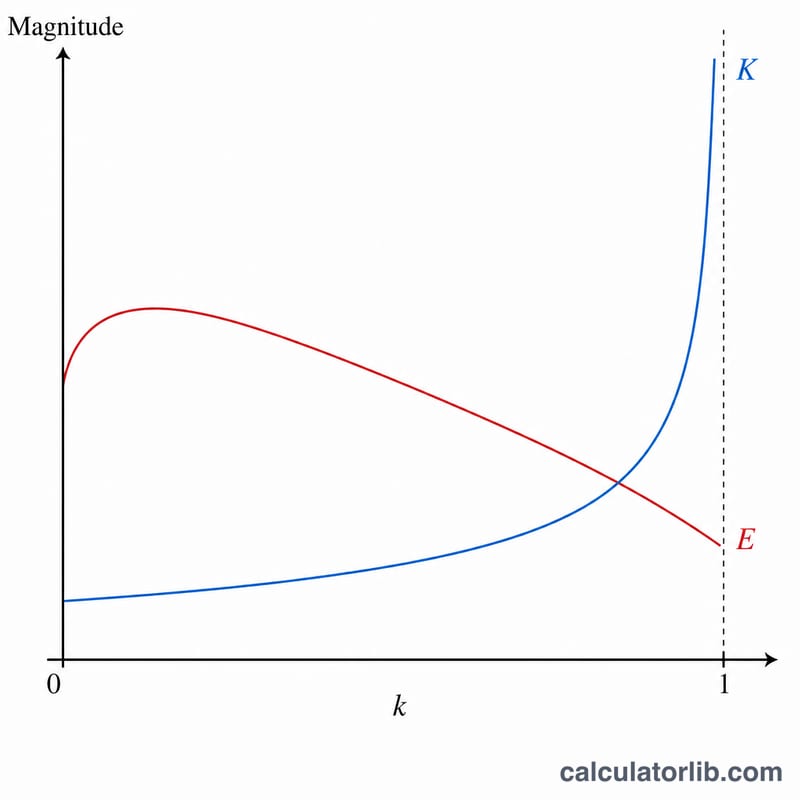
This tool builds a table of the two complete elliptic integrals: \(K(k)\), the first kind, and \(E(k)\), the second kind, evaluated over a sequence of modulus values \(k\). You give a starting value, a step size, and how many rows you want; the calculator marches \(k\) from the initial value, adding the step each row, and reports \(K(k)\) and \(E(k)\) for every row. This is pure mathematics (special functions) and applies identically everywhere.
How to use it
Enter the initial value of k (the modulus, a pure ratio with \(-1 \le k \le 1\)), the increment added to \(k\) each row (it may be negative), and the number of repetitions (rows, an integer \(\ge 1\)). For example, initial 0, step 0.02, 51 rows sweeps \(k\) from 0.00 to 1.00. The integrals depend only on \(k\) squared, so negative \(k\) gives the same values as positive \(k\).
The formula explained
The argument here is the modulus k, not the parameter \(m = k^2\). In integral form, \(K(k)\) is the integral from 0 to \(\pi/2\) of \(d\theta / \sqrt{1 - k^2 \sin^2\theta}\), and \(E(k)\) is the integral of \(\sqrt{1 - k^2 \sin^2\theta}\; d\theta\) over the same range.
$$K(k_i) = \int_{0}^{\pi/2} \frac{d\theta}{\sqrt{1 - k_i^2 \sin^2\theta}}, \qquad E(k_i) = \int_{0}^{\pi/2} \sqrt{1 - k_i^2 \sin^2\theta}\; d\theta$$We evaluate them with the fast, high-precision Arithmetic-Geometric Mean (AGM):
$$K(k) = \frac{\pi}{2 \cdot \text{AGM}(1, \sqrt{1 - k^2})}$$For \(E\) we accumulate the AGM c-terms:
$$E(k) = K(k) \cdot \left(1 - \sum 2^{n-1} c_n^2\right) \quad \text{with } c_0^2 = k^2$$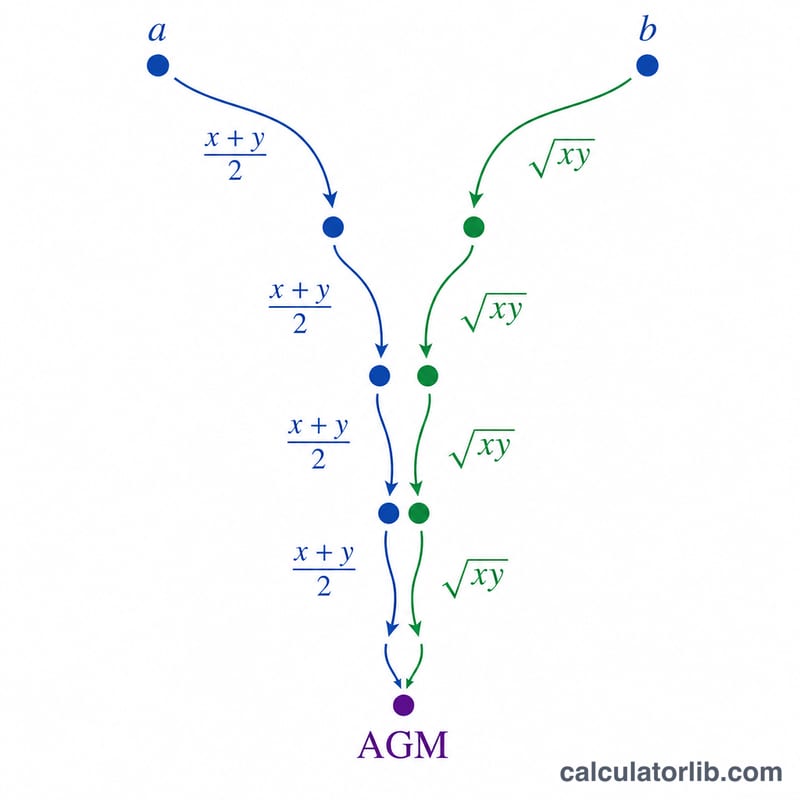
Worked example
For \(k = 0.5\): \(1 - k^2 = 0.75\), \(\sqrt{0.75} = 0.8660254\). \(\text{AGM}(1, 0.8660254) \approx 0.9318082\), so
$$K(0.5) = \frac{\pi}{2 \cdot 0.9318082} = 1.6857503548$$The c-term sum is \(\approx 0.1339804\), giving
$$E(0.5) = 1.6857503548 \cdot (1 - 0.1339804) = 1.4603362889$$FAQ
What happens at k = 1? \(K(1)\) diverges to infinity; \(E(1) = 1\) exactly. The table shows "Infinity" for \(K\) and 1 for \(E\) at the edge rather than crashing.
Does the calculator use k or m? It uses the modulus \(k\). If you have the parameter \(m\), take its square root (\(k = \sqrt{m}\)) before entering.
What about |k| > 1? That is outside the real domain \(-1 \le k \le 1\); such rows are flagged as out of domain.