
What is the complex conjugate?
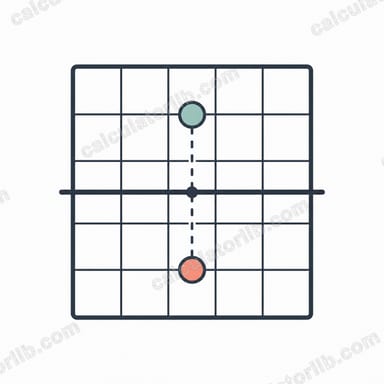
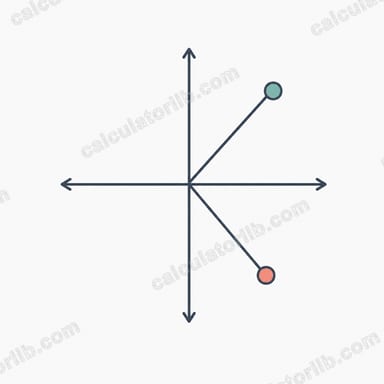
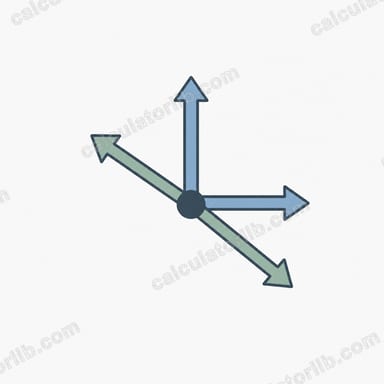
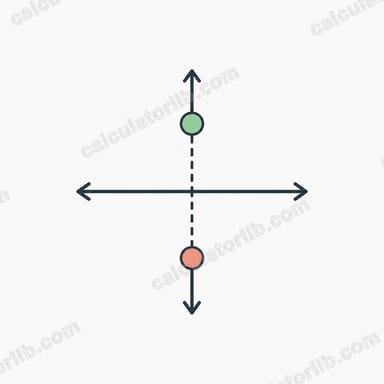
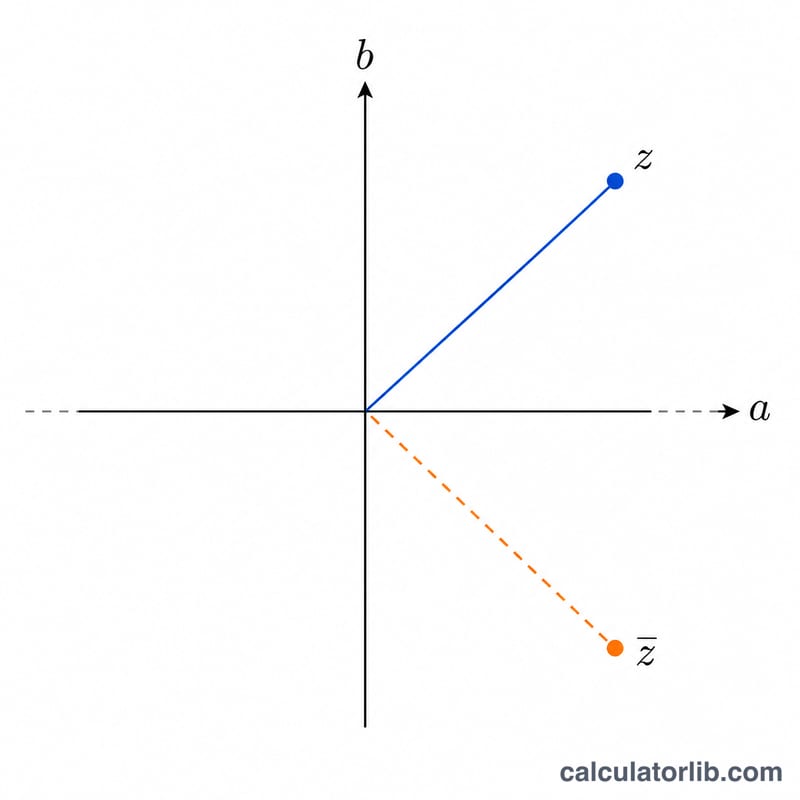
The complex conjugate of a number written in rectangular form \(z = a + bi\) is obtained by flipping the sign of its imaginary part: \(\overline{z} = a - bi\). The real part stays the same while the imaginary part is negated. Geometrically, the conjugate is the reflection of the point across the real (horizontal) axis of the complex plane.
How to use this calculator
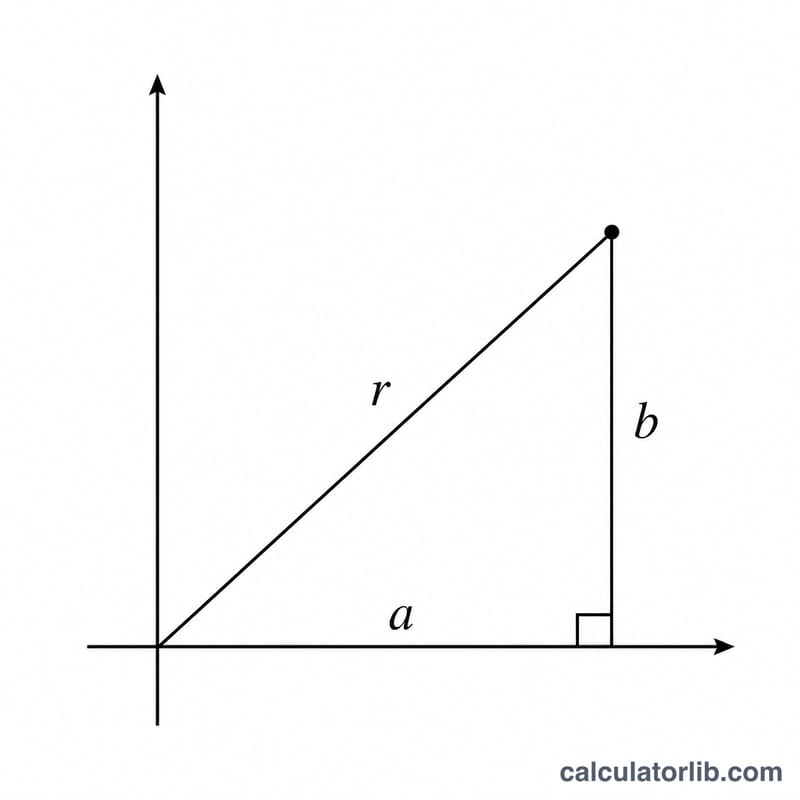
Enter the real part a and the imaginary part b of your complex number, then read off the conjugate. Both values may be positive, negative, or zero, and decimals are supported. The calculator also reports the modulus \(|z| = \sqrt{a^{2} + b^{2}}\), which is unchanged by conjugation.
The formula explained
If \(z = a + bi\), then its conjugate is $$\overline{z} = a - bi$$ A key identity is that \(z \cdot \overline{z} = a^{2} + b^{2}\), a real, non-negative number — this is why conjugates are used to rationalize denominators and to compute the modulus. Conjugation also distributes over addition and multiplication: \(\overline{z + w} = \overline{z} + \overline{w}\).
Worked example
Take \(z = 3 + 4i\). The conjugate negates the imaginary part, giving \(\overline{z} = 3 - 4i\). The modulus is $$\sqrt{3^{2} + 4^{2}} = \sqrt{9 + 16} = \sqrt{25} = 5$$ Notice the modulus of \(z\) and \(\overline{z}\) are identical.
FAQ
What is the conjugate of a real number? If \(b = 0\) the number equals its own conjugate, since there is no imaginary part to flip.
What is the conjugate of a purely imaginary number? For \(z = bi\) the conjugate is \(-bi\), the reflection across the real axis.
Does conjugation change the magnitude? No. \(|z| = |\overline{z}|\) always, because squaring eliminates the sign of \(b\).