
What is a complex fraction?
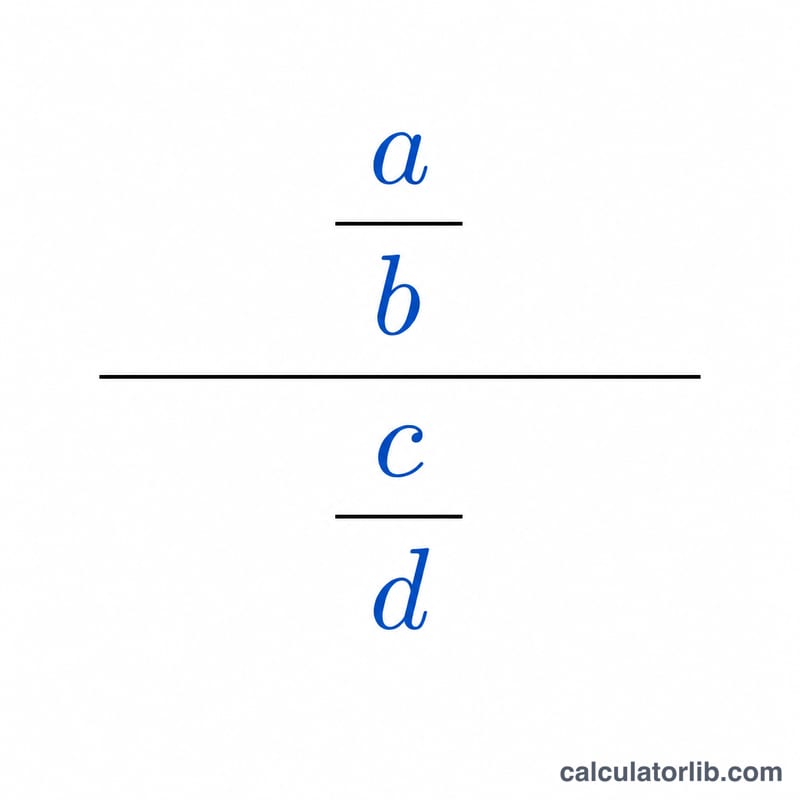
A complex fraction is a fraction whose numerator, denominator, or both are themselves fractions, mixed numbers, or integers. For example, the expression with a top of "5 1/3" over a bottom of "-6/15" is a single complex fraction. This calculator evaluates two complex fractions, performs one arithmetic operation between them (add, subtract, multiply, or divide), and returns the result reduced to lowest terms as a fraction or mixed number.
How to use it
Enter the numerator and denominator of each complex fraction. Each box accepts an integer (e.g. "7"), a simple fraction (e.g. "-6/15"), or a mixed number written with a space (e.g. "5 1/3" or "-1 1/5"). Pick the operator between the two complex fractions and submit. The calculator converts every mixed number to an improper fraction, divides each top by its bottom to get a single simple fraction, applies the chosen operation using exact integer arithmetic, and reduces the final answer with the greatest common divisor.
The formula explained
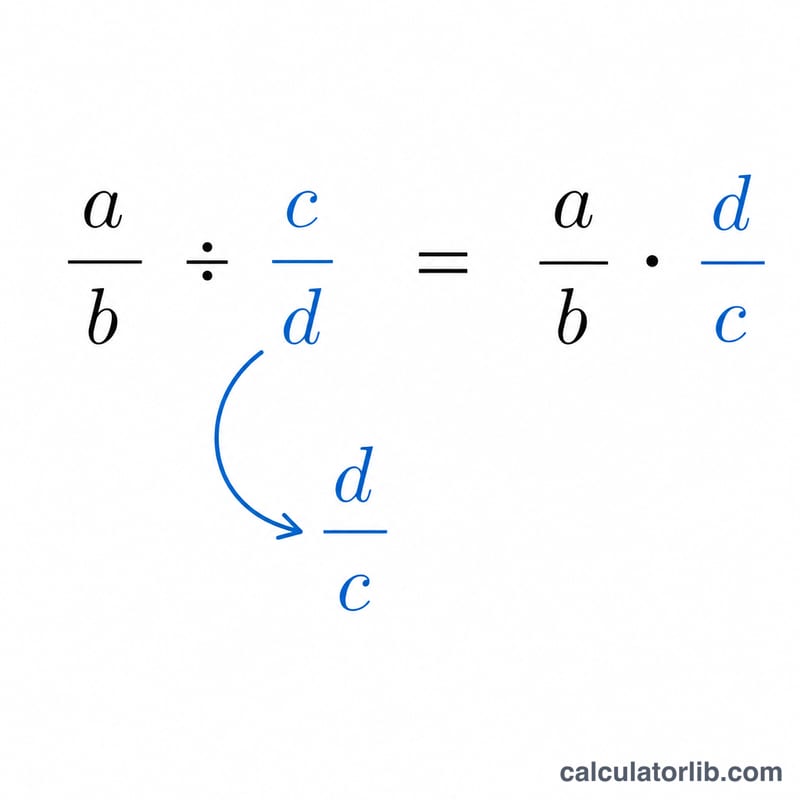
Each complex fraction equals its top divided by its bottom: dividing fractions means multiplying by the reciprocal, so \(\frac{p_1/q_1}{p_2/q_2} = \frac{p_1 q_2}{q_1 p_2}\). Once both complex fractions become simple fractions \(A/B\) and \(C/D\), addition and subtraction use a common denominator: $$\frac{A}{B} \pm \frac{C}{D} = \frac{A D \pm C B}{B D}.$$ Multiplication is \(\frac{A \cdot C}{B \cdot D}\) and division is \(\frac{A \cdot D}{B \cdot C}\). The result is then put in lowest terms.
Worked example
Top1 "5 1/3" = \(\frac{16}{3}\) and bottom1 "-6/15" gives complex fraction 1 = \(\frac{16}{3} \div \left(-\frac{6}{15}\right) = -\frac{40}{3}\). Top2 "7/3" and bottom2 "-1 1/5" = \(-\frac{6}{5}\) gives complex fraction 2 = \(\frac{7}{3} \div \left(-\frac{6}{5}\right) = -\frac{35}{18}\). Adding: $$-\frac{40}{3} + \left(-\frac{35}{18}\right) = -\frac{240}{18} - \frac{35}{18} = -\frac{275}{18},$$ which as a mixed number is \(-15\,\frac{5}{18}\).
FAQ
How do I type a negative mixed number? Write the minus in front, like "-1 1/5"; both the whole and fractional parts are treated as negative, equal to \(-\frac{6}{5}\).
What if a denominator is zero? Any zero denominator makes the expression undefined, so the calculator reports an error instead of dividing by zero.
Is the answer always reduced? Yes. The result is always simplified to lowest terms and shown as a mixed number whenever it is an improper fraction.