
What Is a Complex Fraction?
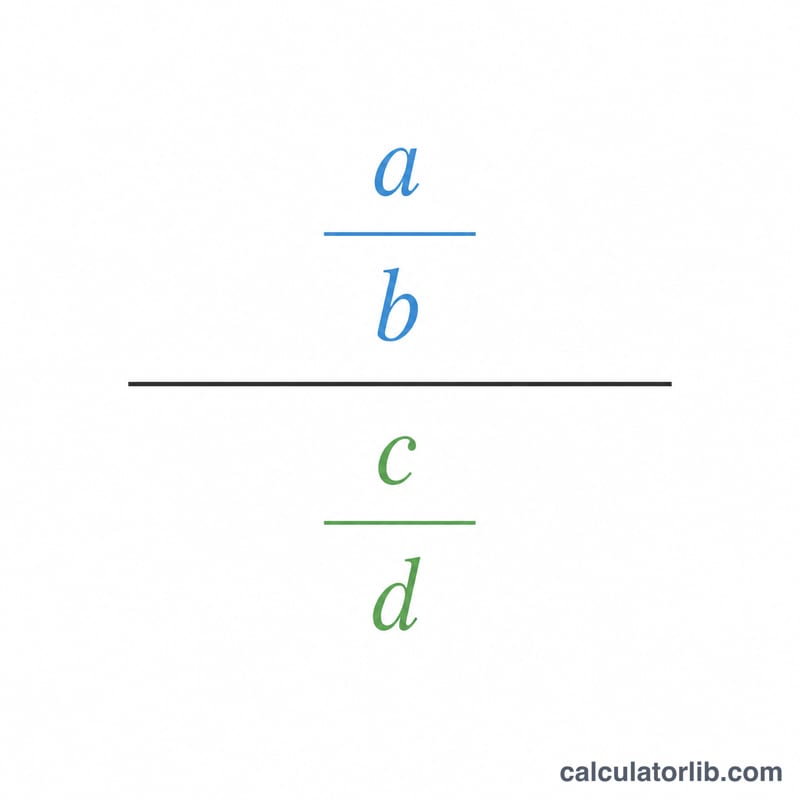
A complex fraction is a fraction whose numerator, denominator, or both are themselves fractions — for example \(\dfrac{a/b}{c/d}\). This calculator simplifies that stacked expression into a single fraction reduced to lowest terms, along with its decimal value. It works for any real numbers and is a universal math tool with no country or currency assumptions.
How to Use It
Enter the four values: the top fraction is \(a/b\) and the bottom fraction is \(c/d\). Press calculate and you will get the simplified single fraction plus the equivalent decimal. The tool automatically reduces the result using the greatest common divisor when the numbers are whole, and keeps a positive denominator.
The Formula Explained
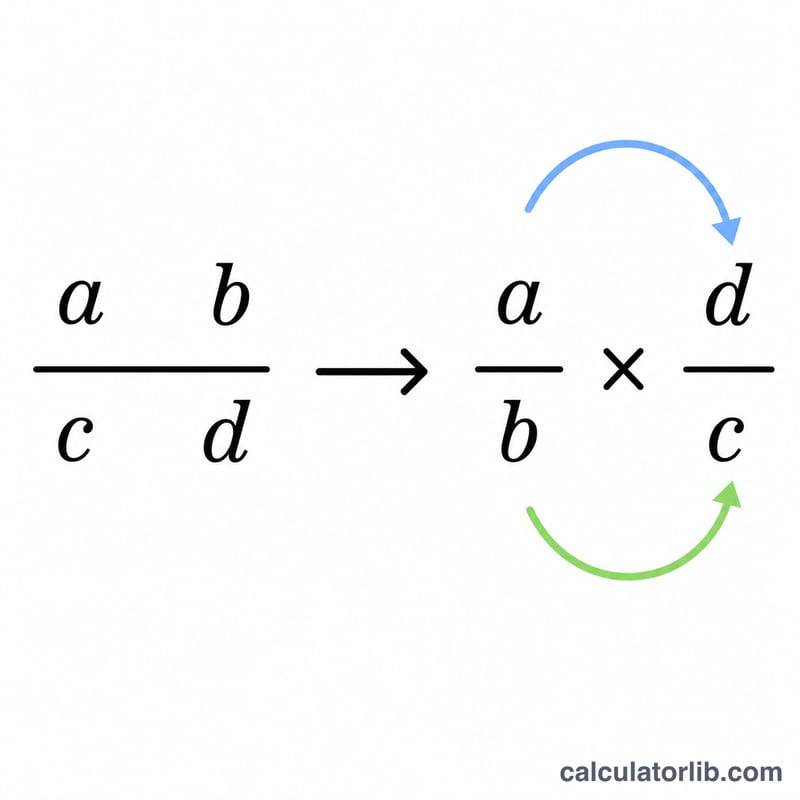
Dividing by a fraction is the same as multiplying by its reciprocal. So \((a/b) \div (c/d)\) becomes \((a/b) \times (d/c)\). Multiplying straight across gives the following:
$$\dfrac{\dfrac{\text{a}}{\text{b}}}{\dfrac{\text{c}}{\text{d}}} = \dfrac{\text{a} \cdot \text{d}}{\text{b} \cdot \text{c}}$$After that, both numerator and denominator are divided by their greatest common divisor to express the answer in lowest terms.
Worked Example
Simplify \(\dfrac{1/2}{3/4}\). Using the rule: numerator \(= 1 \times 4 = 4\), denominator \(= 2 \times 3 = 6\), giving \(\tfrac{4}{6}\). The GCD of 4 and 6 is 2, so the reduced fraction is:
$$\dfrac{4}{6} = \dfrac{2}{3} \approx 0.6667$$which equals about 0.6667 as a decimal.
FAQ
What if one value is negative? The calculator handles negatives and normalizes the result so the denominator stays positive, moving any negative sign to the numerator.
What happens with decimals? Non-whole inputs still compute a correct decimal value; the displayed "simplified" fraction is most meaningful when all four inputs are integers.
What if c or d is zero? Division by zero is undefined. If \(b \times c\) equals zero the decimal cannot be computed and is shown as zero — make sure \(c\) and \(d\) are non-zero for a valid complex fraction.