
What is the mEq/L Calculator?
The mEq/L calculator converts an electrolyte concentration expressed in milligrams per liter (mg/L) into milliequivalents per liter (mEq/L). Milliequivalents account for the electrical charge (valence) of an ion, which is why electrolytes such as sodium, potassium, calcium and magnesium are often reported in mEq/L in clinical chemistry, water treatment, and laboratory work. This tool is a universal unit conversion and applies anywhere.
How to use it
Enter the concentration in mg/L, the atomic weight (or molecular weight) of the ion in grams per mole, and the valence — the absolute value of the ion charge. For example, sodium (Na⁺) has an atomic weight of about 23 and a valence of 1; calcium (Ca²⁺) has an atomic weight of about 40 and a valence of 2. The calculator returns the concentration in mEq/L plus the equivalent molar concentration in mmol/L.
The formula explained
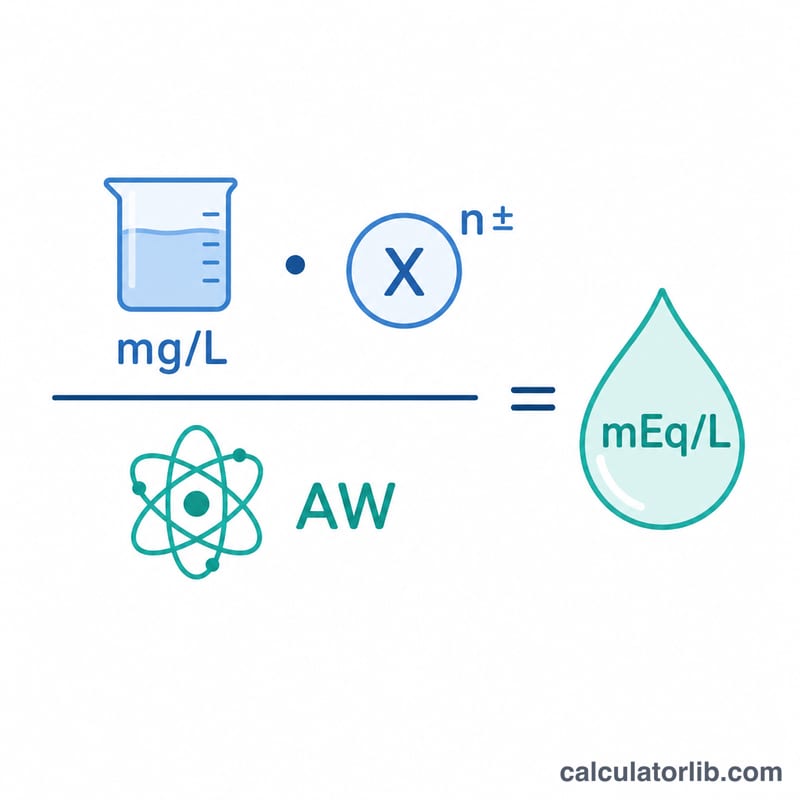
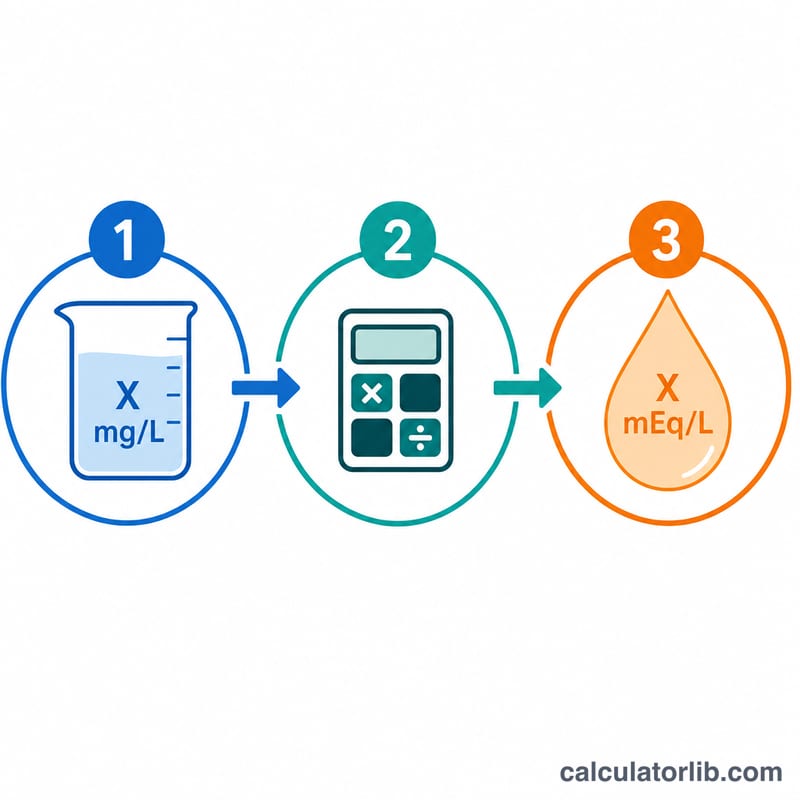
The conversion is $$\text{mEq/L} = \frac{\text{mg/L} \times \text{valence}}{\text{atomic weight}}$$ The mass concentration is first divided by atomic weight to get millimoles per liter, then multiplied by valence to convert moles of ion into equivalents of charge. Because one equivalent represents one mole of charge, multivalent ions yield more equivalents per mole.
Worked example
Suppose a sample contains 140 mg/L of sodium. Sodium has an atomic weight of 23 and a valence of 1. $$\text{mEq/L} = \frac{140 \times 1}{23} = 6.087 \text{ mEq/L}$$ The molar concentration is \(140 \div 23 = 6.087\) mmol/L (equal because valence is 1).
FAQ
What valence should I use? Use the absolute value of the ion charge: 1 for Na⁺/K⁺/Cl⁻, 2 for Ca²⁺/Mg²⁺/SO₄²⁻.
Can I use molecular weight instead of atomic weight? Yes — for polyatomic ions such as bicarbonate (HCO₃⁻, MW ≈ 61) use the molecular weight of the whole ion.
Why is mEq/L equal to mmol/L for sodium? Because sodium has a valence of 1, one millimole equals one milliequivalent. For divalent ions the mEq/L is twice the mmol/L.