
What is the mEq to mg Calculator?
This calculator converts a quantity expressed in milliequivalents (mEq) into milligrams (mg) for electrolytes such as sodium, potassium, calcium, magnesium and chloride. Milliequivalents measure the chemical combining power of an ion — they account for the ion's electrical charge — while milligrams measure simple mass. Because labs, supplements and clinical orders mix both units, converting between them is a routine task.
How to use it
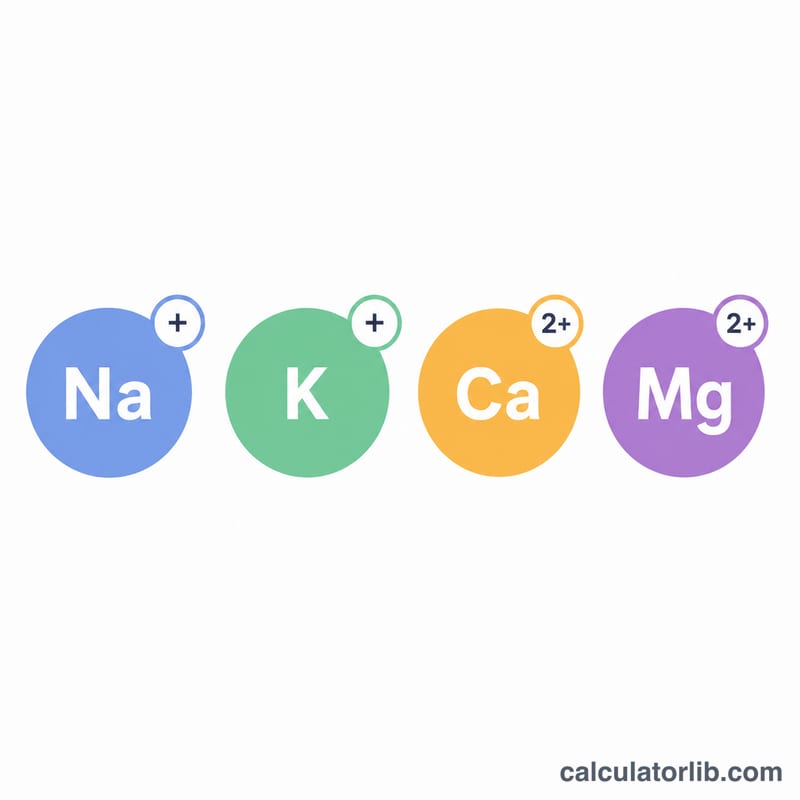
Enter the amount in mEq, the atomic (or molecular) weight of the ion in g/mol, and its valence (the absolute value of the ionic charge). The tool returns the equivalent weight and the resulting mass in mg. Reference values: sodium (Na⁺) 23, valence 1; potassium (K⁺) 39.1, valence 1; calcium (Ca²⁺) 40.1, valence 2; magnesium (Mg²⁺) 24.3, valence 2; chloride (Cl⁻) 35.5, valence 1.
The formula explained
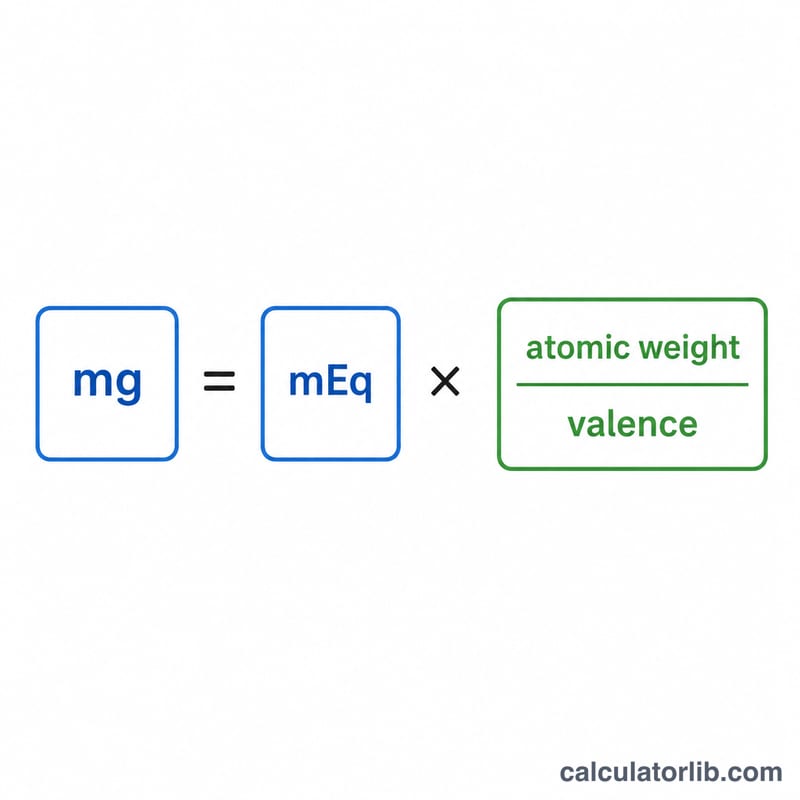
The key is the equivalent weight, defined as the atomic weight divided by the valence. One equivalent of an ion is the amount that carries one mole of charge. So:
$$\text{mg} = \text{mEq} \times \left( \frac{\text{atomic weight}}{\text{valence}} \right)$$
For monovalent ions (valence 1) the equivalent weight equals the atomic weight, so 1 mEq = the atomic weight in mg. For divalent ions (valence 2) the equivalent weight is half the atomic weight.
Worked example
Convert 20 mEq of potassium chloride (KCl) to mg of potassium. Potassium has an atomic weight of 39.1 and a valence of 1. Equivalent weight = \( 39.1 \div 1 = 39.1 \) mg/mEq. $$\text{mg} = 20 \times 39.1 = \mathbf{782 \text{ mg}}$$ of potassium.
FAQ
What valence do I use for calcium? Calcium is Ca²⁺, so its valence is 2. For 10 mEq of calcium: \( 10 \times (40.1 \div 2) = 200.5 \) mg.
Is this the same as mEq to mmol? No. mmol divides mEq by valence only (no atomic weight); mg multiplies mmol by atomic weight.
Does this work for compounds? Yes — use the molecular weight of the salt and its total ionic charge if you want the mass of the whole compound, or use the ion's data for the elemental mass.