
What is Molar Solubility from Ksp?
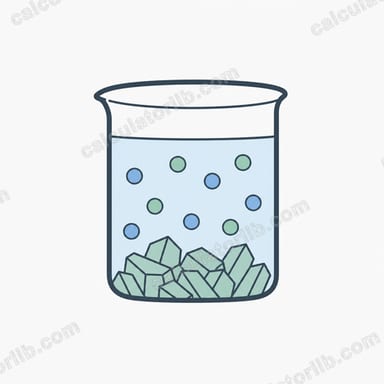
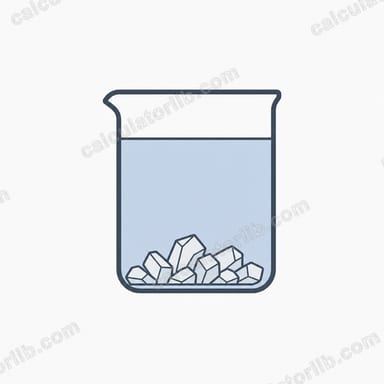
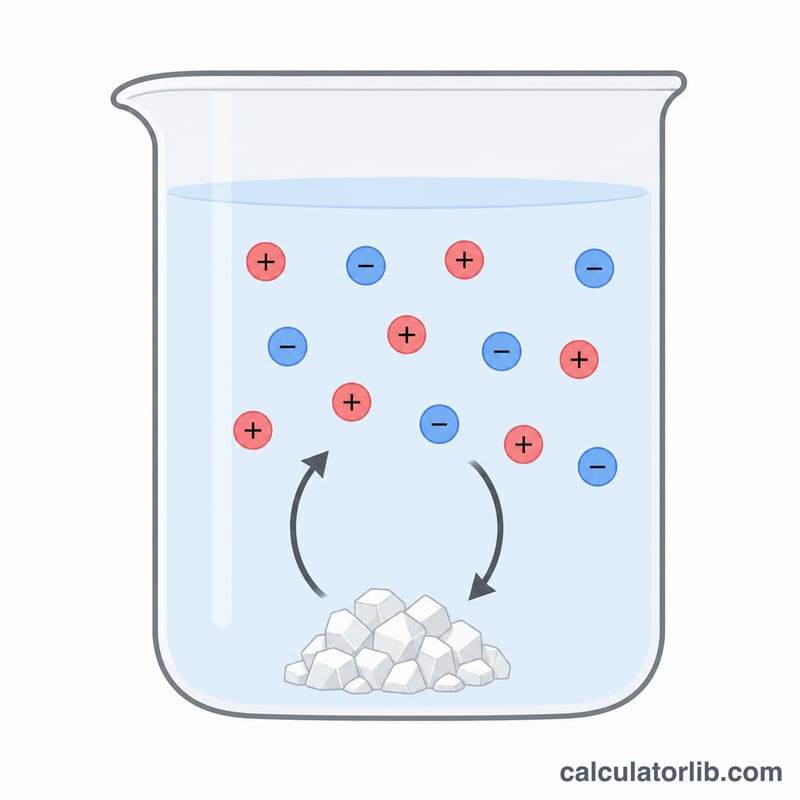
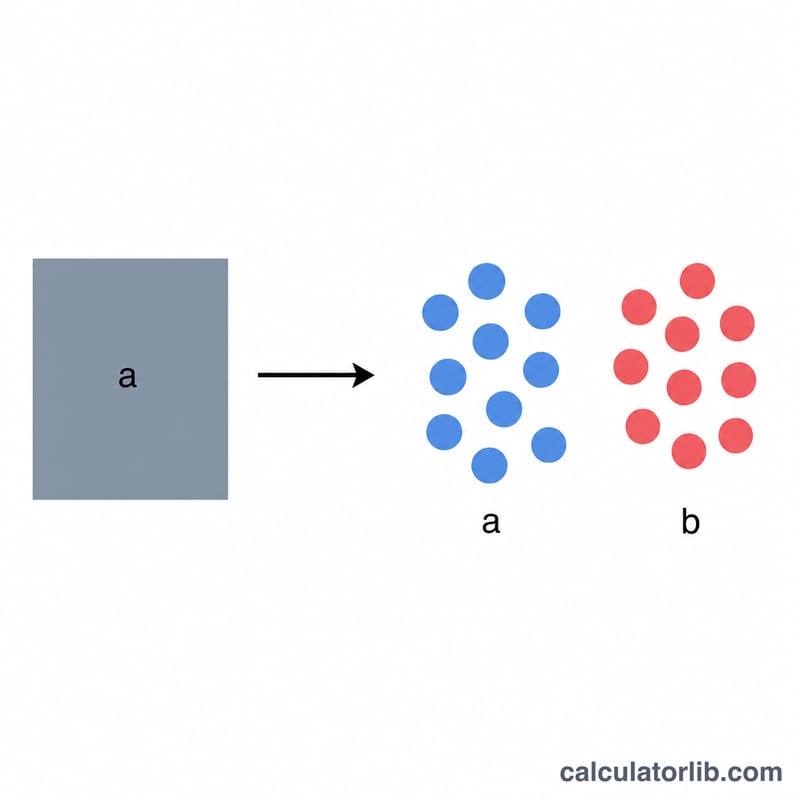
The solubility product constant (Ksp) describes the equilibrium between a sparingly soluble ionic solid and its dissolved ions. Molar solubility (s) is the number of moles of the salt that dissolve per litre of saturated solution. This calculator converts a known Ksp into molar solubility for any salt of the general form AaBb, which dissociates as AaBb \u21cc a A + b B.
How to use the calculator
Enter the Ksp value (scientific notation like 3.9e-11 is accepted), then the stoichiometric coefficients of the cation (a) and the anion (b). For example, AgCl uses \(a = 1\), \(b = 1\); CaF\u2082 uses \(a = 1\), \(b = 2\); and Ag\u2082CrO\u2084 uses \(a = 2\), \(b = 1\). The tool returns the molar solubility plus the equilibrium concentration of each ion.
The formula explained
At saturation, \([A] = a \cdot s\) and \([B] = b \cdot s\). Substituting into the equilibrium expression \(\text{Ksp} = [A]^{a}[B]^{b}\) gives \(\text{Ksp} = (a \cdot s)^{a}(b \cdot s)^{b} = a^{a}b^{b} \cdot s^{(a+b)}\). Solving for \(s\) yields:
$$S = \left( \frac{\text{Ksp}}{a^{a} \cdot b^{b}} \right)^{\frac{1}{a + b}}$$
Worked example
For calcium fluoride, CaF\u2082, \(\text{Ksp} = 3.9 \times 10^{-11}\) with \(a = 1\), \(b = 2\). Then \(a^{a}b^{b} = 1^{1} \cdot 2^{2} = 4\), so $$s = \left( \frac{3.9 \times 10^{-11}}{4} \right)^{1/3} = (9.75 \times 10^{-12})^{1/3} \approx 2.14 \times 10^{-4}\ \text{mol/L}.$$ The fluoride concentration is \(2s \approx 4.28 \times 10^{-4}\ \text{mol/L}\).
FAQ
Does this work for 1:1 salts like AgCl? Yes. With \(a = b = 1\) the formula reduces to \(s = \sqrt{\text{Ksp}}\).
What units does s have? Molar solubility is in moles per litre (mol/L). To convert to grams per litre, multiply by the molar mass.
Does it account for the common-ion effect or activity coefficients? No. It assumes the salt dissolves into pure water with ideal (unit-activity) behavior and no added common ion.