
What is a UUID?
A UUID (Universally Unique Identifier), also called a GUID, is a 128-bit value used to uniquely label information in computer systems without a central authority. This tool generates version 4 UUIDs, which are produced almost entirely from random numbers. With 122 random bits the chance of two generated UUIDs colliding is so vanishingly small that they are treated as globally unique. This is a universal, language-agnostic standard (RFC 4122).
How to use this generator
Choose how many UUIDs you need (1 to 50), pick lowercase or uppercase output, and decide whether to include the standard hyphens. Click calculate and copy the results. UUIDs are handy as database primary keys, API request IDs, file names, session tokens, and distributed-system identifiers where you cannot rely on an auto-incrementing counter.
The format explained
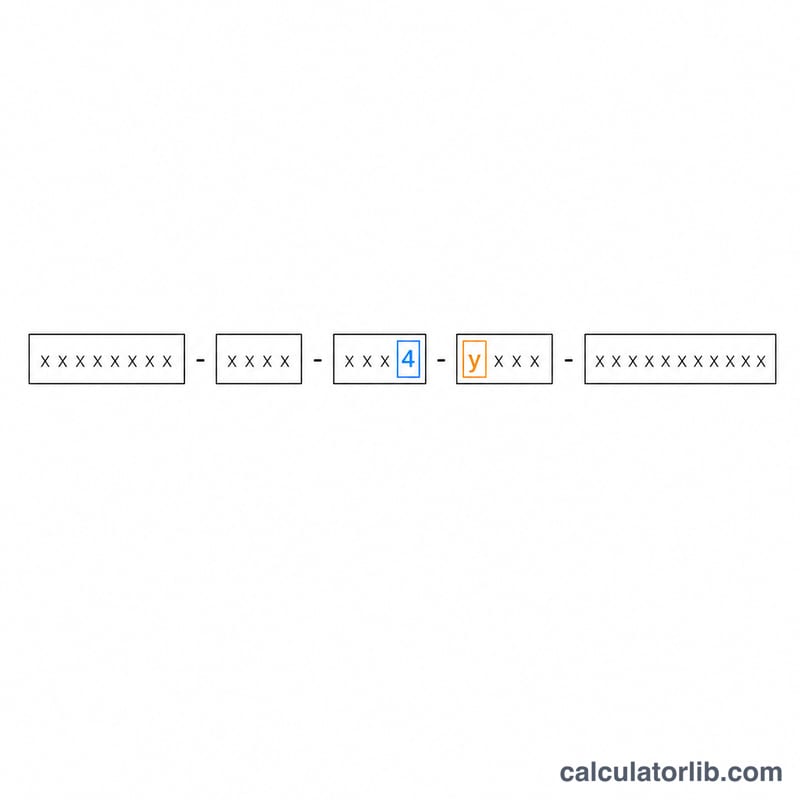
A version 4 UUID is written as 32 hexadecimal digits in five groups separated by hyphens: 8-4-4-4-12, for example xxxxxxxx-xxxx-4xxx-yxxx-xxxxxxxxxxxx. The digit shown as 4 identifies the version. The digit shown as y encodes the variant and must be one of 8, 9, a, or b. Every other x is a random hexadecimal digit.
Worked example
Take a random hex string such as 3f9a7c1e b204 1d88 9c33 a7f019be24c1. To make it a valid v4 UUID we force the 13th digit to 4 and the 17th digit to a variant digit, giving for instance 3f9a7c1e-b204-4d88-9c33-a7f019be24c1. Notice the 4 after the second hyphen and the 9 (a valid variant value) after the third hyphen.
FAQ
Are these UUIDs cryptographically secure? They are generated with the platform's pseudo-random source and are fine for identifiers, but for high-security secrets prefer a dedicated cryptographic random generator.
Can two UUIDs ever be the same? In theory yes, but the probability is negligible — you would need to generate billions per second for many years to have any realistic chance of a collision.
Does removing hyphens change the value? No. Hyphens are purely cosmetic; the underlying 128 bits are identical.