
What is this calculator?
This tool converts water hardness measured in parts per million (ppm), which is equivalent to milligrams per liter (mg/L), into grains per gallon (gpg). Grains per gallon is the unit most commonly used in the United States to rate water softeners and report water hardness, while ppm/mg/L is the standard used in laboratory reports and most of the rest of the world.
How to use it
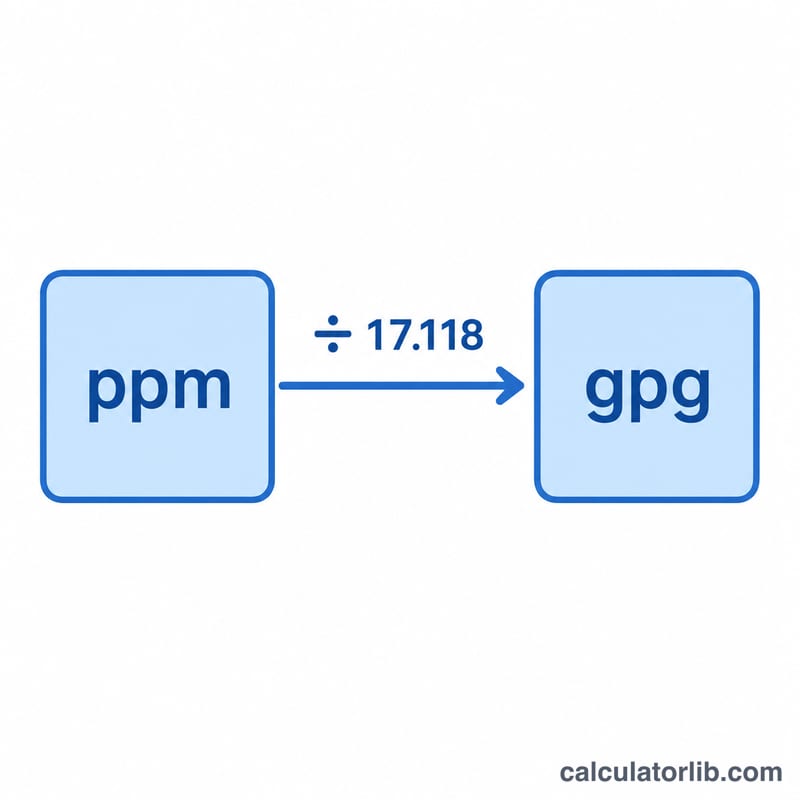
Enter your water hardness value in ppm (or mg/L — they are numerically identical for water). The calculator divides by 17.118 and returns the equivalent hardness in grains per gallon. Use this number when programming a water softener or comparing a lab report to softener specifications.
The formula explained
One grain per gallon equals 17.118 milligrams of calcium carbonate per liter. So to convert ppm to gpg you divide by 17.118:
$$\text{gpg} = \frac{\text{ppm}}{17.118}$$
For example, water classed as "hard" at 120 ppm becomes \(120 / 17.118 = 7.01\) gpg, which falls in the hard range (7–10.5 gpg) on the common US hardness scale.
Worked example
Suppose a lab report lists your hardness at 250 mg/L. Dividing by 17.118 gives \(250 / 17.118 \approx 14.6\) gpg — very hard water, typically requiring a softener.
FAQ
Is ppm the same as mg/L? For dilute water solutions, yes — \(1 \text{ ppm} \approx 1 \text{ mg/L}\), so you can use the values interchangeably here.
What is considered hard water? Roughly: 0–3.5 gpg is soft, 3.5–7 gpg is moderately hard, 7–10.5 gpg is hard, and above 10.5 gpg is very hard.
Why 17.118? One grain equals 64.799 mg and one US gallon is 3.785 liters, so \(64.799 / 3.785 \approx 17.118\) mg/L per grain per gallon.