What is the Pokémon GO Weight Loss Calculator?
Pokémon GO turns walking into a game — you hatch eggs, find Pokémon, and rack up kilometres almost without noticing. This calculator translates those kilometres into something tangible: the calories you burn and a fat-energy equivalent based on the 7,700 kcal per kg rule. It uses the standard MET (Metabolic Equivalent of Task) method, the same approach exercise scientists use to estimate energy expenditure for any activity.
How to Use It
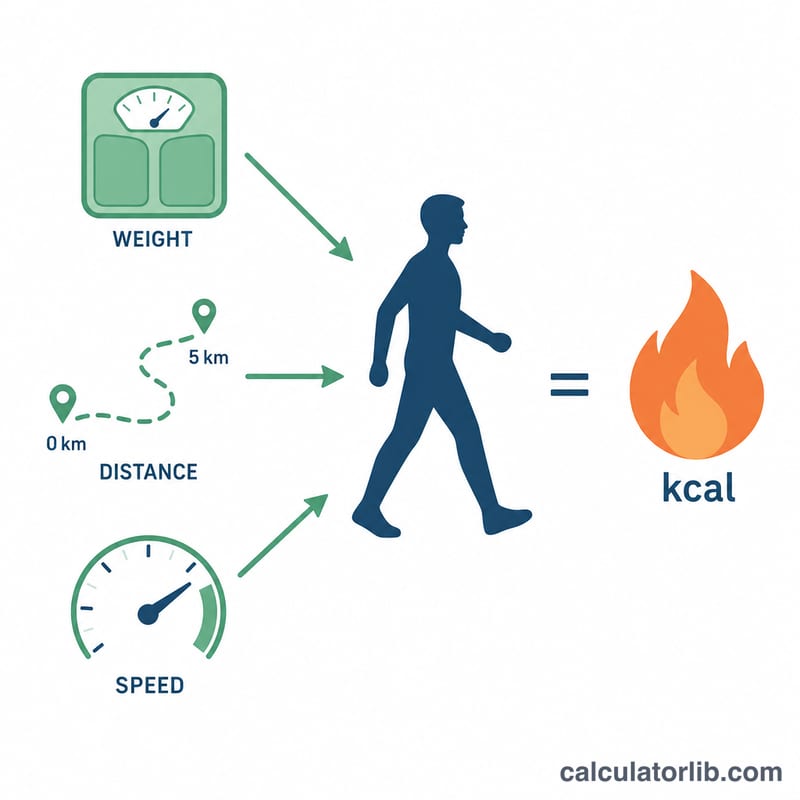
Enter your body weight in kilograms, the distance you walked in kilometres (Pokémon GO conveniently tracks this for you), your average walking speed in km/h, and the MET value of the activity. A normal walking pace (about 5 km/h) is about 3.8 METs; a brisk walk (about 5.6 km/h) is closer to 4.8, and a slow stroll around 2.8. Click calculate to see calories burned, the fat-energy equivalent, and total walking time.
The Formula Explained
The core equation is $$\text{Calories} = \text{MET} \times \text{weight (kg)} \times \text{time (hours)}$$. Time is derived from distance divided by speed. The result is then converted to a fat-energy equivalent using the well-known rule that one kilogram of body fat stores roughly 7,700 kilocalories, so $$\text{fat-energy equivalent (kg)} = \frac{\text{calories}}{7700}$$.
Worked Example
Suppose you weigh 70 kg and walk 5 km at 5 km/h with a MET of 3.8. Walking time is \(5 \div 5 = 1\) hour. Calories burned \(= 3.8 \times 70 \times 1 = 266\) kcal. Fat-energy equivalent \(= 266 \div 7700 \approx 0.0345\) kg, or about 34.5 grams.
MET Values for Walking and Pokémon GO Activities
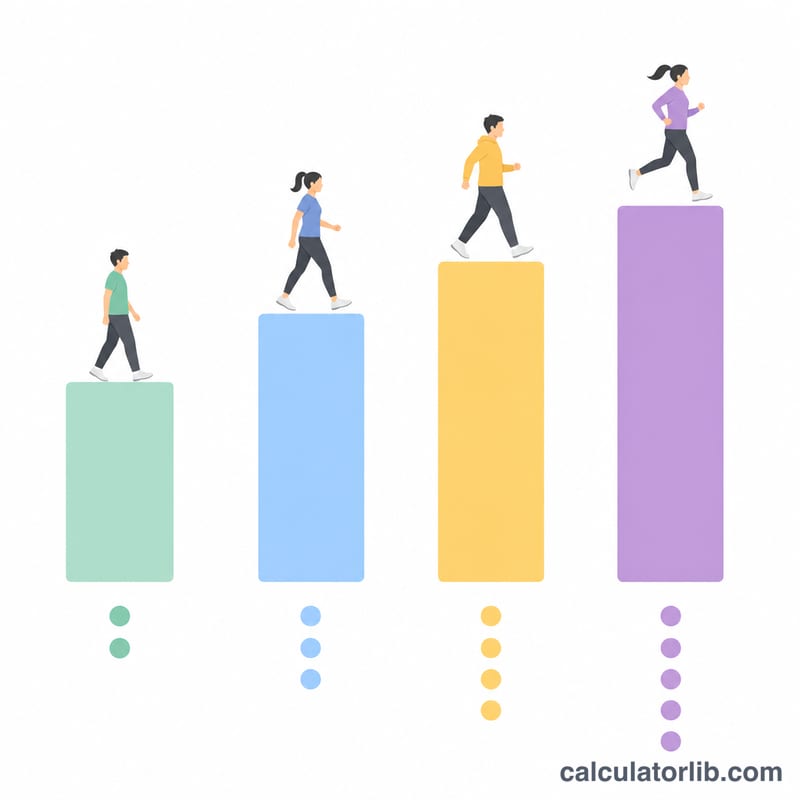
A MET (metabolic equivalent of task) expresses how much energy an activity uses relative to quiet rest (1 MET). The values below are approximate and are based on the Compendium of Physical Activities. Exact numbers differ slightly between editions and with surface, terrain and individual gait, so treat them as typical figures, not exact ones. Pokémon GO has no MET value of its own: the energy you use comes from how you move (walking, jogging, and so on), so choose the MET for your actual pace.
| Activity / speed | Approx. MET |
|---|---|
| Very slow stroll, about 2.0 km/h | ≈ 2.3 |
| Slow walk, about 3.2 km/h (2 mph) | ≈ 2.8 |
| Moderate walk, about 4.8 km/h (3 mph) | ≈ 3.8 |
| Brisk walk, about 5.6 km/h (3.5 mph) | ≈ 4.8 |
| Very brisk walk, about 6.4 km/h (4 mph) | ≈ 5.5 |
| Hiking on trails or uphill walking | Higher, often 5–6+ depending on grade and load |
| Jogging, about 8 km/h (5 mph), for comparison | ≈ 8.5 |
| Running, about 9.7 km/h (6 mph), for comparison | ≈ 9.3 |
In the calculator, enter the MET that best matches your average speed. Use the same speed in the speed field so that the time (distance ÷ speed) is consistent with it.
Interpreting Your Result
- It is a gross estimate. The MET formula counts total energy expenditure during the activity, which includes the resting metabolism you would burn anyway. The extra energy attributable to walking alone is lower (roughly MET − 1 in place of MET).
- 7,700 kcal per kg is a simplification. The figure is a common rule of thumb for the energy content of body fat. Real tissue loss includes water, glycogen and lean mass, and it does not convert in a fixed, linear way.
- Weight change depends on total energy balance. Body weight responds to energy intake and expenditure over weeks and months, not to a single walk. The fat figure shown is a theoretical equivalent, not a prediction of what the scale will show.
- Real play varies. Terrain, hills, stopping at PokéStops and gyms, waiting for spawns, and time spent handling the phone all lower the average speed and effective MET compared with continuous walking. Egg distance counts only when the game registers movement, and device or GPS differences can affect this.
- MET values are averages. Individual fitness, gait, stride and body composition cause real energy use to differ from the tabulated MET.
This is general information only, not medical or professional advice.
FAQ
Is the result exact? No — MET-based estimates are approximations. Individual metabolism, terrain, and fitness all affect real numbers.
What MET should I use? Use 3.8 for ordinary walking (about 5 km/h). Increase it for brisk walking or hilly terrain.
Why 7,700 calories per kg? It is a widely used static rule of thumb for the energy stored in a kilogram of body fat. Real weight change slows over time as the body adapts, so it usually takes longer than the rule predicts.