
What is the complete elliptic integral of the third kind?
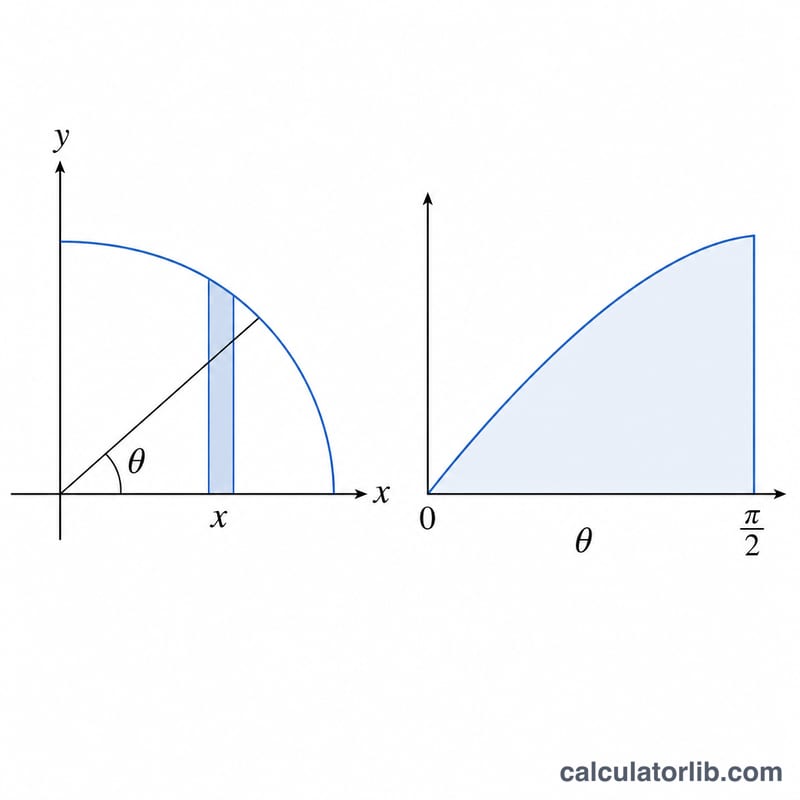
The complete elliptic integral of the third kind, written \(\Pi(n,k)\), is a special function that arises in classical mechanics (the period of a pendulum with damping-like terms), electromagnetism, and geometry. It is defined by the integral of 1 divided by (1 - n sin² theta) times the square root of (1 - k² sin² theta), taken from theta = 0 to pi/2:
$$\Pi(n,k) = \int_{0}^{\pi/2} \frac{d\theta}{\left(1 - \text{n}\,\sin^{2}\theta\right)\sqrt{1 - \text{k}^{2}\,\sin^{2}\theta}}$$This calculator evaluates it numerically and is a pure mathematics tool, valid identically everywhere.
Convention used here
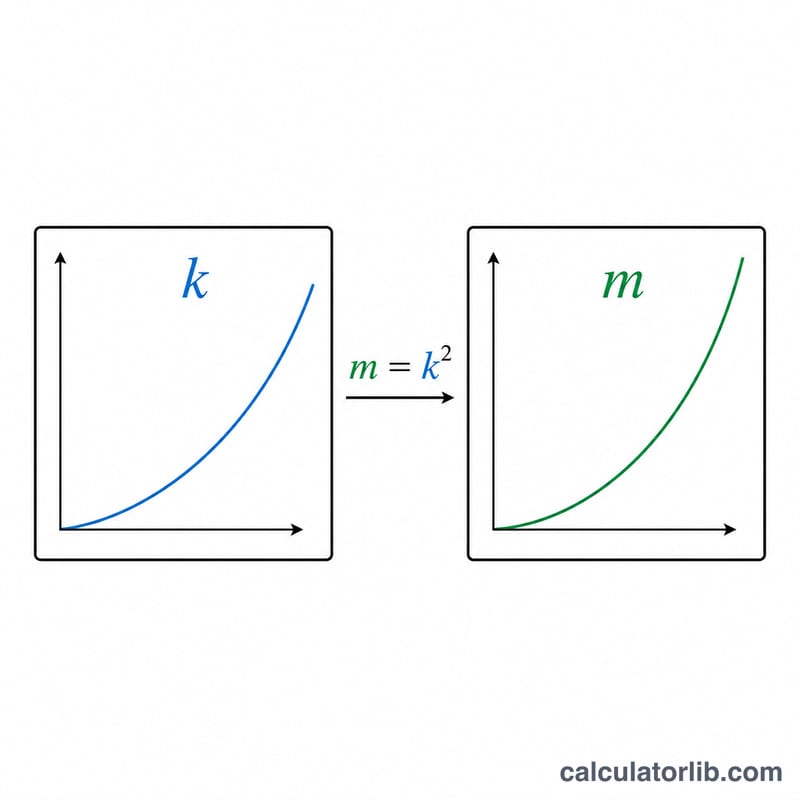
Conventions differ between textbooks, so read this carefully. We use the modulus k convention: the radical contains \(k^{2}\sin^{2}\theta\). Some references instead use the parameter m, where \(m = k^{2}\). We also use the characteristic n in the factor \((1 - n\sin^{2}\theta)\) without squaring n. A few texts write the factor as \((1 + n\sin^{2}\theta)\); to match those, flip the sign of n. Because k only appears squared, the sign of k does not change the result.
How to use it
Enter the characteristic n and the modulus k. For an ordinary finite value, keep \(|k| < 1\) and \(n < 1\). The tool integrates with composite Simpson's rule using 200,000 panels, giving roughly ten or more significant digits for well-behaved inputs.
Worked example
Take \(n = 0.7\) and \(k = 0.1\). A quick estimate is
$$\Pi(n,0) = \frac{\pi/2}{\sqrt{1 - n}} = \frac{1.5707963}{\sqrt{0.3}} = 2.86790.$$Adding the small \(k = 0.1\) correction raises it slightly, and full numerical integration yields \(\Pi(0.7, 0.1) \approx 2.87224\).
FAQ
What if n = 0? Then \(\Pi(0,k)\) equals \(K(k)\), the complete elliptic integral of the first kind.
What if k = 0? The integrand simplifies and \(\Pi(n,0) = \dfrac{\pi/2}{\sqrt{1 - n}}\) for \(n < 1\).
Why is n = 1 not allowed? The factor becomes \(\cos^{2}\theta\), producing a non-integrable singularity at \(\theta = \pi/2\), so the integral diverges. Values \(n > 1\) require a Cauchy principal value, which this basic calculator does not compute.