
What Is the Third Quartile (Q3)?
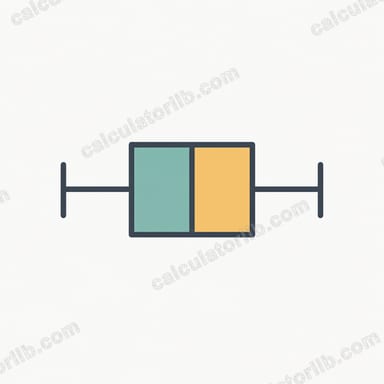
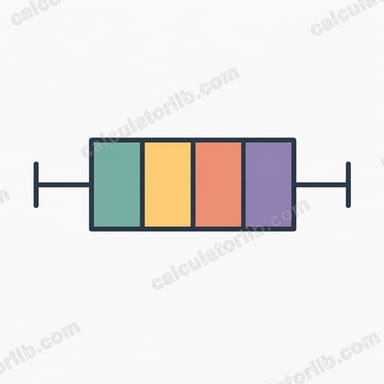
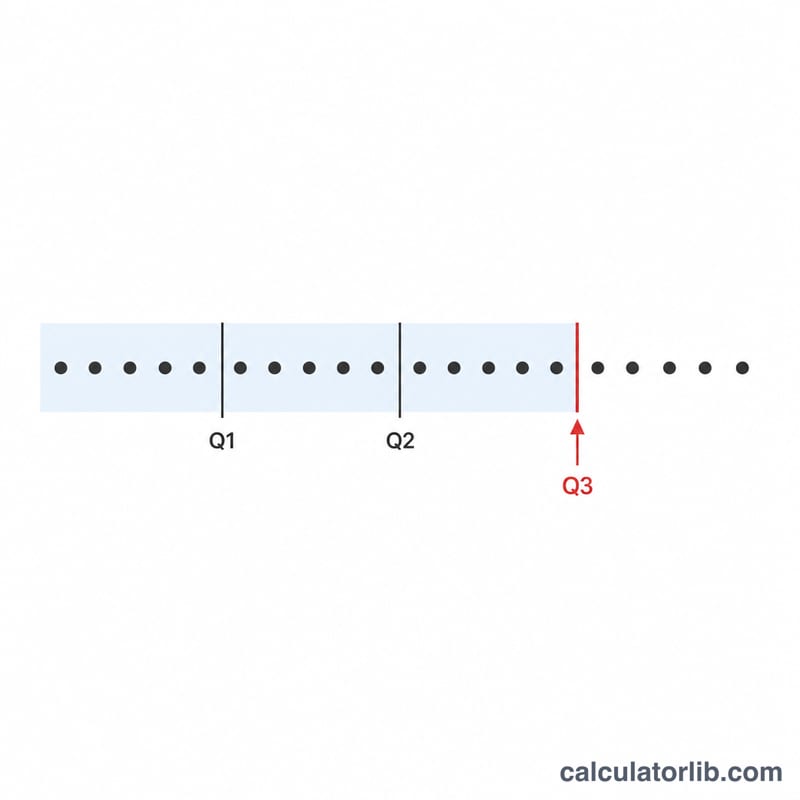
The third quartile, written Q3, is the value below which 75% of the data in a set falls. It is also called the 75th percentile or upper quartile. Together with the first quartile (Q1) and the median (Q2), it divides an ordered data set into four equal parts and is a cornerstone of descriptive statistics and box plots.
How to Use This Calculator
Type your numbers into the field separated by commas or spaces — for example 3, 7, 8, 5, 12, 14, 21, 13, 18. The calculator sorts the values, counts them, and computes Q3 automatically. There is no limit on whether the data is whole numbers or decimals; negative values work too.
The Formula Explained
First sort the data in ascending order. The position of Q3 is found with the rank formula \(L = \frac{3(n + 1)}{4}\), where \(n\) is the number of values and positions are counted from 1. If L is a whole number, Q3 is simply the value at that position. If L lands between two positions, the calculator interpolates linearly: it takes the lower value and adds the fractional part of L times the gap to the next value.
$$Q_3 = x_{\lfloor L \rfloor} + f\left(x_{\lceil L \rceil} - x_{\lfloor L \rfloor}\right)$$ $$\text{where}\quad \left\{ \begin{aligned} L &= \frac{3(n+1)}{4} \\ f &= L - \lfloor L \rfloor \\ n &= \text{count of sorted } \text{Data set} \end{aligned} \right.$$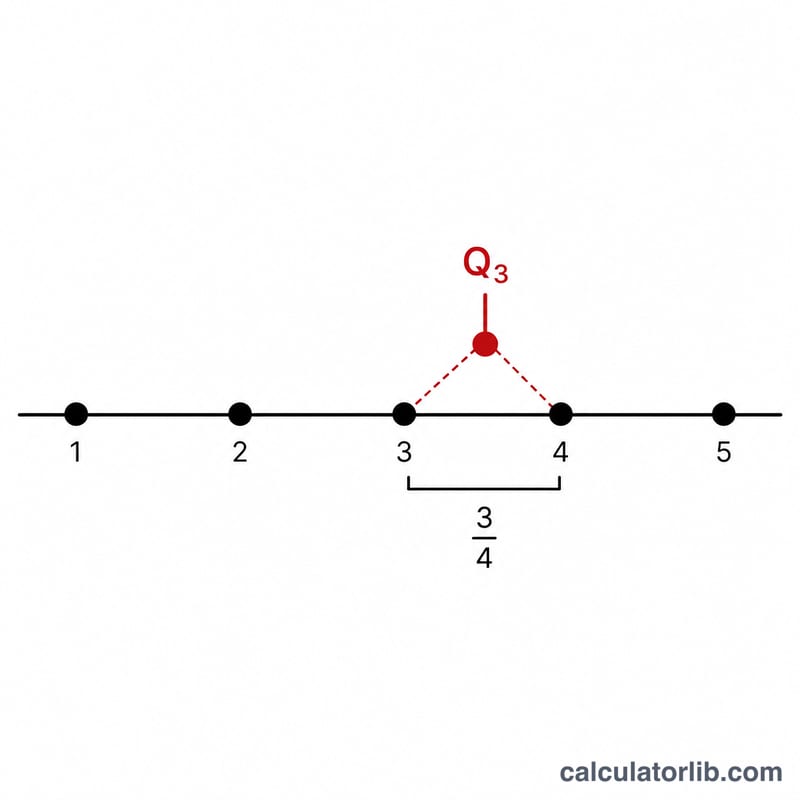
Worked Example
Take the data 3, 5, 7, 8, 12, 13, 14, 18, 21 (already sorted, n = 9). The position is $$L = \frac{3(9 + 1)}{4} = \frac{30}{4} = 7.5.$$ That falls halfway between the 7th value (14) and the 8th value (18), so $$Q_3 = 14 + 0.5 \times (18 - 14) = 14 + 2 = \mathbf{16}.$$
FAQ
Why does my answer differ from another tool? Several quartile methods exist (exclusive, inclusive, Tukey's hinges). This calculator uses the popular \(\frac{3(n+1)}{4}\) interpolation method. Spreadsheet functions like QUARTILE.EXC or QUARTILE.INC may give slightly different results.
What is the interquartile range (IQR)? The IQR equals \(Q_3 - Q_1\) and measures the spread of the middle 50% of the data.
Can I enter decimals? Yes — decimals, negatives, and repeated values are all supported.