
What this calculator does
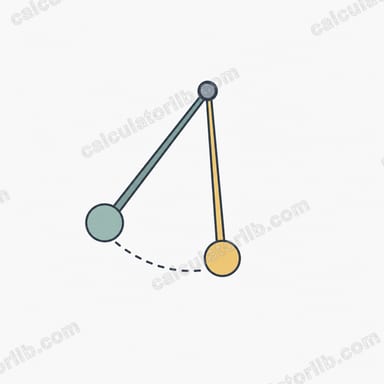
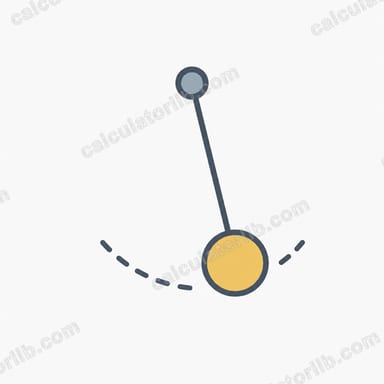
This tool computes the exact oscillation period of an idealized simple pendulum (a point mass on a massless, inextensible string) for any release amplitude up to 180 degrees. The familiar textbook formula \(T = 2\pi\sqrt{l/g}\) is only the small-angle approximation; it gets noticeably wrong as the swing gets wider. Here we use the full nonlinear result built on the complete elliptic integral of the first kind, so the answer stays accurate even for large swings.
How to use it
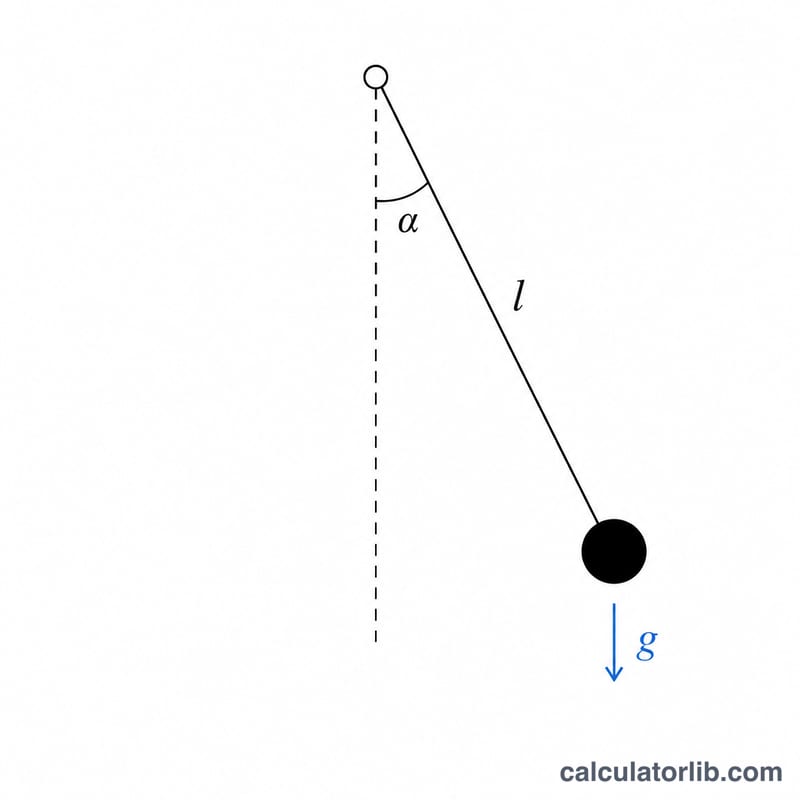
Enter three values: the release angle α in degrees (the maximum angle from vertical at which the bob is let go from rest), the string length l in meters, and the gravitational acceleration g in m/s² (default 9.80665, standard gravity). Press calculate to get the period T in seconds for one complete back-and-forth cycle. The result table also shows the elliptic integral value \(K(k)\), the modulus \(k\), and the small-angle period for comparison.
The formula explained
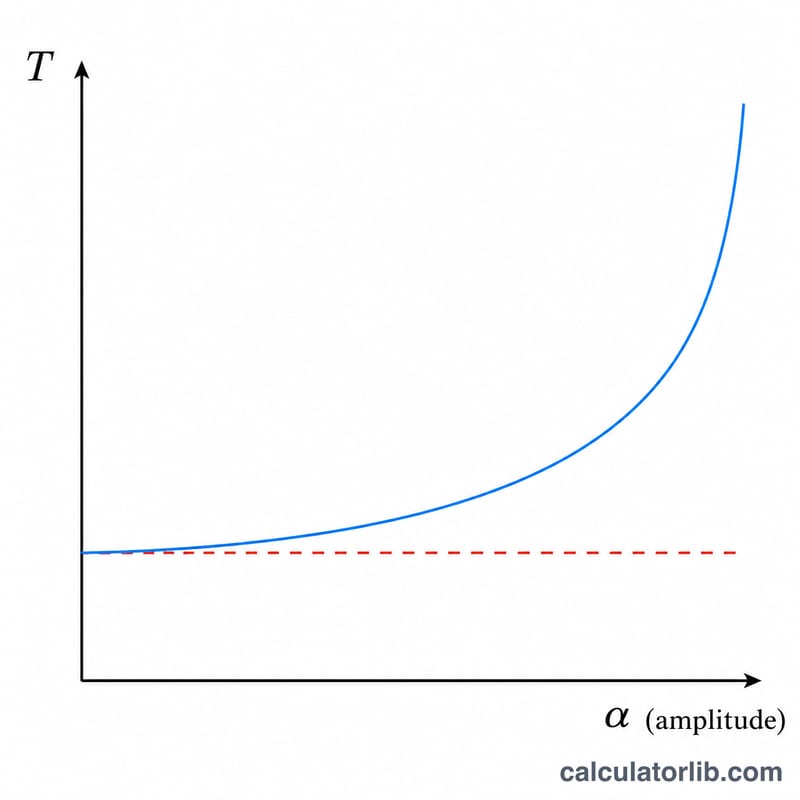
The exact period is $$T = 4\sqrt{\frac{l}{g}}\;K(k),$$ where \(K\) is the complete elliptic integral of the first kind with modulus \(k = \sin(\alpha/2)\). We evaluate \(K(k)\) without lookup tables using the arithmetic-geometric mean (AGM): $$K(k) = \frac{\pi}{2\cdot \operatorname{agm}(1, \sqrt{1-k^2})}.$$ The AGM converges quadratically, so 5-8 iterations reach machine precision. As \(\alpha \to 0\), \(K \to \pi/2\) and \(T\) reduces to the classic \(2\pi\sqrt{l/g}\).
Worked example
For \(\alpha = 30°\), \(l = 1\) m, \(g = 9.80665\): \(k = \sin(15°) = 0.258819\), \(\operatorname{agm}(1, \cos 15°) = 0.982889\), so \(K = 1.598142\) and \(\sqrt{l/g} = 0.319330\). Thus $$T = 4 \times 0.319330 \times 1.598142 \approx 2.0415\ \text{s}$$ — about 1.76% longer than the small-angle value of 2.0062 s. At \(\alpha = 90°\) the period grows to about 2.3685 s, roughly 18% above the small-angle estimate.
FAQ
Why does period depend on amplitude? The pendulum's restoring torque is proportional to \(\sin\theta\), not \(\theta\). Only for small angles is \(\sin\theta \approx \theta\), giving simple harmonic motion with amplitude-independent period. For larger swings the motion is anharmonic and slower.
What happens near 180 degrees? As \(\alpha\) approaches 180° the modulus \(k\) approaches 1 and \(K(k)\) diverges, so the period tends to infinity — the bob lingers ever longer near the unstable inverted top. Values at or above 180° are treated as out of range.
Does it include friction? No. This is the idealized frictionless pendulum; air drag, string mass, and bob size are ignored. Real pendulums lose a little energy and amplitude each cycle.