
What Is the Synodic Period?
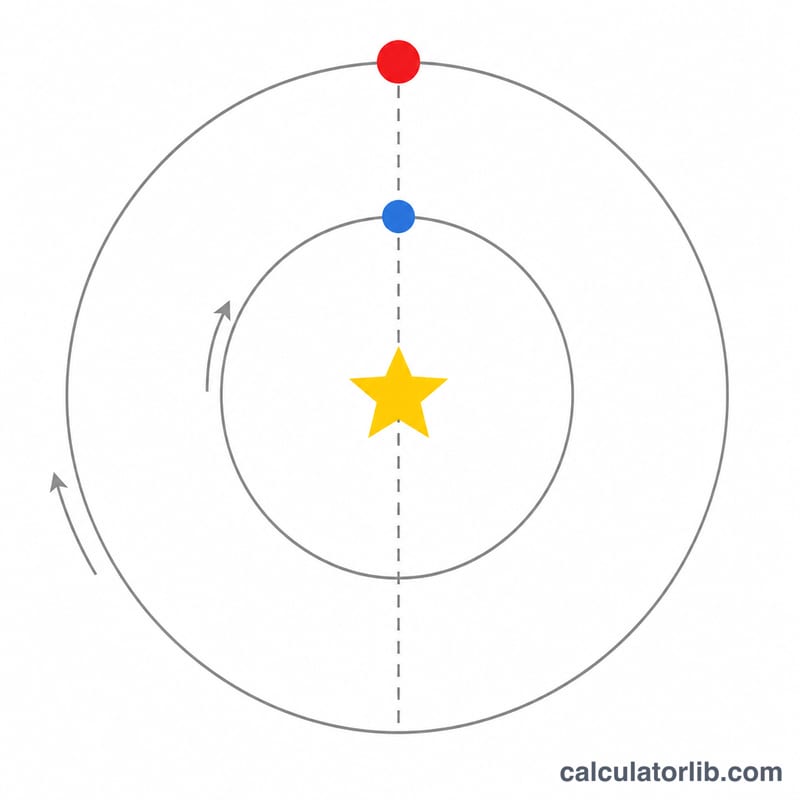
The synodic period is the time it takes for two orbiting bodies to return to the same relative configuration — for example, the time between successive conjunctions or oppositions of two planets as seen from a common reference point. It differs from the sidereal (orbital) period, which measures one full orbit against the fixed stars. Because both bodies are moving, the faster one must "lap" the slower one, and the synodic period captures exactly how long that catch-up takes.
How to Use This Calculator
Enter the orbital period of the first body (\(T_1\)) and the second body (\(T_2\)). Use the same time unit for both — days or years — and the synodic period will be returned in that same unit. The order of the two inputs does not matter because the formula uses an absolute value.
The Formula Explained
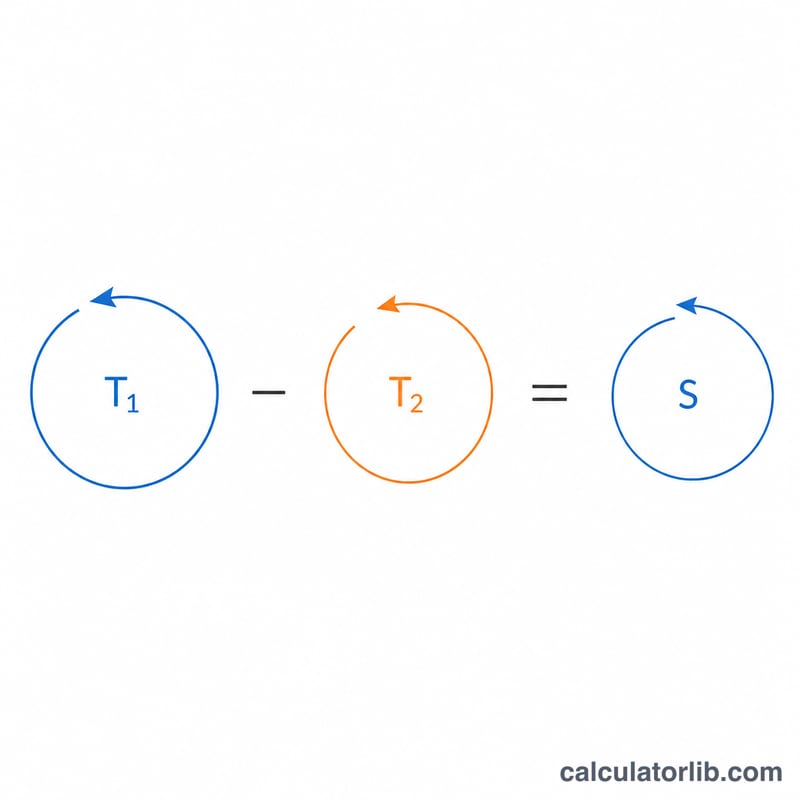
The relationship is $$\frac{1}{S} = \left| \frac{1}{T_1} - \frac{1}{T_2} \right|$$ Each term \(1/T\) is the body's angular rate (fraction of a full orbit per unit time). Subtracting the two rates gives the relative angular rate, and the reciprocal of that relative rate is the synodic period \(S\). Equivalently, $$S = \frac{T_1 \cdot T_2}{\left| T_2 - T_1 \right|}$$
Worked Example
Take Earth (\(T_1 = 365.25\) days) and Mars (\(T_2 = 687\) days). Then \(1/365.25 = 0.0027378\) and \(1/687 = 0.0014556\). The difference is \(0.0012822\), so $$S = \frac{1}{0.0012822} \approx 779.9 \text{ days}$$ — close to the real Earth–Mars synodic period of about 780 days, which is why Mars launch windows recur roughly every 26 months.
FAQ
What's the difference between synodic and sidereal period? The sidereal period is one orbit relative to the stars; the synodic period is the time to return to the same alignment relative to another moving body.
Can I mix units? No — both inputs must share the same unit, and the answer comes out in that unit.
What if both periods are equal? The relative rate is zero, so the synodic period is infinite (the bodies never change alignment); the calculator returns 0 in that undefined case.