
What is a torus?
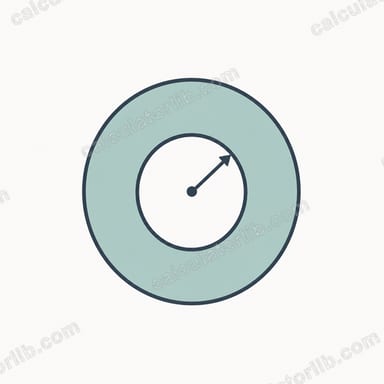
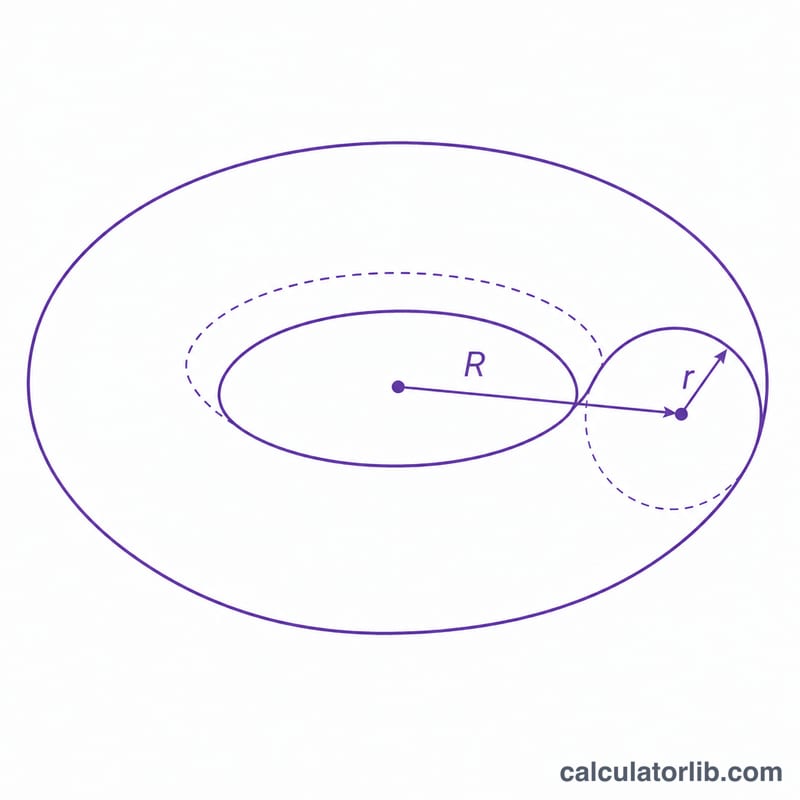
A torus is a doughnut-shaped solid formed by revolving a circle around an axis that lies in the same plane but does not touch the circle. This is a pure-geometry tool that works the same everywhere in the world. This calculator describes the torus using two easy-to-measure radii: the inner radius (the radius of the central hole) and the outer radius (the distance from the central axis to the outer edge of the ring).
How to use it
Enter the inner radius and the outer radius using the same length unit (centimeters, inches, meters — anything, as long as both match). The outer radius must be larger than the inner radius. The calculator returns the volume in cubic units and the surface area in square units, along with the two classic torus parameters it derives internally.
The formula explained
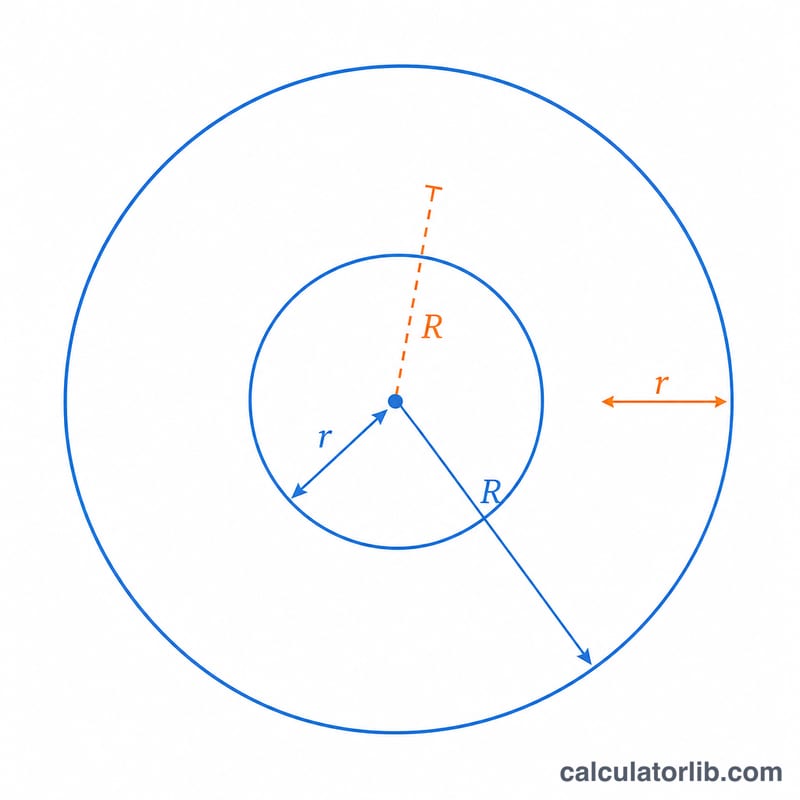
From your two inputs the calculator derives the standard torus parameters. The tube radius (the thickness of the ring) is \(r = (\text{outer} - \text{inner}) / 2\), and the center radius (distance from the axis to the middle of the tube) is \(R = (\text{outer} + \text{inner}) / 2\). Then volume is $$V = 2\pi^{2} R r^{2}$$ and surface area is $$S = 4\pi^{2} R r.$$ The surface area also simplifies neatly to $$S = \pi^{2}(b^{2} - a^{2}),$$ where \(a\) is the inner radius and \(b\) the outer radius.
Worked example
Take an inner radius of 5 cm and an outer radius of 10 cm. The tube radius is $$r = (10 - 5)/2 = 2.5 \text{ cm}$$ and the center radius is $$R = (10 + 5)/2 = 7.5 \text{ cm}.$$ Volume $$V = 2\pi^{2} \times 7.5 \times 2.5^{2} \approx 925.28 \text{ cm}^{3}.$$ Surface area $$S = 4\pi^{2} \times 7.5 \times 2.5 \approx 740.22 \text{ cm}^{2},$$ which matches \(\pi^{2} \times (100 - 25)\).
FAQ
What if the inner radius is 0? That gives a horn torus where the hole closes to a point (\(R = r\)). The formulas still evaluate correctly.
Why must the outer radius be bigger than the inner radius? Otherwise the tube radius would be zero or negative, which is not a valid solid ring; the calculator returns zero in that case.
What units does it use? Whatever single unit you choose for both inputs — volume comes out in that unit cubed and surface area in that unit squared.