What is cylinder terminal velocity?
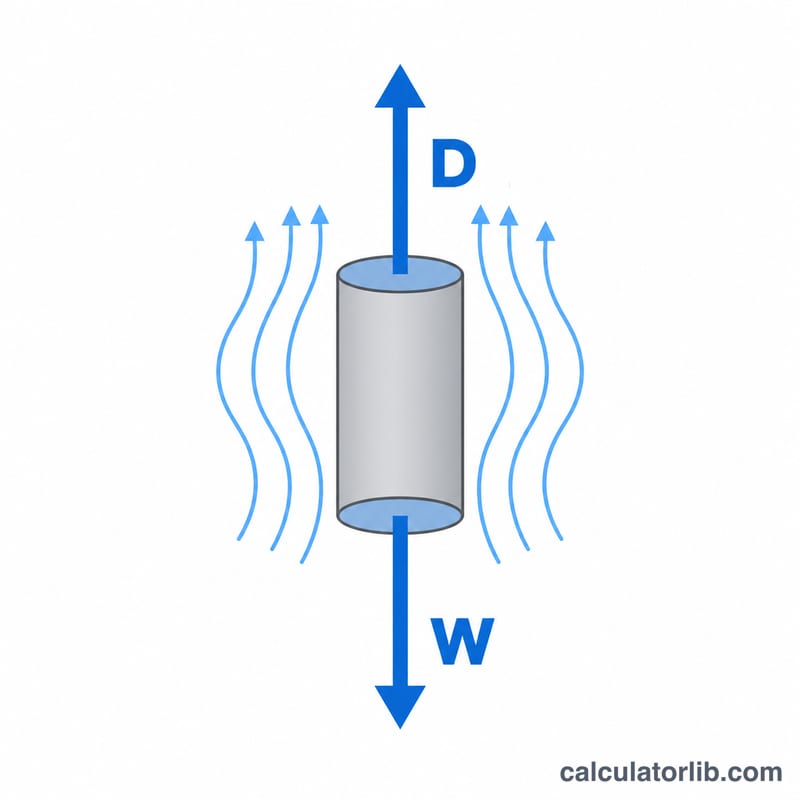
When a cylinder falls through air or another fluid, drag grows with speed. Eventually the upward drag force equals the downward weight, net force becomes zero, and the cylinder stops accelerating. The constant speed it then holds is the terminal velocity. This calculator estimates it from the cylinder mass, size, orientation, drag coefficient, fluid density and gravity.
How to use the calculator
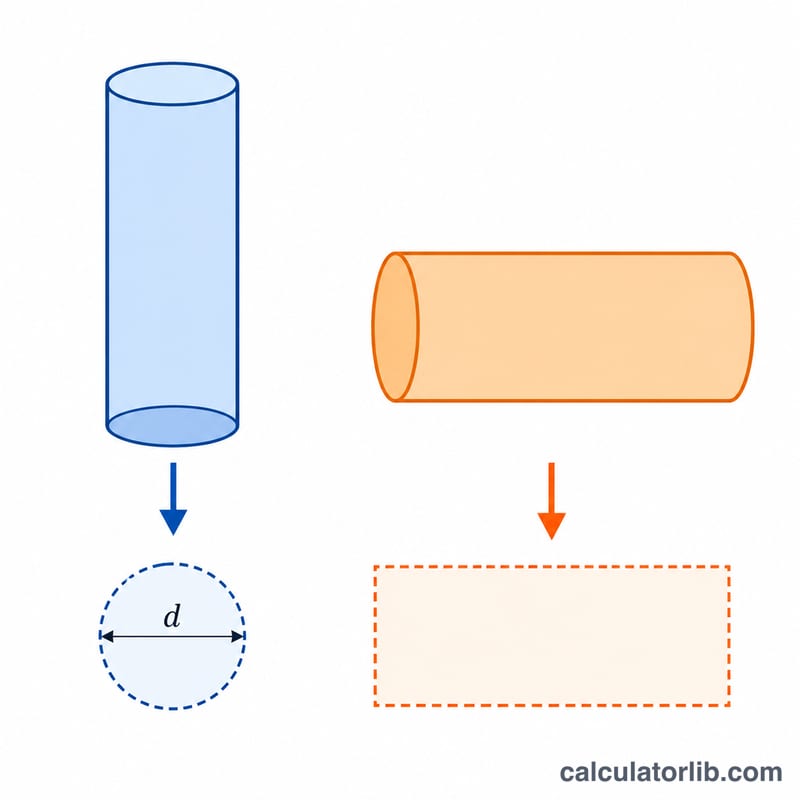
Enter the mass in kilograms, the diameter and length in metres, and choose whether the cylinder falls end-on (axis vertical) or broadside (axis horizontal). Provide a drag coefficient: roughly 0.8 to 1.0 for a flat-ended cylinder falling end-on, and about 1.0 to 1.2 for a long cylinder broadside. The defaults use air at sea level (1.225 kg/m³) and g = 9.81 m/s².
The formula explained
Setting weight equal to quadratic drag gives:
$$v_t = \sqrt{\frac{2 m g}{\rho \, C_d \, A}}$$Here \(m\) = mass in kg, \(g\) = gravity, \(\rho\) = fluid density, \(C_d\) = drag coefficient and \(A\) = projected frontal area. End-on, \(A = \pi d^2/4\); broadside, \(A = d \times L\). Buoyancy is ignored, which is fine for air but not for dense liquids.
Worked example
A 2 kg cylinder with \(d = 0.2\,\text{m}\) and \(L = 0.5\,\text{m}\) falls broadside, with \(C_d = 1.2\), \(\rho = 1.2\,\text{kg/m}^3\) and \(g = 10\,\text{m/s}^2\). The area is \(A = 0.2 \times 0.5 = 0.1\,\text{m}^2\).
$$v_t = \sqrt{\frac{2 \times 2 \times 10}{1.2 \times 1.2 \times 0.1}} = \sqrt{277.78} = 16.67\,\text{m/s}$$That is about 60 km/h.
Typical Drag Coefficients and Fluid Densities
The calculator uses \(v_t = \sqrt{2mg/(\rho C_d A)}\), so the drag coefficient \(C_d\) and the fluid density \(\rho\) directly affect the result. The values below are approximate engineering figures for typical turbulent, high-Reynolds-number flow. Real values depend on the Reynolds number, surface roughness, edge sharpness and how steadily the body falls.
Approximate drag coefficient of a cylinder
| Orientation to flow | Length-to-diameter ratio L/D | Approximate Cd |
|---|---|---|
| End-on (flat face leading, axis along flow) | about 1 | 0.8 – 1.15 |
| End-on (flat face leading) | about 2 – 8 | 0.75 – 0.9 |
| Broadside (axis perpendicular to flow) | 1 – 2 | 0.6 – 0.8 |
| Broadside | 5 – 10 | 0.75 – 0.85 |
| Broadside | 20 – 40 | 0.9 – 1.0 |
| Broadside, very long (near two-dimensional) | > 40 | 1.0 – 1.2 |
Notes: a thin disc (L/D → 0) facing the flow has a Cd of about 1.1–1.2. Rounding the leading edge lowers the end-on value considerably. For a broadside cylinder, Cd is roughly constant at about 1.0–1.2 over a wide Reynolds-number range, then drops sharply at very high Reynolds numbers (the drag crisis). In practice a freely falling cylinder often tumbles, so a fixed orientation is an idealisation. The area used in the formula must match the orientation: \(\pi d^2/4\) for end-on, and roughly \(d \times L\) for broadside.
Typical fluid densities
| Fluid | Density (kg/m³) |
|---|---|
| Air, sea level, 15 °C (ISA standard atmosphere) | 1.225 |
| Air at 2000 m altitude (ISA) | about 1.007 |
| Fresh water, about 20 °C | about 998 |
| Sea water (typical salinity) | about 1025 |
These are approximate. Water density varies slightly with temperature and salinity, and air density varies with weather, temperature and altitude.
Constants and Default Values Used
- Gravity: standard gravity is \(g = 9.80665\) m/s². The calculator default is 9.81 m/s², which is accurate enough for almost all uses. Local gravity varies by about ±0.5% with latitude and altitude. Enter another value for other planets or moons.
- Air density: 1.225 kg/m³ is the International Standard Atmosphere (ISA) value at sea level and 15 °C (101,325 Pa).
- Fluid density in the formula: terminal velocity scales as \(1/\sqrt{\rho}\). Halving the density raises the speed by a factor of about 1.41.
How air density varies
For dry air treated as an ideal gas, \(\rho = p/(R_{\text{air}}\,T)\) with \(R_{\text{air}} \approx 287.05\) J/(kg·K) and \(T\) in kelvin. At the same pressure, warmer air is less dense. Approximate values at sea-level pressure are:
| Condition | Air density (kg/m³) |
|---|---|
| 0 °C | about 1.29 |
| 15 °C | 1.225 |
| 20 °C | about 1.204 |
| 30 °C | about 1.165 |
Density also falls with altitude as pressure drops. In the ISA it is about 1.112 kg/m³ at 1000 m, about 1.007 kg/m³ at 2000 m, and about 0.736 kg/m³ at 5000 m.
Unit conversions for the result
- m/s to km/h: multiply by 3.6.
- m/s to mph: multiply by about 2.237 (exactly 2.23694).
For example, 20 m/s = 72 km/h ≈ 44.7 mph.
FAQ
Does a heavier cylinder fall faster?
Yes. Terminal velocity scales with the square root of mass, so quadrupling the mass doubles the speed.
Why does orientation matter?
It changes both the frontal area and the drag coefficient. A cylinder falling end-on presents a small area and usually reaches a higher speed.
Is the result exact?
It is an estimate. Real cylinders tumble, and the drag coefficient varies with Reynolds number and length-to-diameter ratio.