What this calculator does
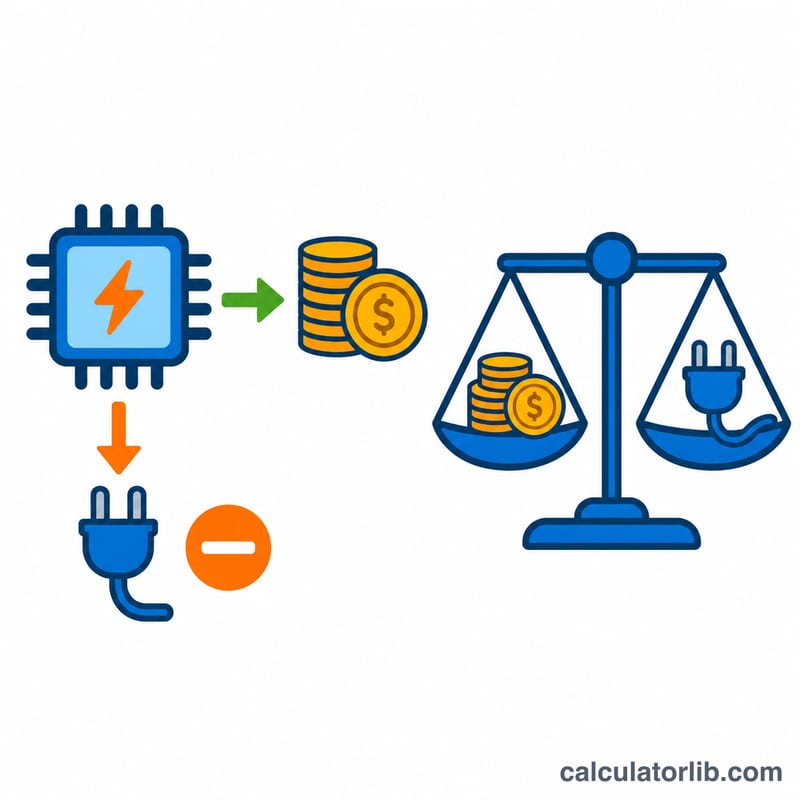
This CPU mining profitability calculator estimates how much you could earn, or lose, by mining a CPU-friendly cryptocurrency (such as a CryptoNote or RandomX style coin). Enter your hash rate, the network difficulty, the block reward, the coin price, your power draw and your electricity tariff, and it returns expected coins per day, revenue, electricity cost, and profit per day, month and year.
How to use it
Enter your CPU hash rate in H/s (kH/s means multiply by 1,000). Use the current network difficulty, defined here as the expected number of hashes needed to find one block. Add the block reward, the coin price, the wall-power consumption of your rig in watts, your electricity cost per kWh and any pool fee percentage. The break-even coin price tells you the price at which profit is exactly zero.
The formula explained
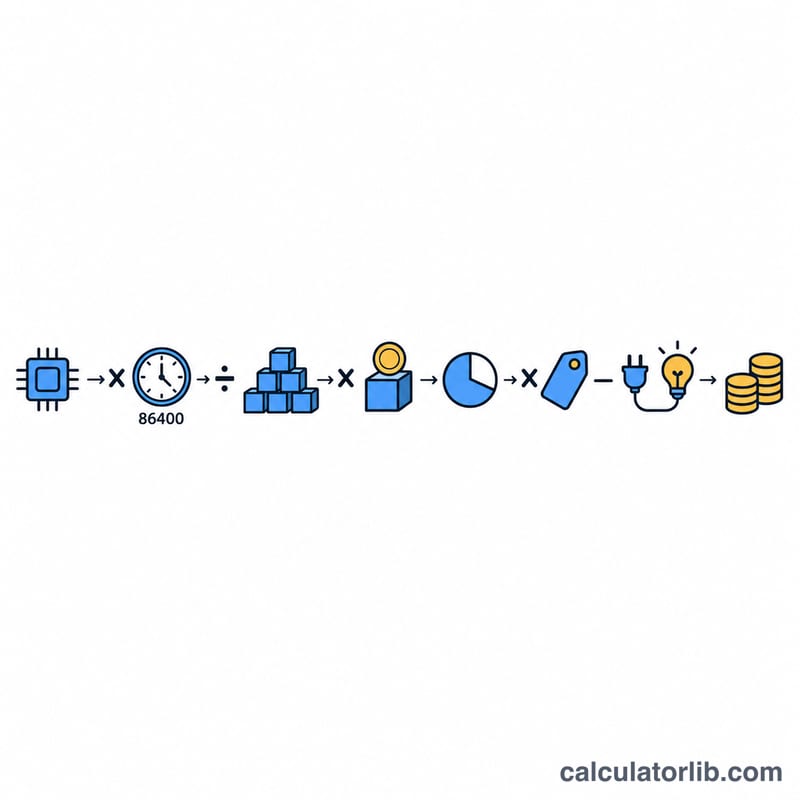
Your share of the network is your hash rate divided by the difficulty-implied hashes per block, so expected blocks per day are \(H \times 86400 / D\). Multiply by the reward \(R\) and by \((1-f)\) for the pool fee \(f\):
$$N = \frac{H \times 86400}{D} \times R \times (1-f)$$Electricity cost per day is \(\frac{W}{1000} \times 24 \times c\), so:
$$\text{Profit} = N \times P - \frac{W}{1000} \times 24 \times c$$This is an expected value; real payouts vary with luck, difficulty changes and price swings.
Worked example
Take \(H = 5000\) H/s, \(D = 3\times10^{11}\), \(R = 0.6\), \(f = 1\%\), price 150 and a 100 W rig at 0.12 per kWh.
$$N = \frac{5000 \times 86400}{3\times10^{11}} \times 0.6 \times 0.99 = 0.00085536$$$$\text{Revenue} = 0.00085536 \times 150 = 0.1283$$$$\text{Cost} = 0.1 \times 24 \times 0.12 = 0.288$$$$\text{Profit} = 0.1283 - 0.288 = -0.1597\text{ per day}$$This rig loses money at these settings, which is common for CPU mining on home electricity.
Profit Under Different Electricity Costs and Power Draws
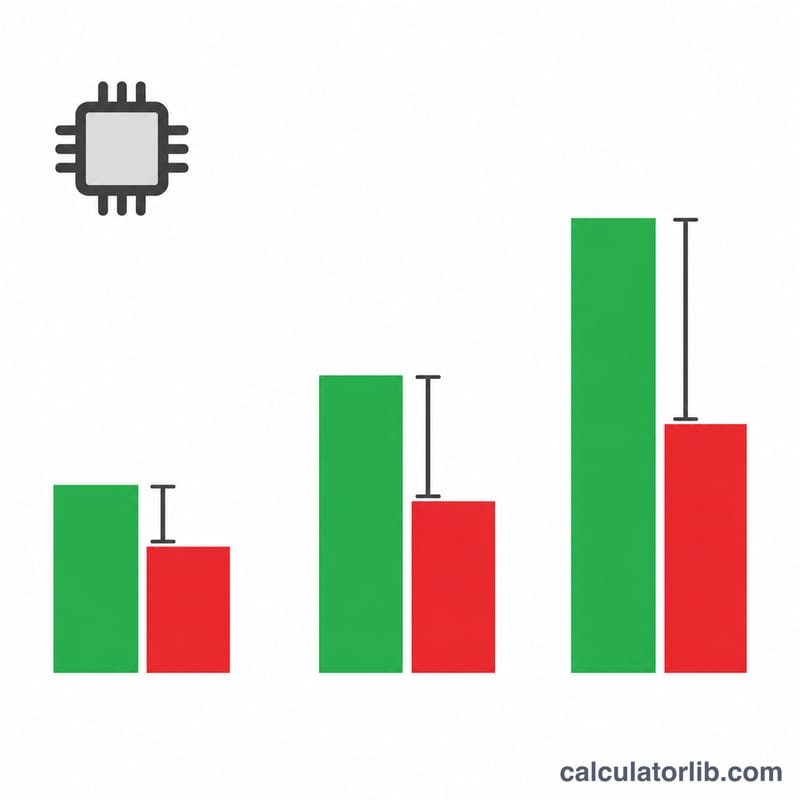
This table reuses one worked example: hash rate \(H = 5000\) H/s, difficulty \(D = 3\times10^{11}\), block reward \(R = 0.6\) coins, pool fee \(f = 1\%\), coin price \(P_c = 150\). Only the wall power draw and the electricity tariff change. All currency amounts are in one generic currency unit per day.
Coins mined per day: $$C = \frac{5000 \times 86400}{3\times10^{11}} \times 0.6 \times \left(1 - \frac{1}{100}\right) = 0.00144 \times 0.6 \times 0.99 = 0.00085536$$
Daily revenue: \(C \cdot P_c = 0.00085536 \times 150 = 0.128304\), or about 0.1283. Daily electricity cost: \(E = \dfrac{P}{1000} \times 24 \times \text{tariff}\). Daily profit: revenue minus \(E\).
| Power draw (W) | Tariff (per kWh) | Energy per day (kWh) | Daily revenue | Daily electricity cost | Daily profit |
|---|---|---|---|---|---|
| 65 | 0.05 | 1.56 | 0.1283 | 0.0780 | 0.0503 |
| 65 | 0.12 | 1.56 | 0.1283 | 0.1872 | -0.0589 |
| 65 | 0.25 | 1.56 | 0.1283 | 0.3900 | -0.2617 |
| 100 | 0.05 | 2.40 | 0.1283 | 0.1200 | 0.0083 |
| 100 | 0.12 | 2.40 | 0.1283 | 0.2880 | -0.1597 |
| 100 | 0.25 | 2.40 | 0.1283 | 0.6000 | -0.4717 |
| 150 | 0.05 | 3.60 | 0.1283 | 0.1800 | -0.0517 |
| 150 | 0.12 | 3.60 | 0.1283 | 0.4320 | -0.3037 |
| 150 | 0.25 | 3.60 | 0.1283 | 0.9000 | -0.7717 |
Revenue is fixed in every row because hash rate, difficulty, reward, fee and price do not change. Only the 65 W and 100 W rows at the cheapest tariff (0.05) are profitable, and the 100 W row only barely. Multiply a daily figure by 30 for a rough monthly estimate, or by 365 for a yearly one.
Mining Terms and Variables Explained
- Hash rate (\(H\)) — unit: H/s
- The number of hash computations your CPU performs per second. 1 kH/s = 1,000 H/s and 1 MH/s = 1,000,000 H/s. Enter the value in H/s in the formula, so convert kH/s or MH/s first.
- Network difficulty (\(D\)) — unit: expected hashes per block
- As used here, the average number of hashes the whole network must compute to find one block. Your share of blocks per day is \(H \times 86400 / D\), where 86400 is the number of seconds in a day. Other coins define difficulty on different scales, so check which definition your coin uses.
- Block reward (\(R\)) — unit: coins per block
- The number of coins issued for each block found. Transaction fees are not included unless you add them to \(R\).
- Pool fee (\(f\)) — unit: percent
- The share of your mining revenue that the pool keeps. Revenue is multiplied by \(1 - f/100\).
- Wall power draw (\(P\)) — unit: watts (W)
- The power the whole system draws from the socket while mining, ideally measured with a plug-in power meter. It is usually higher than the CPU's rated TDP.
- Electricity tariff (\(k\)) — unit: currency per kWh
- The price you pay per kilowatt-hour. Daily electricity cost is \(E = \dfrac{P}{1000} \times 24 \times k\).
- Coin price (\(P_c\)) — unit: currency per coin
- The market price used to value the coins you mine.
- Break-even coin price (\(P_{be}\)) — unit: currency per coin
- The coin price at which daily profit is exactly zero: $$P_{be} = \frac{E}{C}$$ where \(C\) is the net coins mined per day after the pool fee.
Interpreting Your Profit Result
Negative profit means the electricity cost over the period is greater than the expected value of the coins mined. A positive figure means expected revenue exceeds electricity cost, nothing more.
Break-even price. This is the coin price at which profit is zero, \(P_{be} = E / C\). In the worked example (\(C = 0.00085536\) coins/day), a 100 W machine at 0.12 per kWh has \(E = 0.288\) per day, so $$P_{be} = \frac{0.288}{0.00085536} \approx 336.70$$ The coin price of 150 is well below that, which matches the negative profit of -0.1597 per day in the comparison table. If the market price is above your break-even price, expected profit is positive; if it is below, expected profit is negative.
These are expected values. The calculator uses the average block-finding rate. Actual payouts vary because of:
- Luck: block finding is random, especially at low hash rates.
- Difficulty changes: if difficulty rises, your share of blocks falls. The calculator assumes the value you entered stays constant.
- Price swings: coin prices can move substantially within a day.
- Pool variance: payout schemes, minimum payout thresholds and fee structures affect when and how much you receive.
What is not included. The figures exclude hardware purchase cost, taxes on mining income, cooling or extra air-conditioning costs, network or maintenance costs, and transaction fees when you sell or move coins. The tax treatment of mining income depends on your country.
This is general information for understanding the calculation, not financial or investment advice.
FAQ
Why is my CPU mining unprofitable?
CPU hash rates are small compared with network difficulty, so revenue is often below electricity cost unless power is cheap or the coin price is high.
Does this include hardware cost?
No. Divide your hardware price by the daily profit to estimate payback time, if profit is positive.
Which difficulty should I enter?
Use the value your coin network reports as expected hashes per block. Bitcoin-style targets need an extra factor of 2^32, so convert first.