What is a solar battery payback period?
The payback period is the time it takes for the money a home battery saves you to equal what you paid for it. A battery stores surplus solar power or cheap off-peak electricity and uses it when grid prices are high, which reduces your bill. This calculator turns your installed cost, incentives and expected yearly savings into a clear number of years.
How to use the calculator
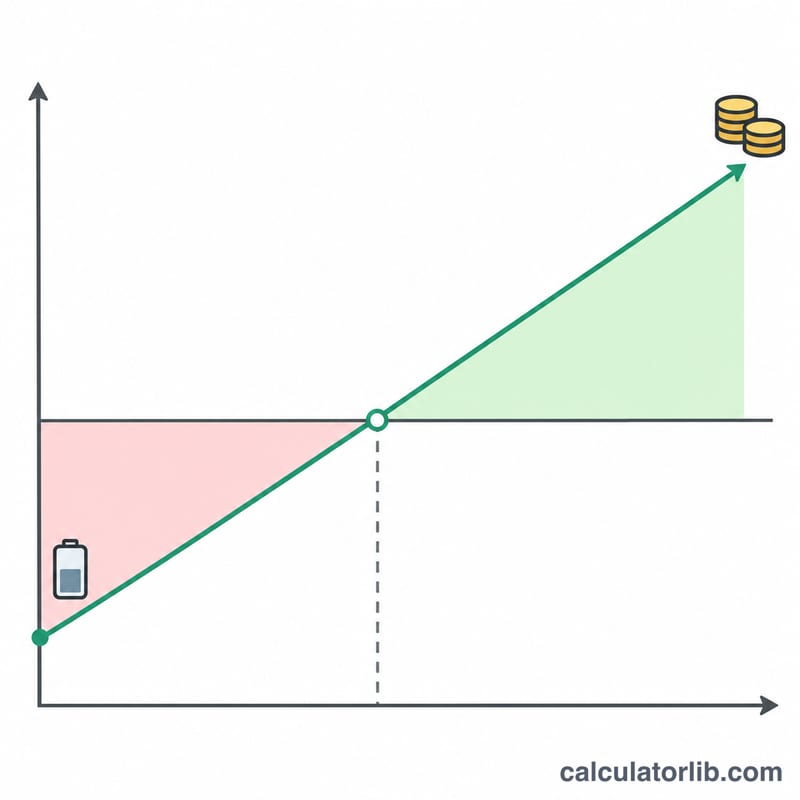
Enter the full installed cost of the battery, then any tax credit or rebate as a percentage of that cost. Add the annual electricity savings you expect (from avoided peak rates, higher self-consumption or backup value) and any yearly maintenance cost. If you expect savings to rise with electricity prices, enter a positive yearly change; enter a negative value to model battery degradation. Finally set the battery lifespan to see lifetime profit.
The formula explained
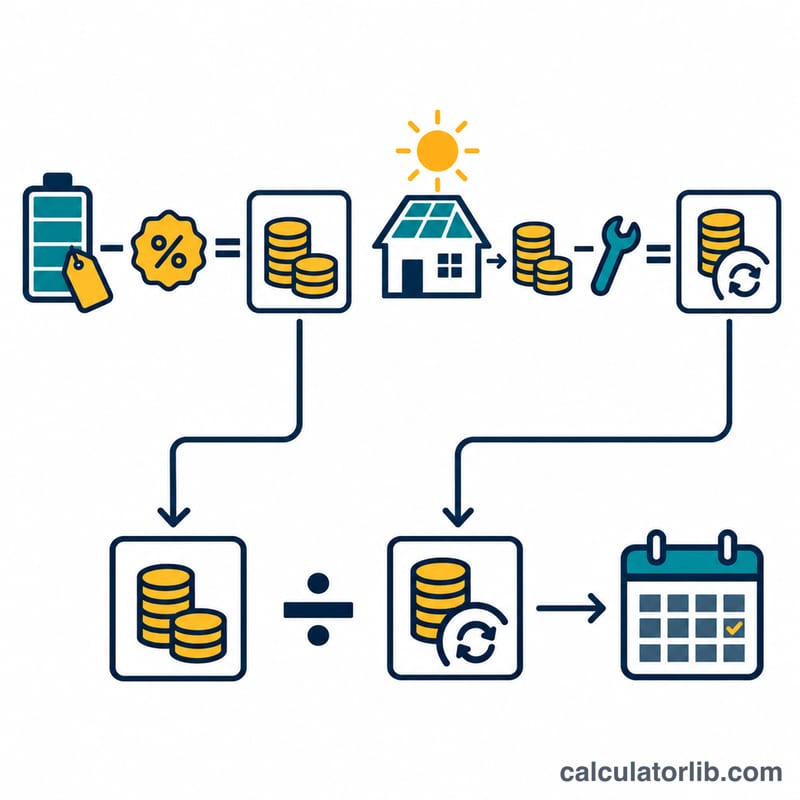
First the net cost is \(C(1-i)\), where \(C\) is installed cost and \(i\) is the incentive share. Net yearly savings are \(S-M\), with \(S\) the annual savings and \(M\) the maintenance. The simple payback is:
$$T = \frac{C(1-i)}{S-M}$$When savings change by rate \(g\) each year, the calculator adds up year-by-year net savings \(S(1+g)^{k-1}-M\) until the total reaches the net cost, and interpolates inside the final year for a fractional answer.
Worked example
A battery costs 10,000 with a 30% incentive, saves 1,200 per year and costs 100 per year to maintain. The net cost and payback are:
$$C(1-i) = 10{,}000 \times 0.70 = 7{,}000$$$$T = \frac{7{,}000}{1{,}200 - 100} = \frac{7{,}000}{1{,}100} \approx 6.36\,\text{years}$$Over a 15-year life the net profit is \(15 \times 1{,}100 - 7{,}000 = 9{,}500\).
Payback Under Different Scenarios
All scenarios use the same battery with an installed cost of 10,000 (any currency), an assumed annual maintenance of 50, and a 15-year lifespan. Net cost is \(C_n = 10{,}000\,(1 - \text{rebate}/100)\). Net yearly savings is \(S - M\). Where the yearly change is \(g = 0\), the simple payback is \(C_n/(S-M)\) and lifetime profit is \(15\,(S-M) - C_n\). With \(g \neq 0\), lifetime profit uses \(\sum_{y=1}^{15} S(1+g)^{y-1} - 15M - C_n\), and the payback is the year in which cumulative net savings reach \(C_n\), interpolated within that year.
| Scenario | Net cost | Net yearly savings (year 1) | Payback (years) | 15-year lifetime profit |
|---|---|---|---|---|
| No incentive, S = 1,200, g = 0% | 10,000 | 1,150 | 10,000 / 1,150 = 8.70 | 15 × 1,150 − 10,000 = 7,250 |
| 30% incentive, S = 800, g = 0% | 7,000 | 750 | 7,000 / 750 = 9.33 | 15 × 750 − 7,000 = 4,250 |
| 30% incentive, S = 1,200, g = 0% | 7,000 | 1,150 | 7,000 / 1,150 = 6.09 | 15 × 1,150 − 7,000 = 10,250 |
| 30% incentive, S = 1,600, g = 0% | 7,000 | 1,550 | 7,000 / 1,550 = 4.52 | 15 × 1,550 − 7,000 = 16,250 |
| 30% incentive, S = 1,200, g = +3%/yr | 7,000 | 1,150 | ≈ 5.66 (flat simple: 6.09) | 1,200 × (1.0315 − 1)/0.03 − 750 − 7,000 = 22,318.69 − 750 − 7,000 = 14,568.69 |
| 30% incentive, S = 1,200, g = −2%/yr | 7,000 | 1,150 | ≈ 6.44 (flat simple: 6.09) | 1,200 × (1 − 0.9815)/0.02 − 750 − 7,000 = 15,685.85 − 750 − 7,000 = 7,935.85 |
Takeaways: a 30% incentive cuts the payback of the 800-savings case from 13.33 years (10,000 / 750, not shown above) to 9.33 years. Higher savings matter even more. A 3% yearly rise in savings shortens payback and lifts lifetime profit, while a 2% yearly decline lengthens payback and cuts lifetime profit by roughly 2,300 compared with the flat case. The 15-year profit figures assume the battery lasts the full 15 years.
Typical Solar Battery Costs, Lifespans and Warranties
The ranges below are general market descriptions, not quotes. They vary widely by country, battery chemistry, installer, system size and local incentives. For current numbers, check manufacturer datasheets and warranty documents, national or regional energy agencies, and several local installer quotes.
- Installed cost: Home batteries are often quoted either per kWh of usable capacity or as a complete system price. Installed prices generally run from several hundred to over a thousand currency units per kWh. A complete residential system often costs several thousand to well over ten thousand. Installation, inverter or hybrid-inverter upgrades, and permitting can change the total significantly.
- Warranty: Manufacturer warranties commonly run about 10 years. Many also cap the total energy throughput (for example, a set number of MWh) or the number of cycles. They usually guarantee a minimum remaining capacity at the end of the term. Read the exact terms, because the first limit reached ends the coverage.
- Expected lifespan: A typical planning assumption is about 10 to 15 years, depending on chemistry, depth of discharge, temperature and how often it cycles. Using a lifespan longer than the warranty makes your payback estimate more optimistic.
- Capacity degradation: Usable capacity declines gradually, typically by a few percent per year or less, with faster loss under heavy cycling or high temperatures. Lower effective capacity means lower yearly savings, which you can model with a negative yearly change.
- Maintenance: Modern lithium-based home batteries need little routine maintenance. Annual costs are usually low, often near zero to a small amount for inspections or monitoring, though out-of-warranty repairs or inverter replacement can add cost.
This is general information, not professional financial or installation advice. Compare quotes and confirm which incentives apply where you live.
FAQ
What is a good payback period for a solar battery?
Many homeowners consider 6 to 10 years reasonable, especially if it is well inside the warranty period, usually 10 years or more.
Should I include backup power value?
Only if you can put a realistic money figure on it, such as avoided outage costs. Otherwise keep savings to bill reductions for a conservative result.
Why is the payback longer than the simple estimate sometimes?
If you enter a negative yearly change to reflect degradation, savings shrink over time, so recovery takes longer than the flat estimate. If it never recovers, the result says so.