What This Calculator Does
The Oxygen Tank Duration Calculator estimates how many minutes of oxygen remain in a compressed gas cylinder based on its current gauge pressure, the cylinder's tank conversion factor, and the prescribed flow rate. It is a planning aid commonly used by clinicians, EMS, and respiratory therapists. It is an estimate only and should never replace direct monitoring of the patient and the tank gauge.
How to Use It
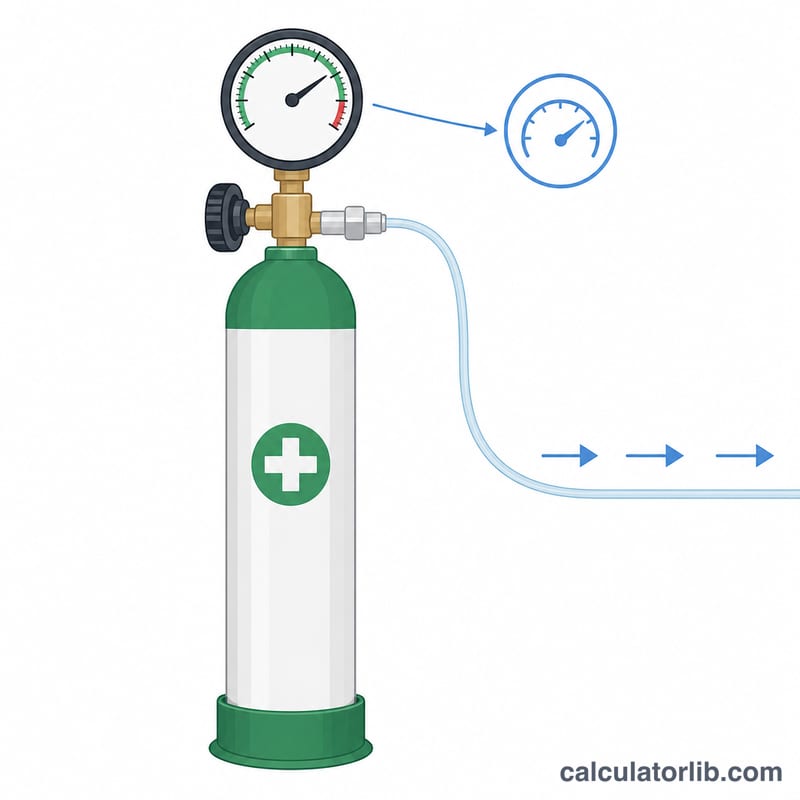
Read the current pressure from the regulator gauge in psi. Choose the factor that matches your cylinder size (D 0.16 L/psi, E 0.28, M 1.56, G 2.41, H/K 3.14). Enter the oxygen flow rate in liters per minute and, if your protocol uses a different reserve, the safe residual pressure (200 psi by default). The calculator returns the usable minutes before the reserve is reached, an hours-and-minutes breakdown and the theoretical time to empty.
The Formula Explained
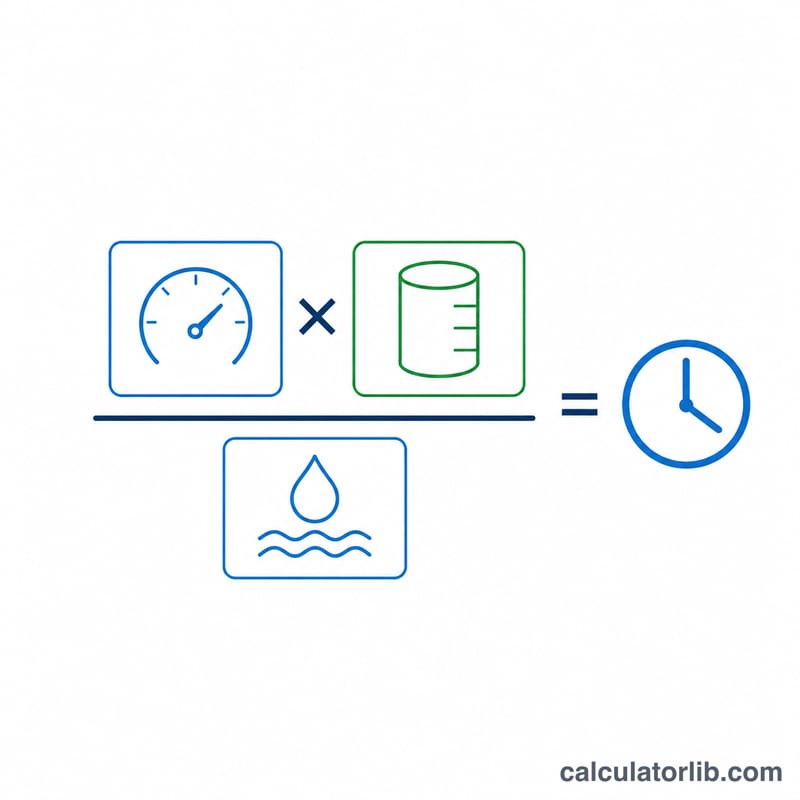
$$\text{Duration (min)} = \frac{\text{Gauge Pressure} \times \text{Tank Factor}}{\text{Flow Rate}}$$ The tank factor converts pressure into available volume of usable gas for a given cylinder, so multiplying it by gauge pressure gives the liters remaining. Dividing by the flow rate (L/min) yields the minutes of supply.
The calculator first subtracts a safe residual pressure (200 psi by default, editable), so its main result is the usable time: Duration = (Gauge − Residual) × Factor ÷ Flow. The time to a completely empty cylinder is shown separately.
Worked Example
An E cylinder (factor 0.28) reads 2000 psi and is set to 2 L/min. $$\text{Duration} = \frac{2000 \times 0.28}{2} = \frac{560}{2} = 280 \text{ minutes}$$ or about 4 hours and 40 minutes.
With the default 200 psi safe residual, the calculator shows \((2000 - 200) \times 0.28 \div 2 = 252\) minutes (about 4 h 12 min) as usable time, and 280 minutes as the time to empty.
Cylinder Tank Factors by Size
The tank factor (liters of gas per psi of gauge pressure) converts a gauge reading into remaining volume: \(\text{Volume (L)} = \text{Pressure (psi)} \times \text{Factor (L/psi)}\). The values below are the commonly used US-convention figures for medical oxygen cylinders rated in psi. Capacities are approximate and assume a full fill of about 2200 psi.
| Cylinder size | Tank factor (L/psi) | Approx. full capacity (L) | Typical full pressure (psi) |
|---|---|---|---|
| D | 0.16 | about 350 | 2000-2200 |
| E | 0.28 | about 620 | 2000-2200 |
| M | 1.56 | about 3,400 | 2000-2200 |
| G | 2.41 | about 5,300 | 2000-2200 |
| H / K | 3.14 | about 6,900 | 2000-2200 |
Verify before relying on it: factors and capacities vary slightly by manufacturer, cylinder material (steel vs. aluminum) and fill pressure, so check the cylinder label or supplier documentation. The calculator's dropdown offers D 0.16, E 0.28, M 1.56, G 2.41 and H/K 3.14. Smaller portable sizes (such as M6 or M9) have brand-specific factors: use the figure printed on the cylinder.
Duration Across Common Scenarios
Each value is \(\text{Duration (min)} = \dfrac{\text{Pressure} \times \text{Factor}}{\text{Flow}}\), the theoretical time until the gauge reads 0 psi. For example, an E cylinder at 2000 psi and 2 L/min gives \(\dfrac{2000 \times 0.28}{2} = \dfrac{560}{2} = \)280 minutes.
| Cylinder (factor) | Gauge (psi) | Gas volume (L) | 2 L/min | 4 L/min | 10 L/min | 15 L/min |
|---|---|---|---|---|---|---|
| D (0.16) | 2000 | 320 | 160 min | 80 min | 32 min | 21.3 min |
| D (0.16) | 500 | 80 | 40 min | 20 min | 8 min | 5.3 min |
| E (0.28) | 2000 | 560 | 280 min | 140 min | 56 min | 37.3 min |
| E (0.28) | 500 | 140 | 70 min | 35 min | 14 min | 9.3 min |
| M (1.56) | 2000 | 3,120 | 1,560 min | 780 min | 312 min | 208 min |
| M (1.56) | 500 | 780 | 390 min | 195 min | 78 min | 52 min |
| G (2.41) | 2000 | 4,820 | 2,410 min | 1,205 min | 482 min | 321.3 min |
| H/K (3.14) | 2000 | 6,280 | 3,140 min | 1,570 min | 628 min | 418.7 min |
Durations are in minutes; divide by 60 for hours (for example, 280 min is about 4 h 40 min). Doubling the flow halves the duration, and halving the pressure also halves it.
Interpreting Your Result
The calculated time is the theoretical time until the gauge reaches 0 psi at a constant flow. In practice, cylinders are not run completely empty. Many facility and supplier protocols keep a safety residual, commonly in the range of 200-500 psi, and swap or refill the cylinder when that point is reached. Check which reserve applies in your setting.
To get usable time, subtract the reserve from the gauge reading before calculating:
$$\text{Usable time (min)} = \frac{(\text{Gauge} - \text{Reserve}) \times \text{Factor}}{\text{Flow}}$$
Example: an E cylinder reads 1500 psi, the flow is 4 L/min, and the reserve is 500 psi. Usable pressure is \(1500 - 500 = 1000\) psi, so \(\dfrac{1000 \times 0.28}{4} = \dfrac{280}{4} = \)70 minutes. Without the reserve, the theoretical time would be \(\dfrac{1500 \times 0.28}{4} = 105\) minutes.
Assumptions and limits:
- Flow is constant and matches the regulator setting. Real flow can drift, and pulse-dose or demand devices use gas differently from continuous flow.
- The gauge reading is accurate. Gauges can have errors, so confirm with the supplier if a reading looks wrong.
- The estimate does not account for temperature, which affects cylinder pressure, or for regulator variation and leaks.
- The tank factor must match your actual cylinder. Confirm it on the label.
Treat the result as an estimate and plan to change the cylinder well before the calculated end time. This is general information, not clinical guidance. Follow your prescriber's, supplier's or facility's instructions for oxygen use and cylinder changes.
FAQ
Should I plan to empty the tank? No. Always keep a safe reserve (often a switch at 200–500 psi) and account for transport time.
Where do tank factors come from? They are standard published constants representing usable liters per psi for each cylinder size.
Does flow rate affect accuracy? Higher flow shortens duration proportionally; the result assumes a constant flow.