
What This Calculator Does
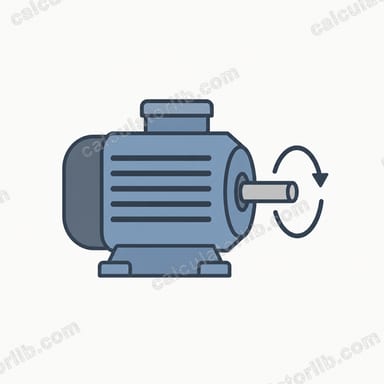
This tool converts an electric motor rated power and speed into the shaft torque it produces. Enter the mechanical power in kilowatts (kW) and the rotational speed in revolutions per minute (RPM), and it returns the torque in newton-metres (N·m), along with a pound-feet conversion. It applies to any rotating machine where you know power and speed, such as electric motors, pumps, fans and gearboxes.
How to Use It
Read the motor power and base speed from the nameplate or data sheet. Type the power in kW and the speed in RPM, then read off the torque. If your motor is rated in horsepower, multiply HP by 0.7457 to get kW first. The speed should be the actual operating speed (for induction motors this is slightly below synchronous speed).
The Formula Explained
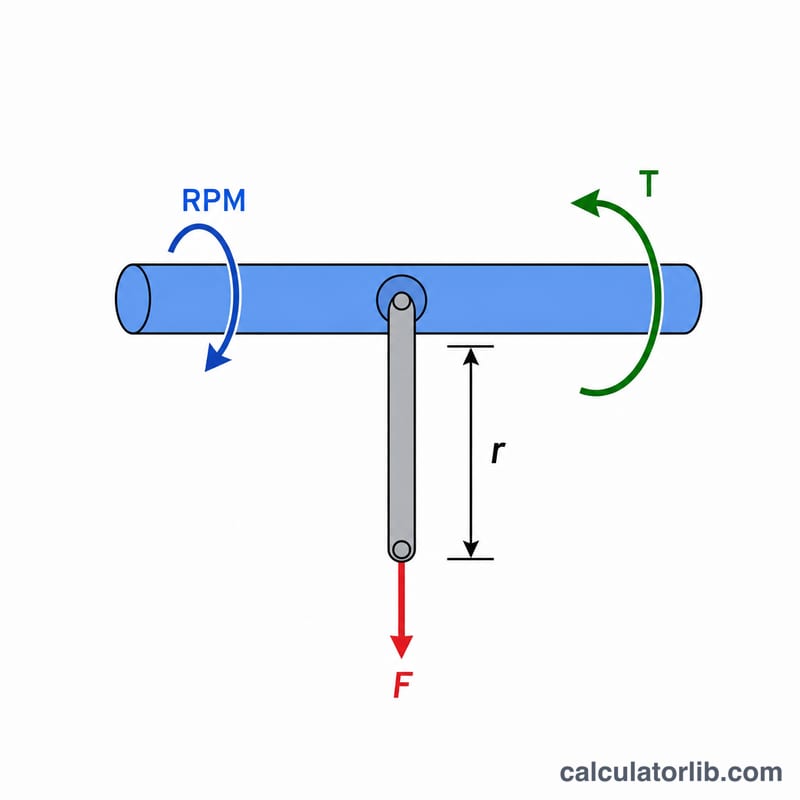
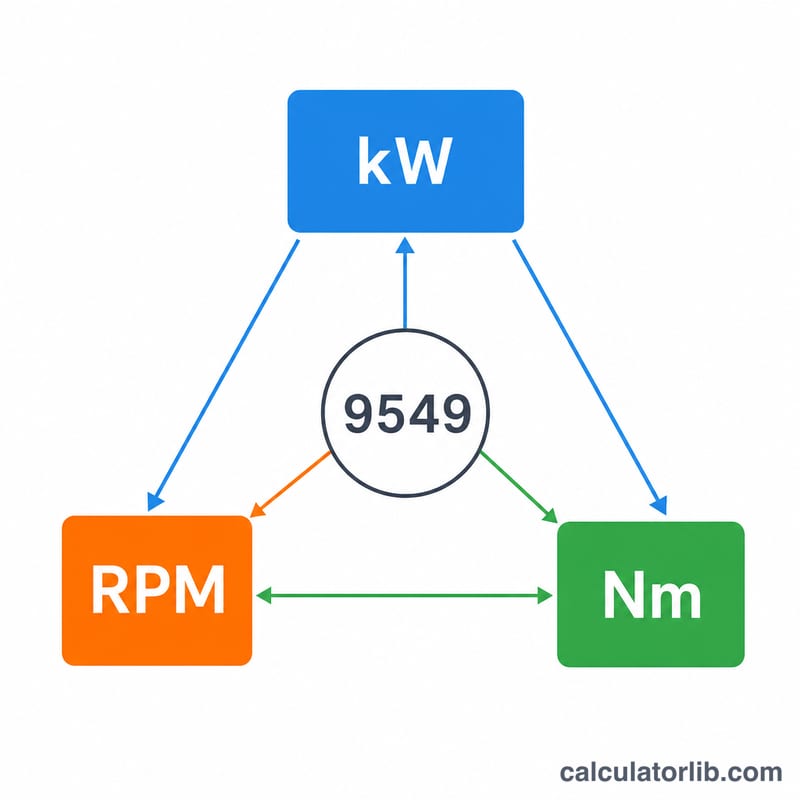
Torque equals power divided by angular velocity: \(T = P / \omega\), where \(\omega\) is in radians per second. Converting power to watts and RPM to rad/s gives the practical constant 9549:
$$T\,(\text{N}\cdot\text{m}) = 9549 \times \frac{P\,(\text{kW})}{\text{RPM}}$$
The constant comes from \(\frac{60}{2\pi} \times 1000 \approx 9549.3\). Lower the speed for the same power and torque rises proportionally, which is why gear reduction multiplies torque.
Worked Example
A 5 kW motor running at 1500 RPM produces
$$T = 9549 \times \frac{5}{1500} = 31.83\ \text{N}\cdot\text{m}$$
or about 23.48 lb·ft. Halving the speed to 750 RPM doubles the torque to about 63.66 N·m.
FAQ
Why 9549 and not 9550? Both are used; 9549.3 is more precise. The small difference is negligible for engineering estimates.
Does this give starting torque? No, it gives the torque at the rated operating point. Starting (locked-rotor) torque is usually a multiple of this and is listed separately on the data sheet.
What if I have horsepower instead of kW? Multiply mechanical HP by 0.7457 to convert to kW, then use this calculator.