
What Is the Elongation Calculator?
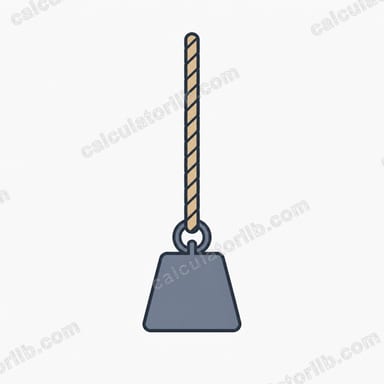
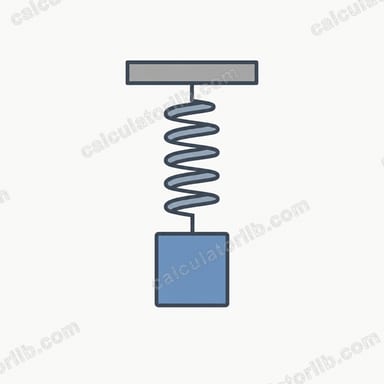
This Elongation Calculator finds how much a straight structural member stretches (or compresses) along its axis when loaded by an axial force. It applies Hooke's law for a uniform prismatic bar in the elastic region, a universal result used in mechanical, civil, and structural engineering worldwide.
The Formula
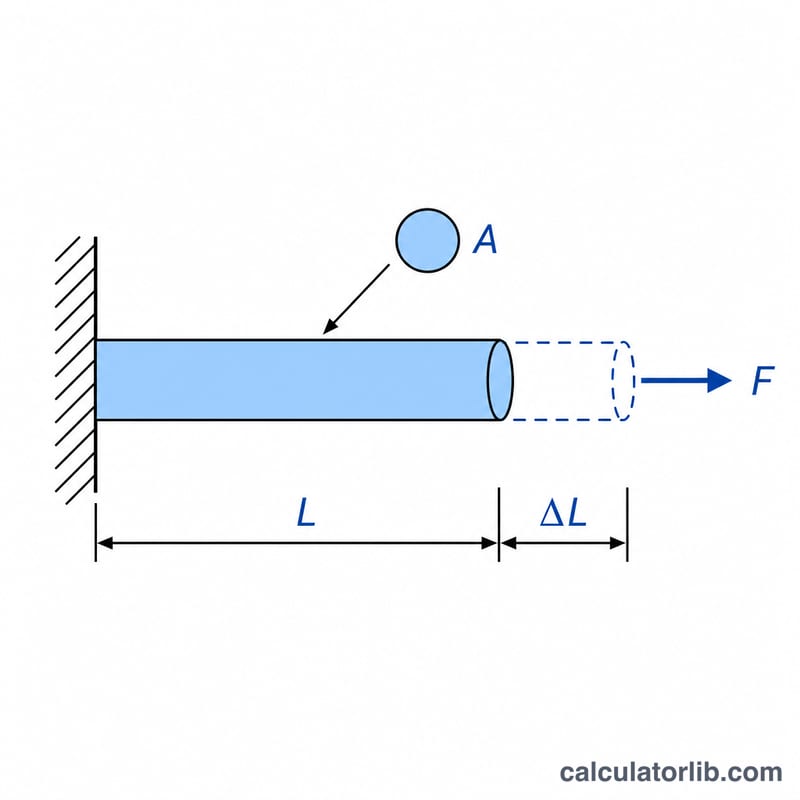
The axial elongation is given by:
$$\Delta L = \frac{\text{Force }F \cdot \text{Length }L}{\text{Area }A \cdot \text{Modulus }E}$$where F is the applied axial force (newtons), L is the original length (meters), A is the cross-sectional area (square meters), and E is Young's modulus (pascals). The calculator also reports the engineering strain \(\varepsilon = \Delta L / L\) and the axial stress \(\sigma = F / A\).
How to Use It
Enter the force, original length, cross-sectional area, and the material's Young's modulus, all in consistent SI units. The result returns the elongation in meters and millimeters, plus strain and stress. Keep loads within the material's elastic limit — this linear formula is only valid below yield.
Worked Example
A steel rod (\(E = 200\ \text{GPa} = 2 \times 10^{11}\ \text{Pa}\)) of length 2 m and cross-section 0.0001 m² (100 mm²) carries a 10,000 N tensile load. Then $$\Delta L = \frac{10000 \times 2}{0.0001 \times 2 \times 10^{11}} = \frac{20000}{20{,}000{,}000} = 0.001\ \text{m} = 1\ \text{mm}.$$ The strain is \(0.001 / 2 = 0.0005\) and the stress is \(10000 / 0.0001 = 100{,}000{,}000\ \text{Pa}\) (100 MPa).
FAQ
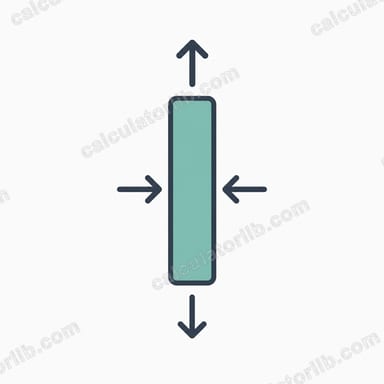
Does this work for compression? Yes — use the same formula with a compressive force; \(\Delta L\) becomes a shortening, provided the member does not buckle.
What units should I use? Use SI: force in N, length and area in m and m², modulus in Pa. Mixing units (e.g. mm with m) will give wrong answers.
Is the result always accurate? The formula assumes a uniform, linear-elastic member loaded below its yield strength. Beyond the elastic limit the response is non-linear and this calculator no longer applies.