
What Is the Magnitude of Acceleration?
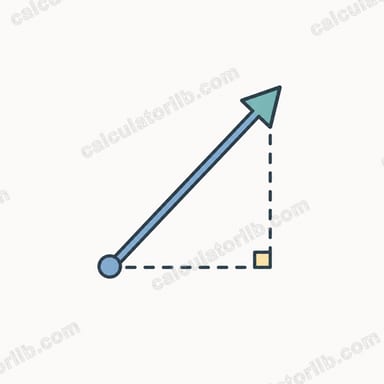
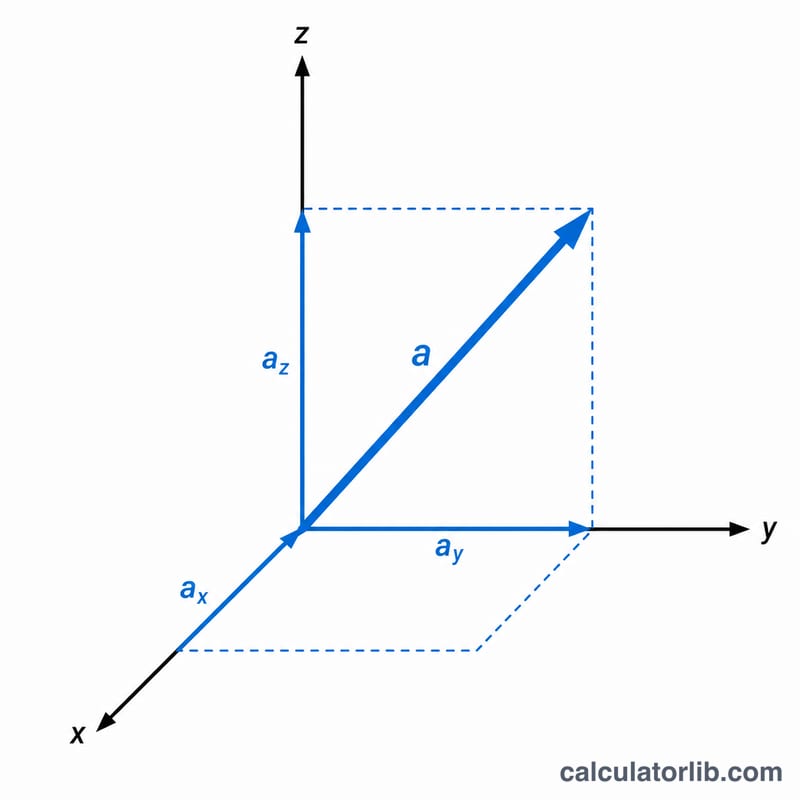
Acceleration is a vector quantity — it has both direction and size. When motion happens in more than one dimension, the acceleration is described by its components along the x, y, and z axes. The magnitude of acceleration is the single number that tells you how strong the overall acceleration is, regardless of direction. This calculator combines the three components into one resultant value using the Pythagorean theorem in three dimensions.
How to Use This Calculator
Enter the acceleration components along each axis in metres per second squared (m/s²). For two-dimensional problems, simply leave the z component at 0. The calculator instantly returns the magnitude \(|\vec{a}|\). The same formula applies in any consistent unit system (ft/s², g-units, etc.) — the output keeps whatever unit you used for the inputs.
The Formula Explained
The magnitude is the length of the acceleration vector:
$$|\vec{a}| = \sqrt{\text{a}_x^{2} + \text{a}_y^{2} + \text{a}_z^{2}}$$
Each component is squared (which removes any negative sign), the squares are summed, and the square root gives the resultant length. By Newton's second law this also equals the net force divided by mass, \(F/m\), since force and acceleration are parallel vectors.
Worked Example
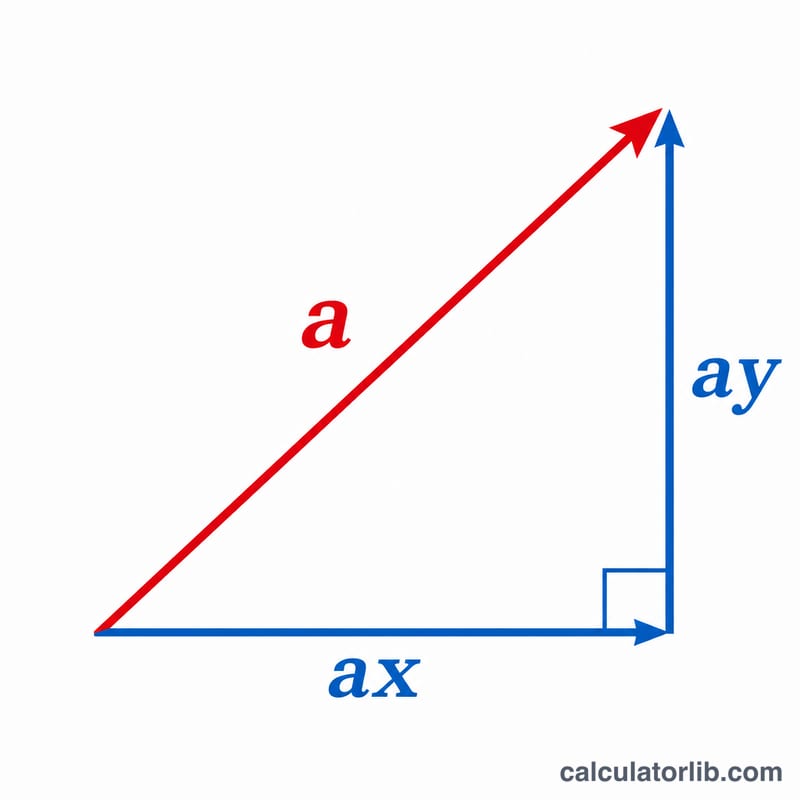
Suppose an object accelerates with \(a_x = 3 \text{ m/s}^2\), \(a_y = 4 \text{ m/s}^2\), and \(a_z = 0\). Then $$|\vec{a}| = \sqrt{3^2 + 4^2 + 0^2} = \sqrt{9 + 16} = \sqrt{25} = 5 \text{ m/s}^2.$$ The familiar 3-4-5 triangle gives a clean resultant of 5 m/s².
FAQ
Can I use this for 2D problems? Yes — set the z component to 0 and it reduces to \(\sqrt{\text{a}_x^{2} + \text{a}_y^{2}}\).
Does the sign of a component matter? Not for the magnitude. Squaring removes the sign, so a value of −4 contributes the same as +4.
What units should I use? Any consistent unit works. If you enter m/s² the answer is in m/s²; the formula itself is unit-independent.