
What Is the Inclined Plane Calculator?
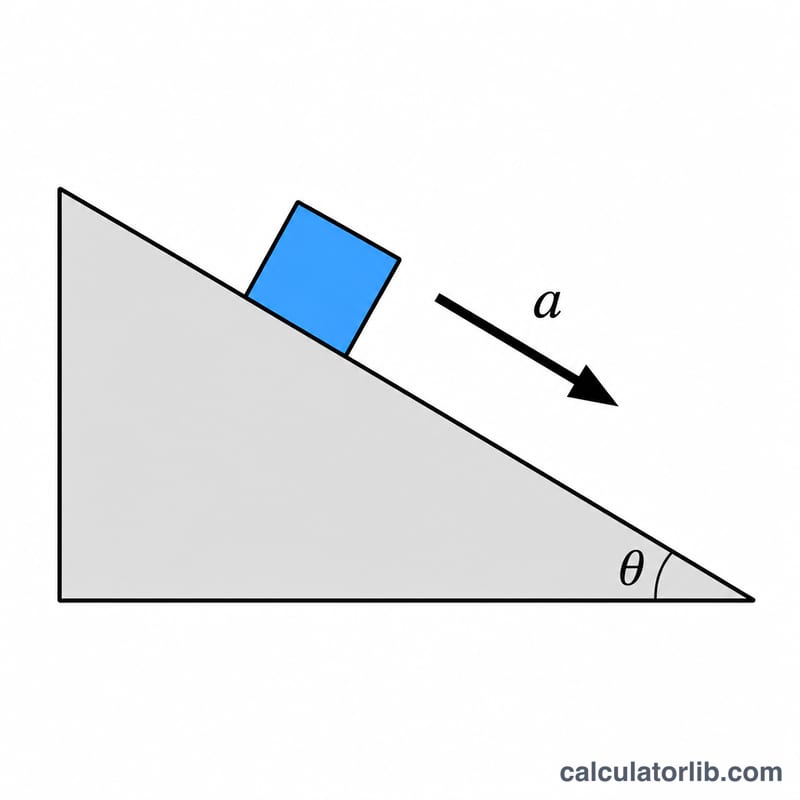
An inclined plane is a flat surface tilted at an angle. This calculator works out how an object on a ramp behaves: the acceleration it experiences sliding down, the gravity component pulling it along the slope, the normal force pressing it into the surface, and the friction force resisting motion. It is a universal physics tool useful for homework, lab work, and engineering estimates.
How to Use It
Enter the object's mass in kilograms, the incline angle in degrees (0–90), the coefficient of friction (\(\mu\)) between the object and the surface, and the local gravity (default 9.81 m/s² for Earth). The calculator returns the acceleration along the slope plus a breakdown of each force.
The Formula Explained
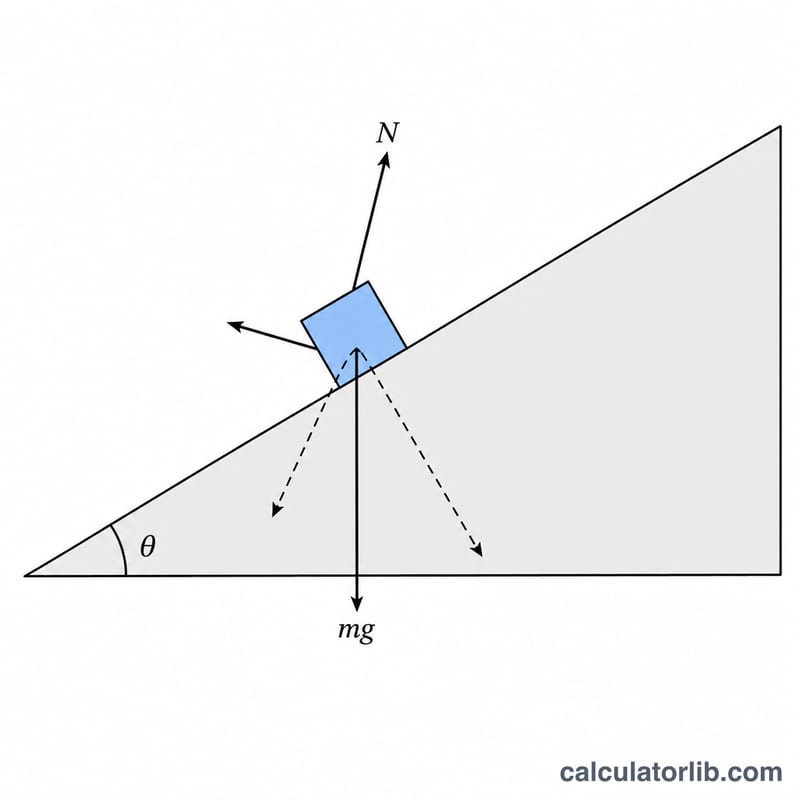
The weight of the object is \(mg\). On a slope of angle \(\theta\) this splits into a component along the slope, \(mg\cdot\sin\theta\), and a component pressing into the surface, the normal force \(N = mg\cdot\cos\theta\). Kinetic friction opposes sliding with force \(\mu\cdot N = \mu\cdot mg\cdot\cos\theta\). The net force along the slope is therefore \(mg\cdot\sin\theta - \mu\cdot mg\cdot\cos\theta\), and dividing by mass gives the acceleration:
$$a = \text{g}\left(\sin\theta - \mu\cos\theta\right)$$
A negative acceleration means friction is strong enough to keep a stationary object at rest (static friction prevents sliding).
Worked Example
A 10 kg block on a 30° ramp with \(\mu = 0.2\) and g = 9.81 m/s². \(\sin 30° = 0.5\), \(\cos 30° \approx 0.8660\). Acceleration = $$9.81 \times (0.5 - 0.2 \times 0.8660) \approx 9.81 \times 0.3268 \approx 3.21 \text{ m/s}^2.$$ Parallel force = \(10 \times 9.81 \times 0.5 = 49.05 \text{ N}\). Normal force = \(10 \times 9.81 \times 0.866 \approx 84.96 \text{ N}\). Friction = \(0.2 \times 84.96 \approx 16.99 \text{ N}\).
FAQ
What if the result is negative? A negative acceleration indicates friction exceeds the gravity component, so the object will not start sliding on its own.
Does this include air resistance? No — it assumes only gravity, normal force, and kinetic friction.
What gravity should I use? Use 9.81 m/s² on Earth, or change it for other planets (e.g. 1.62 for the Moon).