
What is the polar moment of inertia?
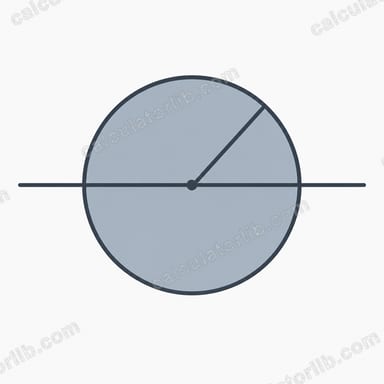
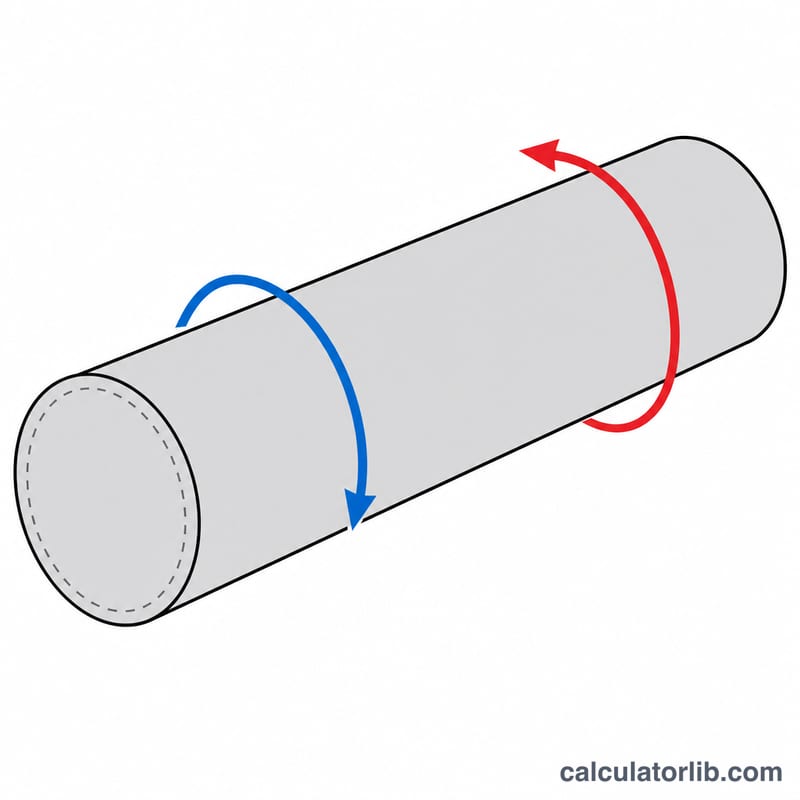
The polar moment of inertia (J), also called the second polar moment of area, measures a cross-section's resistance to torsion (twisting). For circular shafts it appears directly in the torsion formula \(\tau = T\cdot r / J\), where T is the applied torque and r is the radial distance from the center. A larger J means the shaft twists less under the same torque. This calculator works for solid round bars and hollow round tubes.
How to use this calculator
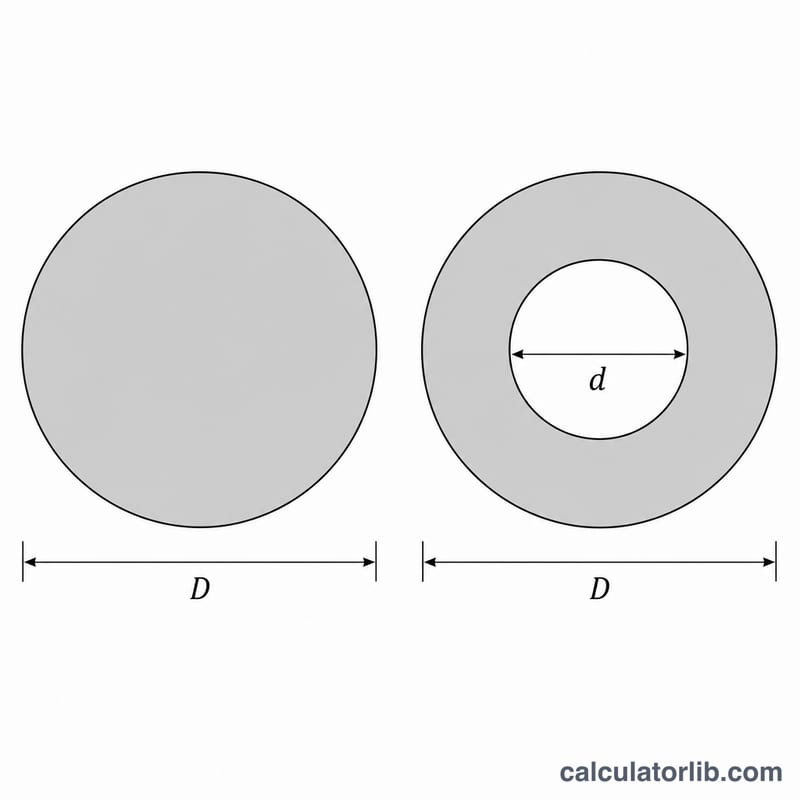
Choose whether your cross-section is a solid circle or a hollow circle (tube). Enter the outer diameter D. For a hollow section, also enter the inner (bore) diameter d. The result J is returned in length⁴ — so if you enter diameters in millimeters, J is in mm⁴; if in inches, J is in in⁴. The calculator also reports the polar section modulus \(Z_p = J/(D/2)\), useful for computing maximum surface shear stress as \(\tau = T/Z_p\).
The formula explained
For a solid circle of diameter D: $$J = \frac{\pi \text{D}^{4}}{32}$$ For a hollow circle, you subtract the bore's contribution: $$J = \frac{\pi(\text{D}^{4} - \text{d}^{4})}{32}$$ Because the diameter is raised to the fourth power, increasing diameter has a dramatic effect on torsional stiffness, while material near the center contributes very little — which is why hollow shafts are an efficient use of material.
Worked example
A hollow shaft has D = 50 mm and d = 30 mm. $$J = \frac{\pi(50^{4} - 30^{4})}{32} = \frac{\pi(6{,}250{,}000 - 810{,}000)}{32} = \frac{\pi \times 5{,}440{,}000}{32} = \pi \times 170{,}000 \approx 534{,}070.75 \text{ mm}^4$$ The section modulus \(Z_p = J/(25) \approx 21{,}362.83 \text{ mm}^3\).
FAQ
What's the difference between J and the area moment of inertia I? For a circle, \(J = 2I\) because \(J = I_x + I_y\) and \(I_x = I_y\). J governs torsion; I governs bending.
Can I use radius instead of diameter? This tool expects diameters. If you have radius, multiply by 2 first, or note that \(J = \pi r^{4}/2\) for a solid circle.
What units does J use? Whatever length unit you enter to the fourth power — keep diameters in consistent units (all mm or all inches).