
What This Calculator Does
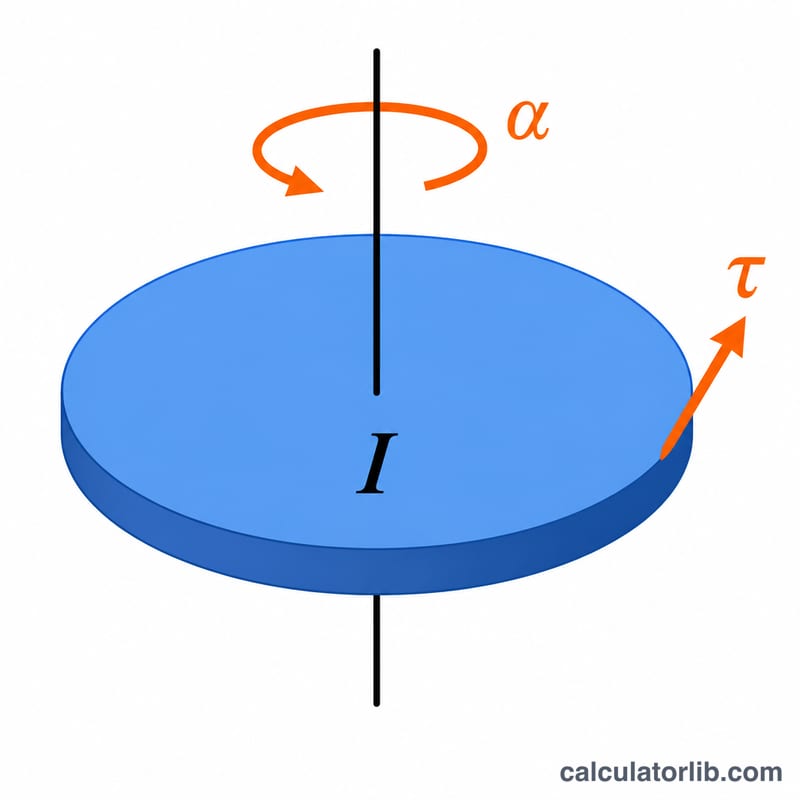
This tool computes the torque required to rotate an object using the rotational form of Newton's second law, \(\tau = I \cdot \alpha\). Given a body's moment of inertia and the angular acceleration you want to achieve, it returns the net torque needed in newton-metres (\(\text{N}\cdot\text{m}\)). It is a universal physics tool that applies to any rotating system — flywheels, motor shafts, wheels, robotic joints and turntables.
How to Use It
Enter two values: the moment of inertia I in kilogram-square-metres (\(\text{kg}\cdot\text{m}^2\)), which describes how mass is distributed about the rotation axis, and the angular acceleration α in radians per second squared (\(\text{rad/s}^2\)), which is the rate of change of angular velocity. The calculator multiplies them to give the required torque. To find \(\alpha\) from a speed change, use \(\alpha = \Delta\omega / \Delta t\).
The Formula Explained
The equation \(\tau = I \cdot \alpha\) mirrors the linear relation \(F = m \cdot a\). Here torque \(\tau\) plays the role of force, moment of inertia \(I\) plays the role of mass, and angular acceleration \(\alpha\) plays the role of linear acceleration. A larger moment of inertia (mass spread far from the axis) or a higher desired acceleration both demand more torque.
Worked Example
Suppose a flywheel has a moment of inertia of \(5\ \text{kg}\cdot\text{m}^2\) and you want it to spin up at \(2\ \text{rad/s}^2\). The required torque is $$\tau = 5 \times 2 = 10\ \text{N}\cdot\text{m}$$ If you doubled the acceleration to \(4\ \text{rad/s}^2\), you would need \(20\ \text{N}\cdot\text{m}\).
FAQ
Does this include friction? No — \(\tau\) here is the net torque. To overcome friction or drag, add those resisting torques to the result.
What units should I use? Use SI units (\(\text{kg}\cdot\text{m}^2\) and \(\text{rad/s}^2\)) so the torque comes out in \(\text{N}\cdot\text{m}\). Mixing units gives wrong answers.
How do I get angular acceleration from RPM? Convert the RPM change to \(\text{rad/s}\) (multiply RPM by \(2\pi/60\)), then divide by the time taken to reach that speed.