
What is the Alarm Time Calculator?
The Alarm Time Calculator tells you exactly what time to set your alarm based on when you go to bed, how long it takes you to fall asleep, and how many hours of sleep you want. Instead of doing fuzzy mental math at midnight, you get a precise 24-hour wake-up time that accounts for the time you spend lying awake before drifting off.
How to use it
Enter your current (bedtime) hour and minute in 24-hour format, the number of hours of sleep you'd like, and an estimate of how many minutes it usually takes you to fall asleep (the "sleep latency"). The calculator adds the buffer and the desired sleep duration to your bedtime and rolls past midnight if needed.
The formula
The math is simple time arithmetic in minutes:
$$\text{alarm} = (\text{current\_time} + \text{fall\_asleep\_buffer} + \text{desired\_sleep\_hours}) \bmod 24\text{h}$$
Everything is converted to minutes from midnight, summed, then taken modulo 1440 (the number of minutes in a day) to get a valid clock time, which is finally split back into hours and minutes.
Worked example
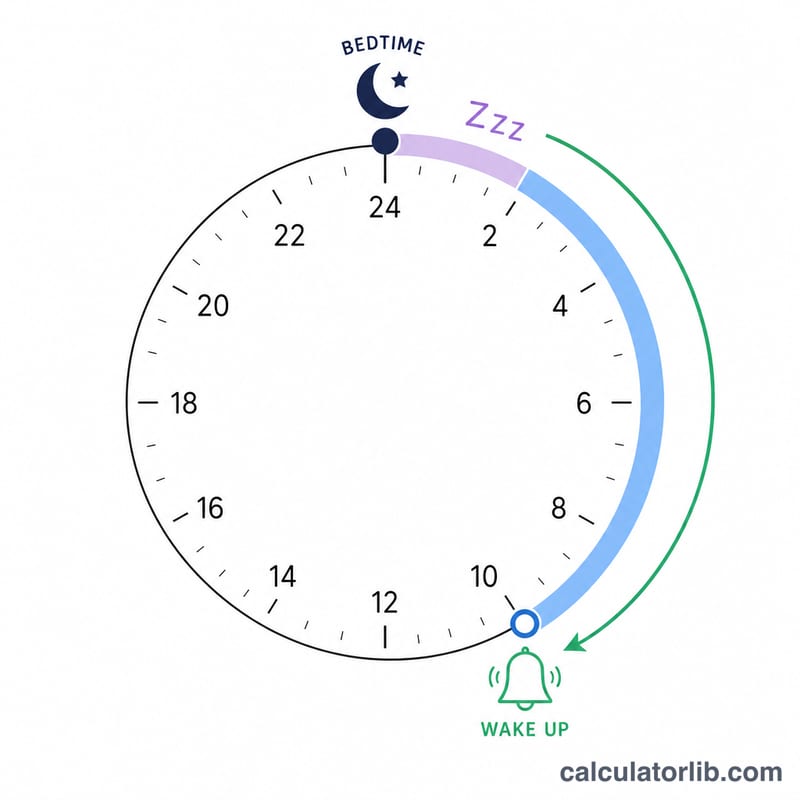
Suppose you go to bed at 23:00, it takes you 15 minutes to fall asleep, and you want 8 hours of sleep. Start = \(23\times60 + 0 = 1380\) minutes. Add buffer 15 \(\rightarrow 1395\). Add 8 hours (480 min) \(\rightarrow 1875\). Take \(1875 \bmod 1440 = 435\) minutes = 7 hours 15 minutes. So your alarm should be set for 07:15.
Recommended Sleep Durations by Age
To set a useful alarm time, you first need a sensible sleep goal. The figures below come from the National Sleep Foundation consensus recommendations and are consistent with guidance from the U.S. Centers for Disease Control and Prevention (CDC). Pick the band that matches your age, then add the time it takes you to fall asleep (sleep latency) on top of it.
| Age band | Recommended sleep per 24 h | Source |
|---|---|---|
| Newborn (0–3 months) | 14–17 hours | National Sleep Foundation |
| Infant (4–11 months) | 12–15 hours | National Sleep Foundation |
| Toddler (1–2 years) | 11–14 hours | National Sleep Foundation |
| Preschool (3–5 years) | 10–13 hours | National Sleep Foundation |
| School age (6–13 years) | 9–11 hours | National Sleep Foundation |
| Teen (14–17 years) | 8–10 hours | National Sleep Foundation / CDC |
| Young adult (18–25 years) | 7–9 hours | National Sleep Foundation |
| Adult (26–64 years) | 7–9 hours | National Sleep Foundation / CDC |
| Older adult (65+ years) | 7–8 hours | National Sleep Foundation / CDC |
Sleep latency (time to fall asleep): A healthy adult typically takes about 10–20 minutes to drift off after lights out. Use this as your buffer value. Falling asleep in under 5 minutes can signal sleep deprivation, while routinely needing more than 30 minutes may indicate difficulty initiating sleep.
These ranges are general population guidance, not personalized medical advice. Individual needs vary, and persistent trouble sleeping or daytime fatigue is worth discussing with a clinician.
FAQ
Why include a fall-asleep buffer? Most people take 10–20 minutes to actually fall asleep. Counting that time as "sleep" would make your alarm go off before you've really had the rest you planned.
What if my sleep period crosses midnight? No problem — the calculator uses modulo arithmetic, so a late bedtime correctly produces a morning alarm.
Should I align to sleep cycles? Sleep cycles are roughly 90 minutes. To wake at the end of a cycle, try setting desired sleep to a multiple of 1.5 hours (6, 7.5, or 9 hours).