
What this calculator does
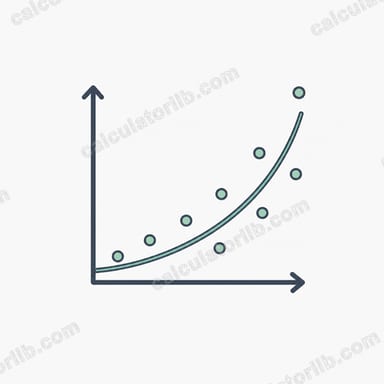
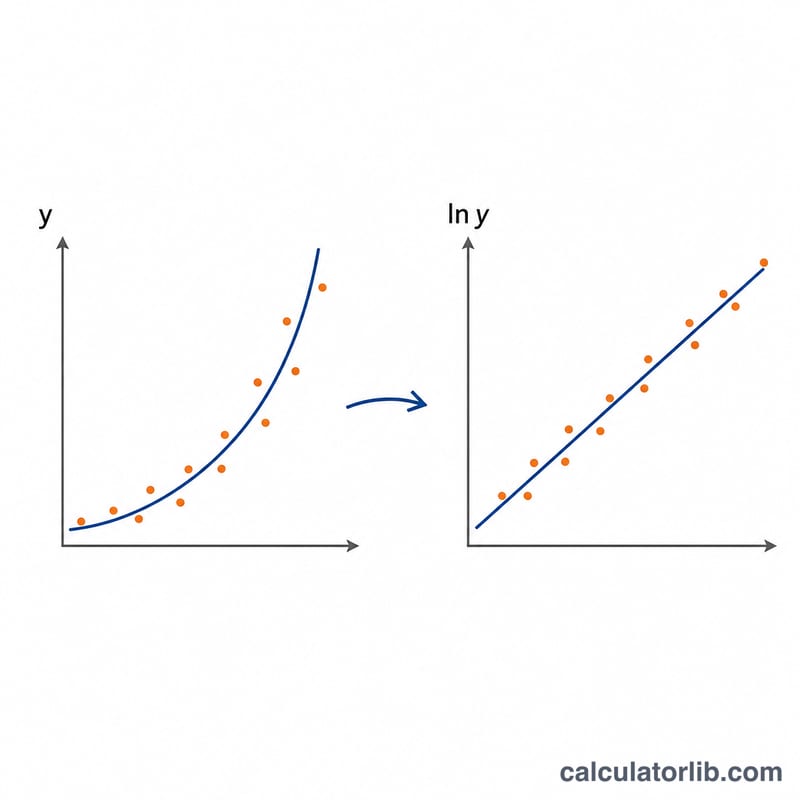
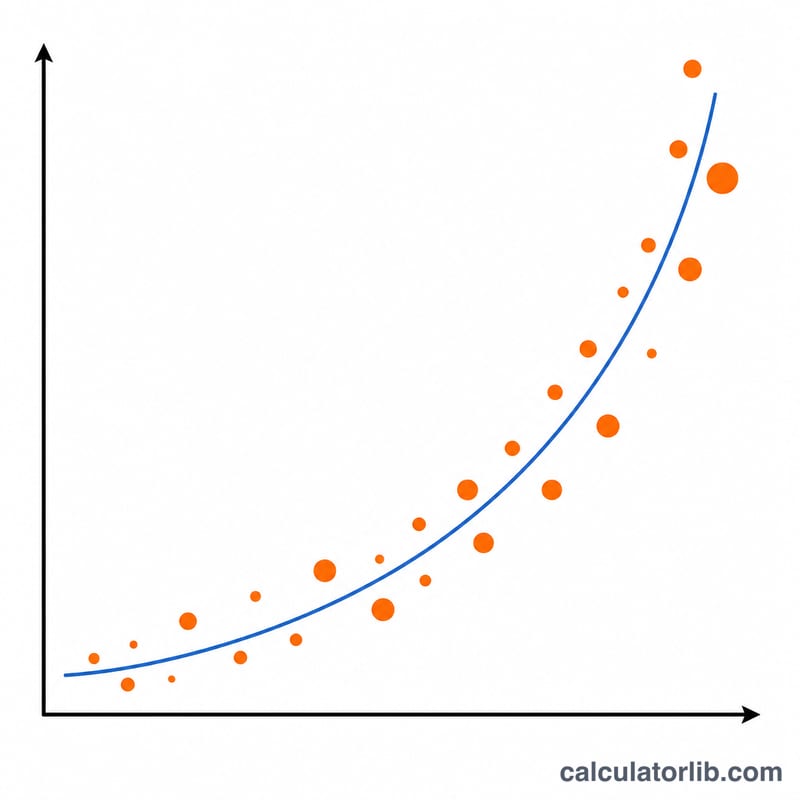
This tool fits an exponential trend curve of the form \(y = A \cdot e^{Bx}\) to a frequency-weighted data set. Each data row is a triple (x, y, f), where f is the frequency or weight — the number of times that observation appears. It returns the fitted coefficients A and B plus the correlation coefficient r of the underlying linear fit. This is pure mathematics and applies identically anywhere, with no region-specific rules.
How to use it
Enter one point per line as x, y, f. The y value must be greater than 0, because the model is linearized by taking its natural logarithm. If you omit the third column, the frequency defaults to 1. Choose how many significant digits to display, then read off A, B, r and the substituted fitted equation.
The formula explained
Because ln y = ln A + B·x, fitting the exponential reduces to a weighted linear regression of ln y on x. Using weighted sums where every term is multiplied by the frequency f, define n = Σf, the weighted means x̄ and L̄ (mean of ln y), and the weighted sums of squares Sxx, Syy and cross product Sxy. Then \(B = S_{xy} / S_{xx}\), \(A = e^{\,\bar{L} - B\bar{x}}\), and \(r = S_{xy} / (\sqrt{S_{xx}} \cdot \sqrt{S_{yy}})\). An r near ±1 means a strong fit.
Worked example
Take the points (1, 2.7), (2, 7.4), (3, 20.1), (4, 54.6) each with frequency 1, which lie close to \(y = e^{x}\). Here \(\bar{x} = 2.5\), \(\bar{L} \approx 2.49887\), \(S_{xx} = 5\), \(S_{xy} \approx 5.0098\), \(S_{yy} \approx 5.0196\). So \(B \approx 1.0020\), \(A = e^{(2.49887 - 2.5048)} \approx 0.9940\), and \(r \approx 0.9998\). The fitted equation is approximately $$y = 0.9940 \cdot e^{(1.0020 \cdot x)}$$ — essentially \(y = e^{x}\).
FAQ
Why must y be positive? The fit uses ln(y); the logarithm of zero or a negative number is undefined, so such rows are rejected.
What does the frequency f represent? It weights how strongly each point influences the fit — useful for frequency distribution tables where many observations share the same (x, y).
How do I read r? |r| above 0.7 is a strong correlation, 0.4–0.7 moderate, 0.2–0.4 weak, and below 0.2 essentially none.