
What this solver does
The Nth-Degree Polynomial Equation Solver finds all roots — real and complex — of a polynomial equation \(a_0 x^{n} + a_1 x^{n-1} + \cdots + a_{n-1} x + a_n = 0\) with real coefficients. It uses the Durand-Kerner method (also called the Weierstrass method, the basis of the DKA / Durand-Kerner-Aberth family), a simultaneous iterative scheme that refines every root estimate at once. It is a universal mathematical tool with no country scope or units.
Coefficient convention
This tool indexes coefficients leading-first: a0 multiplies xn (the leading coefficient, which must be nonzero) and an is the constant term. This is the reverse of the textbook "a_k multiplies x^k" convention, so enter your coefficients accordingly. Coefficients with index larger than n are ignored.
How to use it
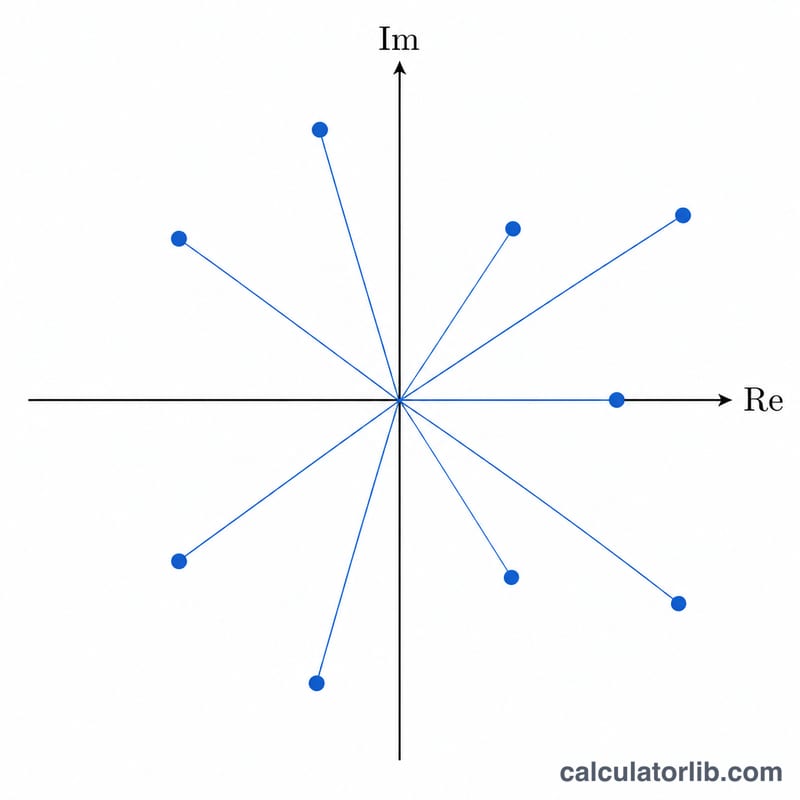
Pick the degree n (1 to 16), type coefficients a0 through an (leave unused ones at 0), choose how many significant digits to display, and submit. Real roots are shown with a zero imaginary part; complex roots of a real polynomial appear in conjugate pairs (re + i·im and re − i·im).
The formula
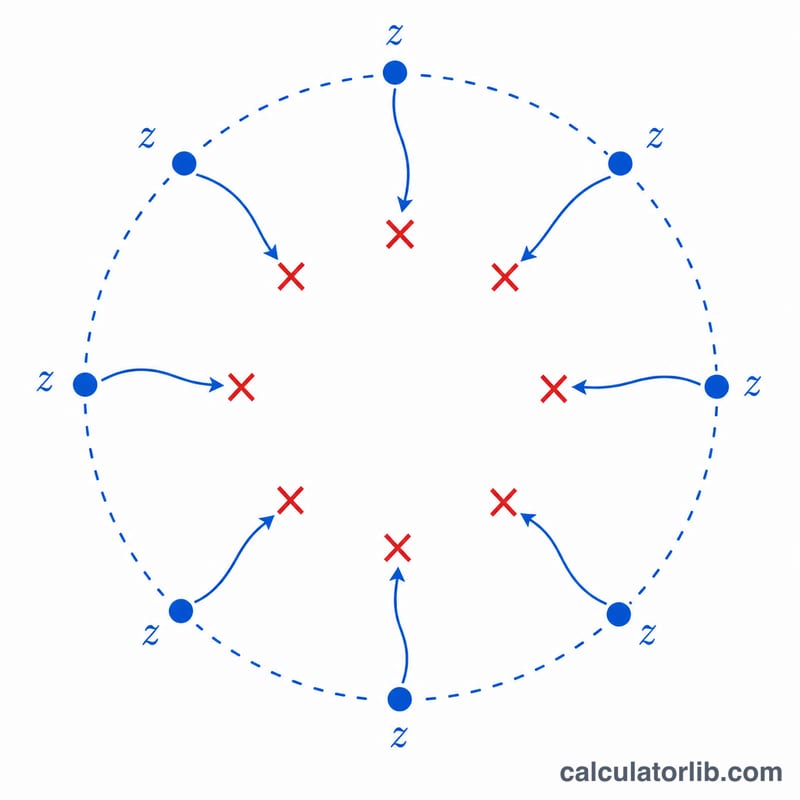
After dividing every coefficient by a0 to get a monic polynomial \(p(x) = x^{n} + b_1 x^{n-1} + \cdots + b_n\), each estimate is updated by $$z_i \leftarrow z_i - \frac{p(z_i)}{\displaystyle\prod_{j \ne i}\left(z_i - z_j\right)}$$ Starting from distinct points spread around a circle, the estimates converge simultaneously to the n roots.
Worked example
For \(x^3 - 6x^2 + 11x - 6 = 0\) enter n=3, a0=1, a1=−6, a2=11, a3=−6. The polynomial factors as $$(x-1)(x-2)(x-3)$$ and the iteration converges to the roots 1, 2 and 3 (all real).
FAQ
Why must a0 be nonzero? If the leading coefficient is zero the equation is not truly degree n; the tool treats \(a_0 = 0\) as invalid.
Why do complex roots come in pairs? A polynomial with real coefficients always has complex roots in conjugate pairs, so you will see matching +i·im and −i·im values.
Are repeated roots handled? Yes, but multiple (repeated) roots converge more slowly, so the solver allows many iterations and a looser tolerance; tiny imaginary residues are snapped to zero.