
What is a literal equation?
A literal equation is a formula that contains several letters (variables) rather than only numbers. Examples include the area of a triangle \(A = \tfrac{1}{2}bh\), distance \(d = rt\), Ohm law \(V = IR\), and the slope-intercept line \(y = mx + b\). Solving a literal equation means rearranging it so that one chosen variable stands alone on one side of the equals sign. This calculator does that rearrangement and then plugs in your known values to return the missing variable.
How to use this calculator
Pick the equation you are working with from the dropdown. Each option already states which variable will be solved. Then enter the known quantities in the order shown in the label (First, Second, and a Third when the formula needs three knowns). The calculator applies inverse operations — undoing multiplication with division, and undoing addition with subtraction — and reports the isolated variable plus the step it used.
The method explained
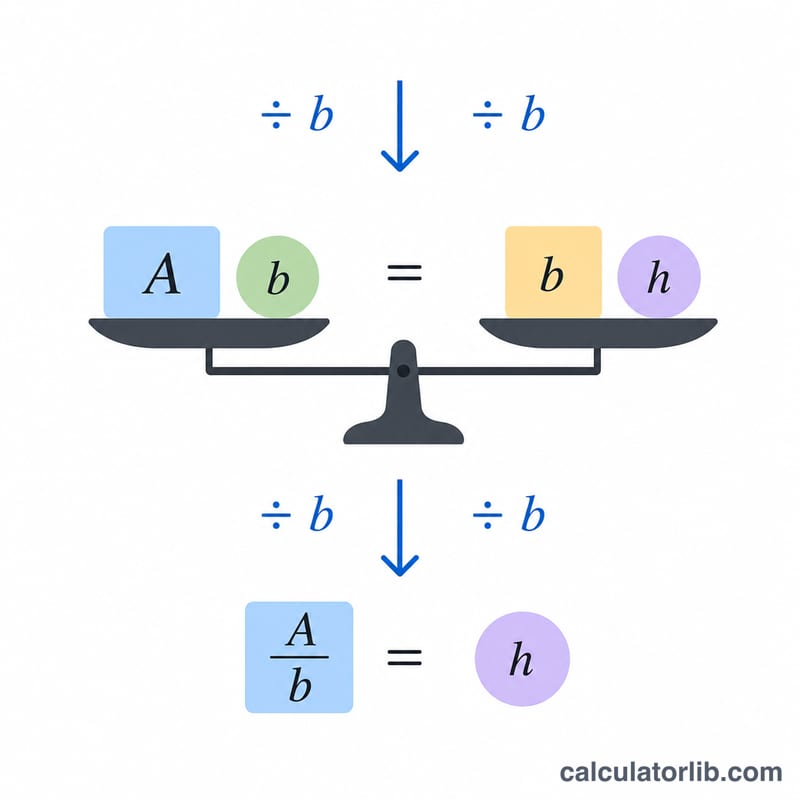
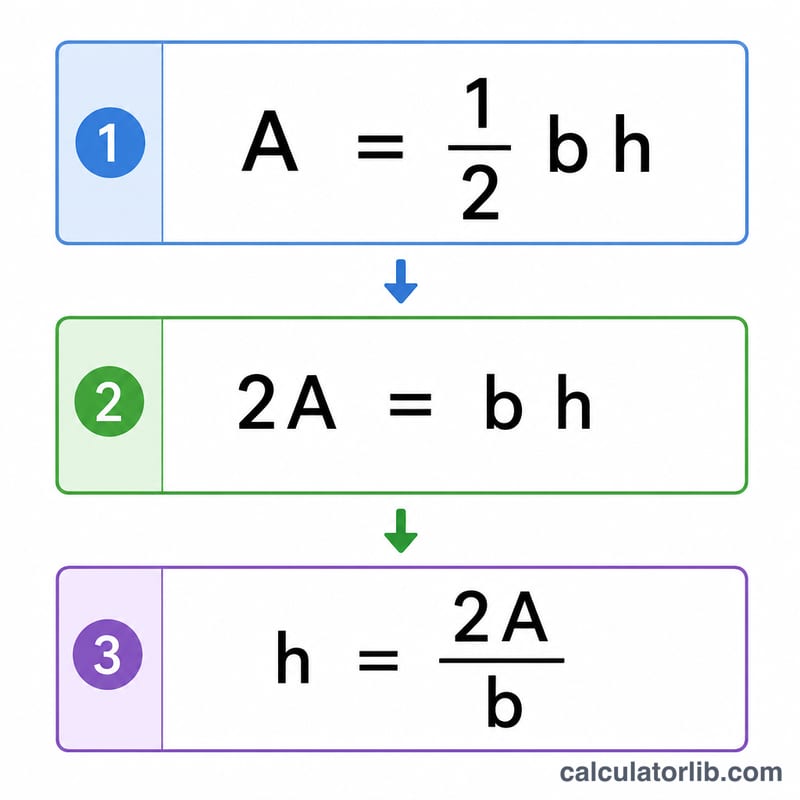
To isolate a variable you reverse every operation attached to it, in the opposite order. For \(A = \tfrac{1}{2}bh\), the height \(h\) is multiplied by ½ and by \(b\), so you divide both sides by ½b, giving \(h = \frac{2A}{b}\). For \(y = mx + b\) you first subtract \(b\) from both sides, then divide by \(m\), giving \(x = \frac{y - b}{m}\). The same logic generalizes to every formula in the menu.
Worked example
Suppose a triangle has area A = 20 and base b = 5, and you want the height. Using \(h = \frac{2A}{b}\):
$$h = \frac{2 \times 20}{5} = \frac{40}{5} = \mathbf{8}$$So the height is 8 units.
FAQ
Which value goes in each box? The label tells you: First is the first letter in the equation (often the result, like A or d), Second is the next, and Third is used only for three-term formulas such as simple interest.
Why did I get 0? A divisor turned out to be zero (for example b = 0). Division by zero is undefined, so the calculator returns 0 as a guard.
Can it handle negatives and decimals? Yes — enter any real number, including negatives and decimals, and the inverse operations still apply.