

What this calculator does
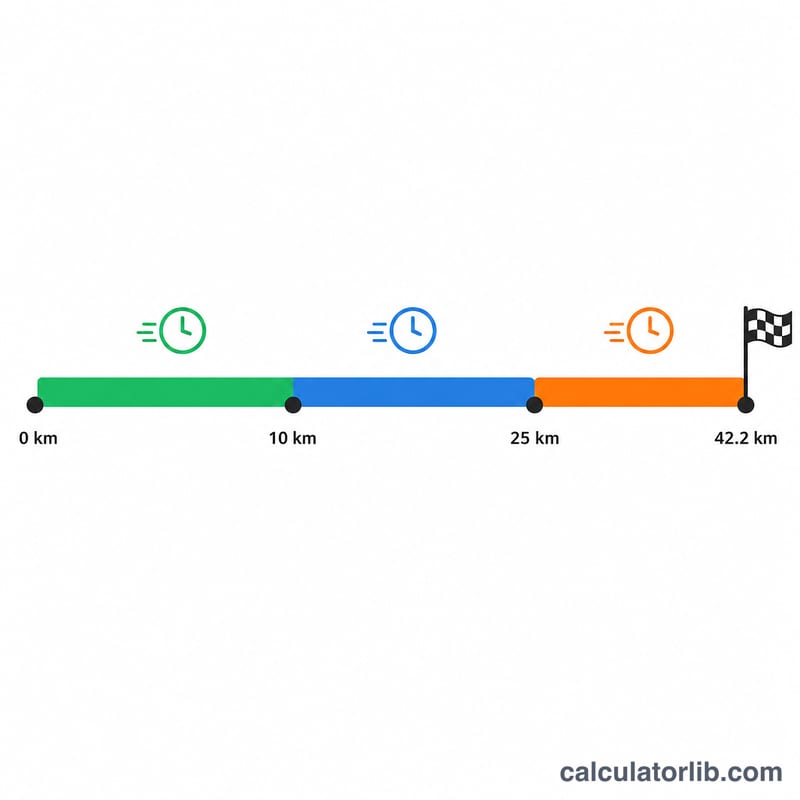
This tool estimates the total finish time of a run, such as a full marathon (42.195 km) or half marathon (21.0975 km), from a starting per-kilometer pace. It can also model up to three mid-race pace changes, so you can plan a realistic race where you slow down late or surge in the middle. It is pure arithmetic (pace times distance) and applies anywhere; distances are in kilometers, the metric convention used across most of the world.
How to use it
Enter your start pace as minutes and seconds per kilometer (for example 4 min 30 sec = 4:30/km). Enter the total race distance in kilometers. For each optional change, pick the distance at which it takes effect, the amount in seconds per km, and a direction: "Down" means you slow down (pace gets bigger), "Up" means you speed up (pace gets smaller). Each change is cumulative and stays in effect for the rest of the race. Leave a change point on "No change" to skip it.
The formula
The base pace is \(P_0 = 60 \times \text{minutes} + \text{seconds}\), in seconds per km. The course is split into segments at each active change point. For each segment the time is segment length multiplied by the current pace, and at every change point the signed delta (plus for slower, minus for faster) is added to the running pace. The segment times are summed and converted to h:mm:ss.
$$ T = \sum_{i} (\Delta d_i \cdot p_i) $$ $$ \text{where}\quad \left\{ \begin{aligned} p_0 &= 60\cdot\text{Start min} + \text{Start sec} \\ p_i &= p_{i-1} \pm \text{Change (sec/km)} \\ \Delta d_i &= \text{segment length up to } \text{Distance (km)} \end{aligned} \right. $$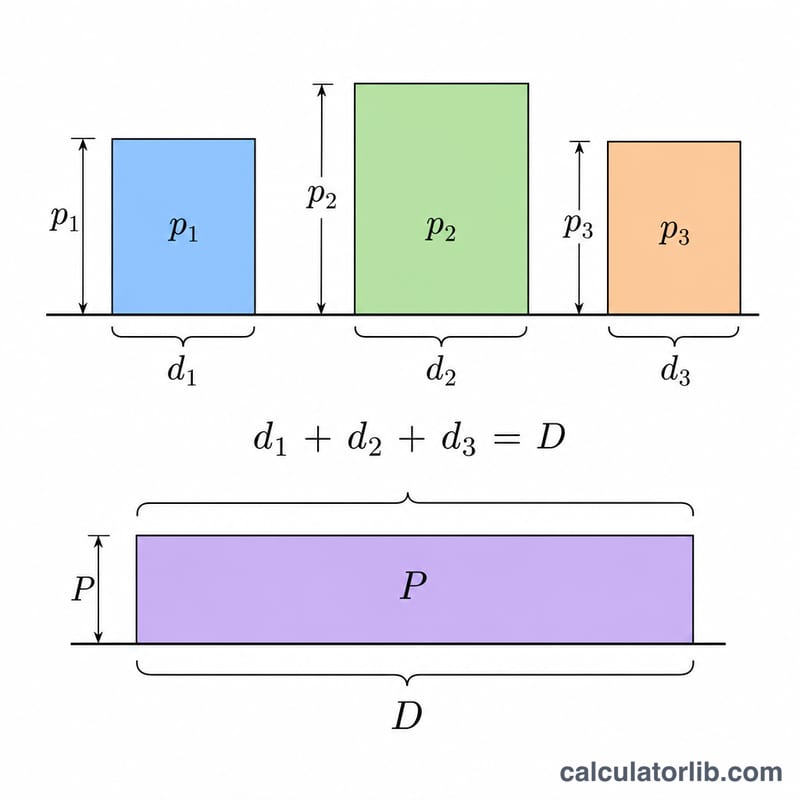
Worked example
Start 4:30/km (\(P_0 = 270\) s/km), distance 42.195 km, with +3 s/km at 20 km, +5 s/km at 30 km and +2 s/km at 35 km, all "Down". Segment 0-20: $$ 270 \times 20 = 5400 \text{ s} $$ Segment 20-30: $$ 273 \times 10 = 2730 \text{ s} $$ Segment 30-35: $$ 278 \times 5 = 1390 \text{ s} $$ Segment 35-42.195: $$ 280 \times 7.195 = 2014.6 \text{ s} $$ Total = 11534.6 s, about 3:12:15. Final pace = 280 s/km = 4:40/km.
FAQ
What if I add no pace changes? The time is simply distance \(\times\) base pace at constant speed.
What happens to a change point past the finish? Any change at or beyond the race distance never takes effect and is ignored.
Can the pace go negative if I speed up a lot? No. The calculator clamps the pace to a minimum of 1 second per km to keep results physically meaningful.