
What is the 5/3/1 Calculator?
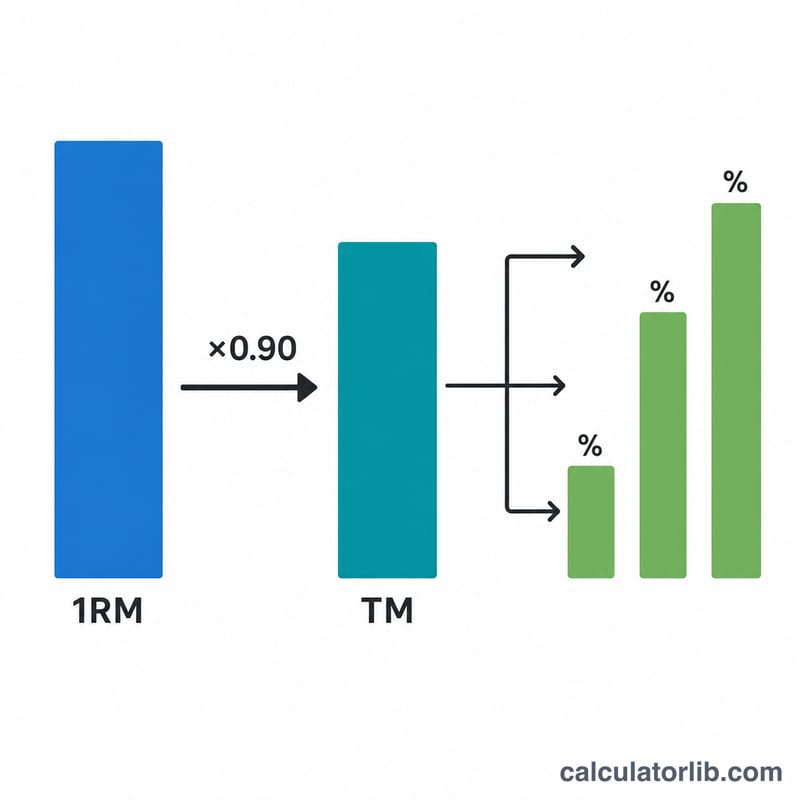
The 5/3/1 method, created by powerlifter Jim Wendler, is one of the most popular strength-training programs for building raw strength on the squat, bench press, deadlift, and overhead press. A core idea of the program is the Training Max (TM) — a deliberately conservative number set to 90% of your true one-rep max (1RM). All working sets are then calculated as percentages of this Training Max, not your actual 1RM, which keeps every session sustainable and repeatable.
How to Use It
Enter your one-rep max for a given lift, choose the Training Max percentage (90% is the standard), and select your units (lb or kg). The calculator returns your Training Max plus the full three-week wave of working sets: 65/75/85% in week 1, 70/80/90% in week 2, and 75/85/95% in week 3. The final set each week is an AMRAP (as many reps as possible) set.
The Formula Explained
First the Training Max is found: $$\text{TM} = \text{1RM} \times 0.90$$ Each working set is then $$\text{Set Weight} = \text{TM} \times \text{percent}$$ For example, the week-1 top set is \(\text{TM} \times 0.85\). Using a TM that is 10% below your true max builds in a buffer so you can hit your prescribed reps and progress steadily by adding 5 lb (upper body) or 10 lb (lower body) to the TM each cycle.
Worked Example
Suppose your bench press 1RM is 200 lb. Training Max = $$200 \times 0.90 = \textbf{180 lb}$$ Week-1 sets: \(180 \times 0.65 = 117\) lb, \(180 \times 0.75 = 135\) lb, and \(180 \times 0.85 = 153\) lb. You would round these to the nearest plate-friendly weight in practice.
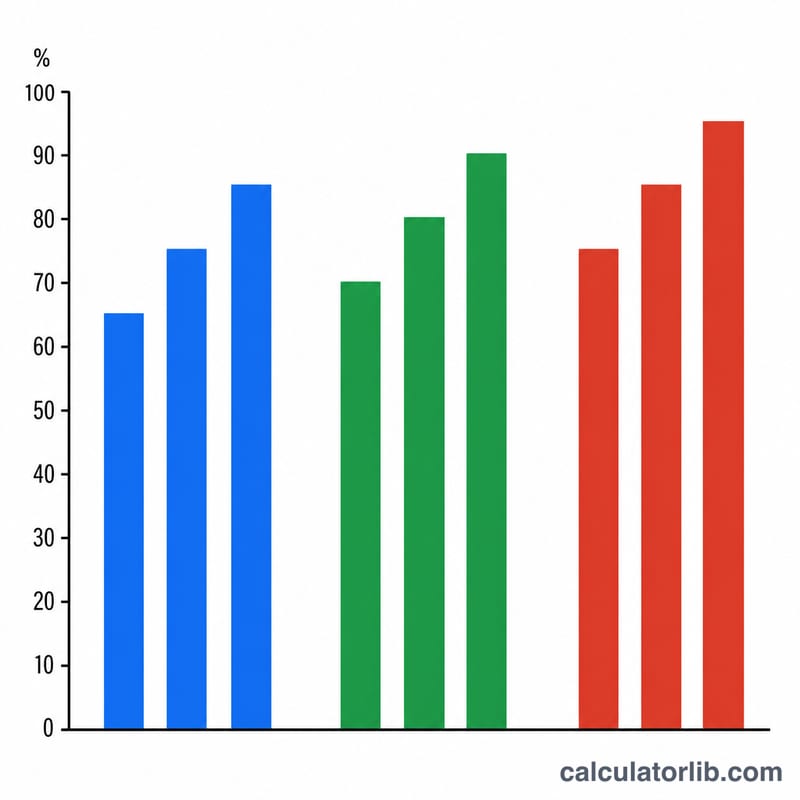
5/3/1 Weekly Set & Rep Scheme
The 5/3/1 program by Jim Wendler runs in four-week cycles. Every working weight is calculated as a percentage of your Training Max (TM), which is 90% of your true one-rep max — not of your 1RM itself. Each main lift is trained once per week with three working sets. The final set of weeks 1–3 is an AMRAP set ("as many reps as possible"), meaning you push past the prescribed minimum to set a rep record while keeping good form.
| Week | Set 1 | Set 2 | Set 3 (top / AMRAP) |
|---|---|---|---|
| Week 1 (5s) | 65% × 5 | 75% × 5 | 85% × 5+ |
| Week 2 (3s) | 70% × 3 | 80% × 3 | 90% × 3+ |
| Week 3 (5/3/1) | 75% × 5 | 85% × 3 | 95% × 1+ |
| Week 4 (Deload) | 40% × 5 | 50% × 5 | 60% × 5 |
All percentages above are of the Training Max. The "+" denotes the AMRAP set; the deload week (Week 4) has no AMRAP set and is performed at a deliberately easy effort to recover before the next cycle, where the TM is typically increased by 5 lb for upper-body lifts and 10 lb for lower-body lifts.
Key 5/3/1 Terms
- Training Max (TM)
- The working number all 5/3/1 percentages are based on, set to 90% of your true or estimated 1RM. Using a sub-maximal TM leaves margin for productive AMRAP sets and steady progression.
- 1RM (One-Rep Max)
- The maximum weight you can lift for a single full repetition of an exercise. It can be tested directly or estimated from a submaximal set using a formula such as Epley or Brzycki.
- AMRAP
- "As Many Reps As Possible." The final top set of weeks 1–3 (the "+" set), performed for as many clean reps as you can to drive progress and gauge strength.
- Working set
- A prescribed set at a target percentage of the Training Max, as opposed to a warm-up set. In 5/3/1 each lift has three working sets per session.
- Cycle
- One complete four-week block (5s week, 3s week, 5/3/1 week, deload). At the end of a cycle the Training Max is increased before the next block begins.
- Deload
- The lighter fourth week (40/50/60% × 5) used for recovery and to manage fatigue before increasing the Training Max for the following cycle.
- Squat
- A lower-body main lift in which the bar rests on the back while you squat down and stand back up. One of the four core 5/3/1 lifts.
- Bench Press
- An upper-body pressing lift performed lying on a bench, pressing the bar from the chest to full arm extension.
- Deadlift
- A full-body pulling lift in which the bar is lifted from the floor to a standing, locked-out position.
- Overhead Press
- A standing shoulder press (also called the military press) in which the bar is pressed from the shoulders to overhead. It is the fourth core 5/3/1 lift and usually progresses fastest in small increments.
FAQ
Why 90% and not 100%? The 10% buffer makes the program sustainable, leaves room for AMRAP sets, and reduces injury risk.
Should I round the weights? Yes — round to the nearest 5 lb or 2.5 kg based on the plates you have.
How do I progress? After each cycle, add 5 lb to upper-body TMs and 10 lb to lower-body TMs, then recalculate.