
What is the Training Pace Calculator?
This tool converts the pace of a recent race into the slower paces you should run during everyday training. Racing fast all the time leads to burnout and injury, so coaches prescribe different speeds for different sessions. By starting from a result you actually achieved, the calculator gives realistic, personalised pace targets instead of generic guesses.
How to use it
Enter the distance of a recent race in kilometres and the time you finished in (minutes and seconds). The calculator first works out your race pace, then multiplies it by a factor for each training zone. Read off the seconds-per-kilometre value for each zone and use it to set your watch or treadmill.
The formula explained
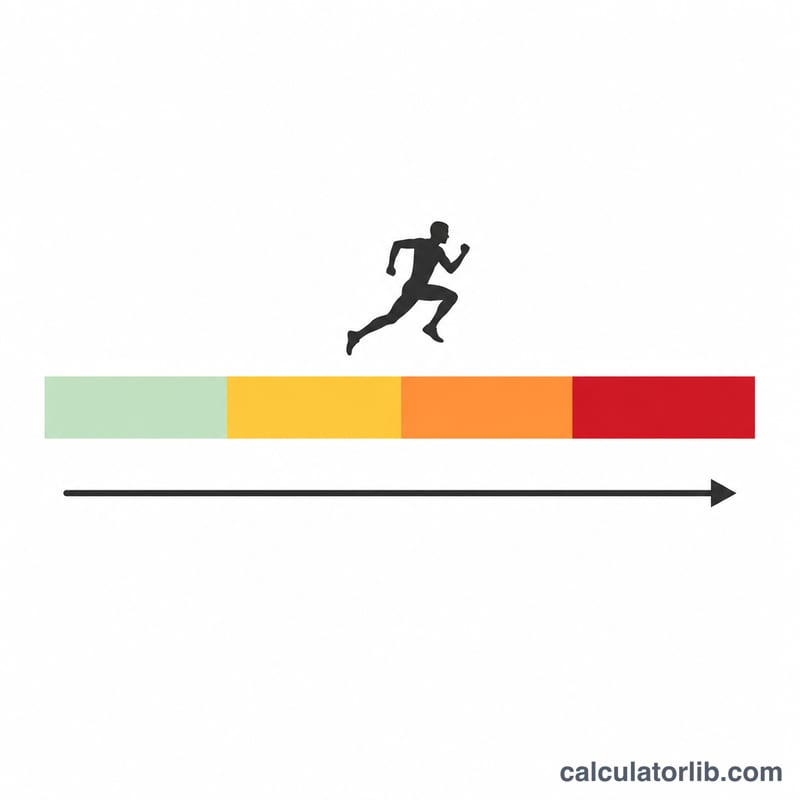
Race pace is total race time in seconds divided by the distance in kilometres. Each training pace is that race pace multiplied by a slowdown factor: tempo runs are about 6% slower (1.06), threshold 10% slower (1.10), easy/recovery runs roughly 25% slower (1.25), and long runs about 30% slower (1.30). A larger factor means more seconds per kilometre, i.e. a slower, more comfortable pace.
$$\text{Race Pace} = \frac{60 \times \text{Minutes} + \text{Seconds}}{\text{Distance (km)}}\ \text{s/km}$$$$\begin{gathered} \begin{aligned} \text{Tempo} &= 1.06\,P \\ \text{Threshold} &= 1.10\,P \\ \text{Easy} &= 1.25\,P \\ \text{Long} &= 1.30\,P \end{aligned} \\[1.5em] \text{where}\quad P = \dfrac{60 \times \text{Minutes} + \text{Seconds}}{\text{Distance (km)}} \end{gathered}$$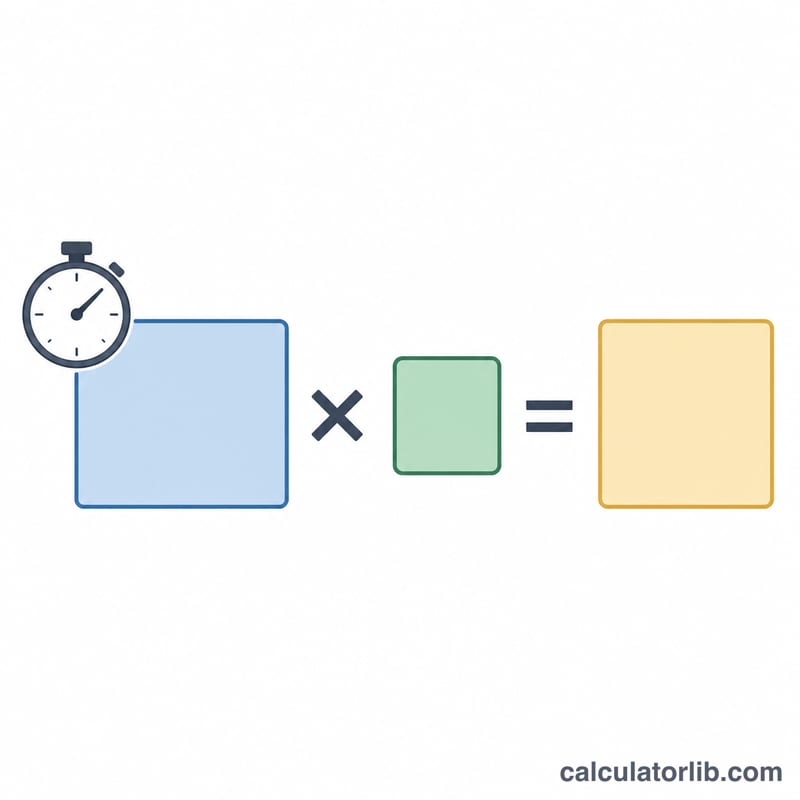
Worked example
Suppose you ran a 5 km race in 25:00. That is 1500 seconds over 5 km, so your race pace is 300 seconds/km (5:00 per km). Your easy pace is \(300 \times 1.25 = 375\) seconds/km (6:15 per km), tempo is \(300 \times 1.06 = 318\) seconds/km, and your long run is \(300 \times 1.30 = 390\) seconds/km. These are the paces to aim for in the corresponding workouts.
FAQ
Which race should I use? Pick something you raced hard in the last few weeks so the paces reflect your current fitness.
Why are easy paces so much slower? Easy running builds aerobic endurance with low stress; running it too fast undermines the purpose and slows recovery.
Can I convert seconds per km to a min:sec pace? Yes — divide the seconds by 60 for the minutes and take the remainder as seconds. For example 375 s/km = 6 min 15 s per km.