What this calculator does
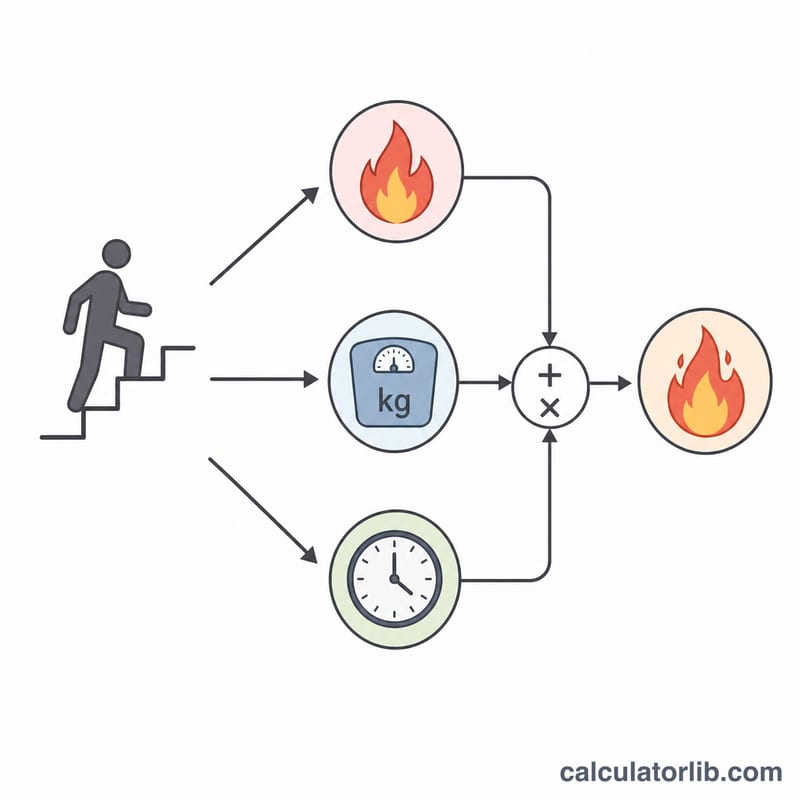
The Calories Burned Climbing Stairs Calculator estimates how much energy you expend walking or running up stairs. It uses the standard MET (Metabolic Equivalent of Task) method, which links the intensity of an activity, your body weight, and the time spent to total calories burned. Stair climbing is a vigorous, high-impact cardio activity, so it burns calories quickly compared with flat walking.
How to use it
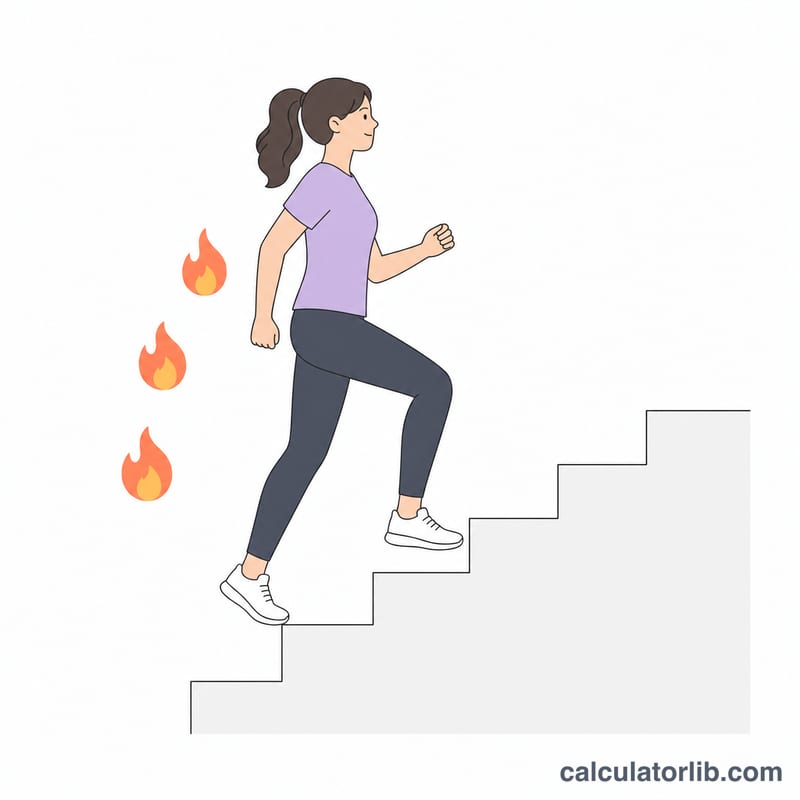
Enter your body weight in kilograms, the number of minutes you spent climbing, and choose an intensity level. The MET value represents how hard the activity is: a slow, leisurely climb is about 4.5, general stair climbing is about 6.8, and running quickly up stairs can reach 15.0. The tool returns your total calories burned plus a per-minute breakdown.
The formula explained
The calculation is $$\text{kcal} = \frac{\text{MET} \times 3.5 \times \text{kg}}{200} \times \text{minutes}$$. The constant 3.5 ml/kg/min is resting oxygen consumption (one MET). Multiplying by your weight and the MET value, then dividing by 200, converts oxygen use into calories per minute. Multiplying by your total minutes gives the calories burned for the whole session.
Worked example
Suppose a 70 kg person climbs stairs at a general pace (MET 6.8) for 10 minutes. Per minute: $$6.8 \times 3.5 \times 70 \div 200 = 8.33 \text{ kcal/min}.$$ Over 10 minutes that's \(8.33 \times 10 = \)83.3 kcal.
MET Values for Stair Climbing and Related Activities
A MET (metabolic equivalent of task) is a multiple of resting energy expenditure, conventionally defined as an oxygen uptake of 3.5 mL of O2 per kg of body mass per minute, which is roughly 1 kcal per kg per hour. The values below are drawn from the 2024 Adult Compendium of Physical Activities (Herrmann et al., Journal of Sport and Health Science), the reference list this calculator's three intensity options are based on. The Compendium is an international research standard, but its values are population averages measured largely in healthy adults — they are not personalised measurements.
| Activity (Compendium description) | MET | Available in this calculator |
|---|---|---|
| Stair climbing, slow pace / leisurely walking up stairs | 4.5 | Yes — "slow / leisurely" |
| Stair climbing, general (steady continuous ascent) | 6.8 | Yes — "general" |
| Stair climbing, fast pace / running up stairs | 15.0 | Yes — "fast / running" |
| Stair-treadmill ergometer / stepper machine, general | 9.0 | No — use 6.8 as the closest option |
| Descending stairs (walking down) | 3.5 | No — see note below |
| Walking on level ground, 5 km/h (3.1 mph), firm surface | 3.5 | No — shown for contrast |
Two points worth noting from this table. First, climbing stairs at a general pace (6.8 MET) costs roughly 1.9 times as much energy per minute as walking briskly on the flat (3.5 MET), which is why stairs are an efficient way to raise exercise intensity without extra time. Second, going down stairs is only about 3.5 MET — so if you climb and descend repeatedly (for example on a stadium or tower staircase), your session average falls somewhere between the ascent and descent values rather than sitting at the ascent value throughout.
Calories Burned Climbing Stairs by Weight and Duration
All figures below use the same formula as the calculator, at MET 6.8 (stair climbing, general pace):
$$\text{kcal} = \frac{\text{MET} \times 3.5 \times \text{weight (kg)}}{200} \times \text{minutes}$$At MET 6.8 the per-minute rate simplifies to \(6.8 \times 3.5 / 200 = 0.119\) kcal per kilogram per minute, so a 70 kg person burns about 8.33 kcal per minute of continuous climbing.
| Body weight | 5 min | 10 min | 15 min | 30 min |
|---|---|---|---|---|
| 55 kg (121 lb) | 32.7 kcal | 65.5 kcal | 98.2 kcal | 196.4 kcal |
| 70 kg (154 lb) | 41.7 kcal | 83.3 kcal | 125.0 kcal | 249.9 kcal |
| 85 kg (187 lb) | 50.6 kcal | 101.2 kcal | 151.7 kcal | 303.5 kcal |
| 100 kg (220 lb) | 59.5 kcal | 119.0 kcal | 178.5 kcal | 357.0 kcal |
How much intensity matters
Take the 70 kg, 15-minute row and recompute it at the other two MET settings, keeping weight and time identical:
- Slow / leisurely, MET 4.5: \(\dfrac{4.5 \times 3.5 \times 70}{200} \times 15 = 5.5125 \times 15 \approx\) 82.7 kcal
- General, MET 6.8: \(\dfrac{6.8 \times 3.5 \times 70}{200} \times 15 = 8.33 \times 15 \approx 125.0\) kcal
- Fast / running up stairs, MET 15.0: \(\dfrac{15.0 \times 3.5 \times 70}{200} \times 15 = 18.375 \times 15 \approx 275.6\) kcal
The same body weight and the same quarter-hour span a range of roughly 83 to 276 kcal — a factor of about 3.33, exactly the ratio of the MET values. Because the formula is linear in all three inputs, doubling your time doubles the estimate, and someone twice as heavy burns twice as much for identical work. Choosing the right intensity band is therefore the single biggest driver of accuracy: if you stopped to rest, or if you counted time spent walking back down, the honest choice is a lower MET value or a shorter entered duration.
Interpreting Your Result
The number is gross energy expenditure, not "extra" calories. MET values are multiples of resting metabolism, so the total includes the energy your body would have spent simply staying alive during those minutes. To get the net cost of the exercise — the part genuinely added by climbing — subtract one resting MET for the same weight and time:
$$\text{net kcal} = \text{gross kcal} - \frac{1 \times 3.5 \times \text{weight (kg)}}{200} \times \text{minutes}$$For the 70 kg, 15-minute example at MET 6.8: the resting portion is \(\dfrac{1 \times 3.5 \times 70}{200} \times 15 = 1.225 \times 15 \approx 18.4\) kcal, so the net cost is about \(125.0 - 18.4 \approx 106.6\) kcal. This distinction matters most for long, low-intensity sessions, where the resting share is a larger fraction of the total.
MET values are averages, not measurements of you. The Compendium figure for "stair climbing, general" was derived from groups of participants, and the formula contains only weight, time and intensity. It cannot see your cardiorespiratory fitness, body composition, age, mechanical efficiency, the riser height and steepness of your staircase, your step rate, whether you take two steps at a time, or whether you carried a bag. Real individual expenditure for the same described activity commonly differs from the Compendium estimate by tens of percent in either direction. Treat the output as a reasonable ballpark for planning and comparison, not a measured quantity.
Keep single sessions in proportion. The figure most often cited for the energy equivalent of body fat is about 7,700 kcal per kilogram (roughly 3,500 kcal per pound), based on the energy density of adipose tissue. Against that benchmark, a 15-minute climb of about 125 kcal is under 2% of a kilogram-equivalent, and the arithmetic of real weight change is more complicated than the ratio suggests because appetite, spontaneous daily movement and metabolic adaptation all respond to training. Stair climbing is worth doing for fitness, leg and hip strength, and cardiovascular health — not because any one session moves the scale.
Where stairs fit in activity guidelines. The World Health Organization's 2020 guidelines on physical activity recommend that adults accumulate 150–300 minutes of moderate-intensity aerobic activity per week, or 75–150 minutes of vigorous-intensity activity, or an equivalent combination, plus muscle-strengthening work on two or more days. Activities of roughly 3–6 MET count as moderate and those above about 6 MET as vigorous, so ordinary continuous stair climbing (6.8 MET) and running stairs (15.0 MET) both fall in the vigorous band, while a slow leisurely climb (4.5 MET) counts as moderate. Because vigorous minutes are conventionally counted as about double moderate minutes, short stair sessions contribute disproportionately to a weekly total. Note that these are minutes of activity, not calories — the guidelines are expressed in time and intensity, which is why logging your climbing duration is useful independently of the kcal estimate.
This calculator gives a general estimate from a published population formula. It is general information, not medical or professional advice, and it is not a diagnosis, a prescribed exercise dose or a weight-loss plan. If you have a heart, lung, joint or balance condition, are pregnant, or are starting vigorous exercise after a long inactive period, discuss stair training with a qualified clinician first.
FAQ
Is this accurate? MET-based estimates are good general approximations but don't account for fitness, body composition, or stair steepness, so treat results as a guide.
What MET should I pick? Use 4.5 for a relaxed climb, 6.8 for normal steady climbing, and 15.0 for fast or running ascents.
Does this work for a stair machine? Yes — choose the intensity that matches your effort; a hard stepper session is roughly MET 8–9.